
Two Decades in Another Decade

10 November 2025: Fiftieth anniversary of the release of Patti Smith’s Horses.
‘It is a struggle to recall that life wasn’t always like this,’ writes Simon Reynolds in Retromania; ‘that relatively recently, one lived most of the time in a cultural present tense.’ The 2000s were ‘about every other previous decade happening again all at once.’ In the fifteen years since Retromania was published, the previous decades have just kept on happening, and, as Reynolds says, it’s the 1960s and 1970s especially that have ‘a seemingly limitless scope for being rehashed’. In the realm of film culture, or in my corner of it, it’s a particular version of the 1970s that has eclipsed the present. This article could have been provoked by any number of events – a retrospective, a box set, a conference paper, things it would be impolitic to name – and the initial impulse was purely critical and self-critical. I spent four years in the 1970s, researching Stephen Dwoskin; I didn’t get around to reading Retromania till now because I’ve been too busy living it. But, in starting to write this article, something gave me pause, and ambivalence set in.
For Reynolds, Patti Smith was a ‘recombinant star’, like David Bowie, andHorses was ‘one long exercise in rock mythography’ (not that he doesn’t like it). The album appeared ‘towards the end of a year (1975) when rock’s narrative seemed to have ground to a halt.’ In other words, it was a harbinger of the retromanic present. What is surprising from the vantage point of today is that Reynolds scarcely touches on Patti Smith’s unusual position, in the 1970s, as a woman rock star. All he says on this point in Retromania is that Horses was ‘in large part all about Smith’s Freudian “family romance” with her sixties fathers’ – an idea that, if one were to give it the weight it deserves, would undermine his main argument, since it suggests that Horses is not just retro rock after all. Reynolds had written extensively on the ‘family romance’ aspect in his 1995 book (co-authored with Joy Press), Sex Revolts: Gender, Rebellion, and Rock 'n' Roll. Reynolds almost certainly passed over it in 2011 simply because he had been there before. Still, I doubt he would write about Horses in the same way now.
Something happened in the 2010s, between 2011 and now, and this is what gave me pause: film culture’s 1970s fixation is closely bound up with a process of feminist reclamation, in which Another Gaze has played a significant part.
13 November 2025: Fiftieth anniversary of the publication of J. G. Ballard’s High-Rise.
At the end of Ben Wheatley’s 2015 adaptation of High-Rise – after the building’s inhabitants, liberated by affluence and technology, have descended into savagery – we hear a familiar voice on the radio. It’s Margaret Thatcher in 1976, not quite saying that there is no alternative to capitalism, but saying that the only alternative to largely free-market capitalism is state capitalism, and that this entails political authoritarianism. The scene is not in the novel, which is largely free of period references, let alone contemporary politics, and it seems at odds with Ballard’s sensibility. Nothing we have seen in the film can easily be related to Thatcher’s argument – but to mention this is pedantry. The scene appeals to a common and enduring understanding of the 1970s, one that unites the normie left and postliberal right: it was an era of social solidarity, soon to be torn apart by the selfishness unleashed by the folk devil Maggie in the 1980s. As for a third or fourth alternative to capitalism: no one is looking to Ben Wheatley for that.

13–16 November 2025: Fiftieth anniversary of ‘Schizo-Culture’, conference organised by Sylvère Lotringer at Columbia, New York City.After the ‘Schizo-Culture’ conference, Bigelow studied with Lotringer at Columbia. She was involved in producing the special issue of Semiotext(e) that drew from that event. He featured on the soundtrack of one of her first films, apparently performing a kind of semiotic analysis of the action.
“How important are semiotics and the structuralists today?” Kathryn Bigelow asked me when I interviewed her the other month for Sight and Sound. When I told her just how important, she interjected, “Really? So it’s still alive and kicking, sort of...” I spent the seconds I was meant to spend asking about Point Break and Strange Days saying there was a great deal of academic interest in the film theory of the 1970s – and everything from that point on has been footnotes to what they wrote back then, I added, tongue not entirely in cheek. But the young filmmakers of today, she asked: were they making “subversive, somewhat heretical material”, as they were back then? I wouldn’t know, I said, only a little disingenuously, I’m not close enough to the action.
21 November 2025: Fiftieth anniversary of the single release of David Bowie’s ‘Golden Years’.
In my room, there are various archives: some mine, some on loan. The first of them came from Peter Whitehead, collaborator of Penny Slinger and Niki de Saint Phalle. It’s a box containing a cache of magazines he sent me in 2004 via the writer and editor Gareth Evans, the week after George W. Bush was re-elected. Most of these are issues of Films and Filming and Continental Film Review – hot stuff, some of the pages are missing– but there are also some rarities.
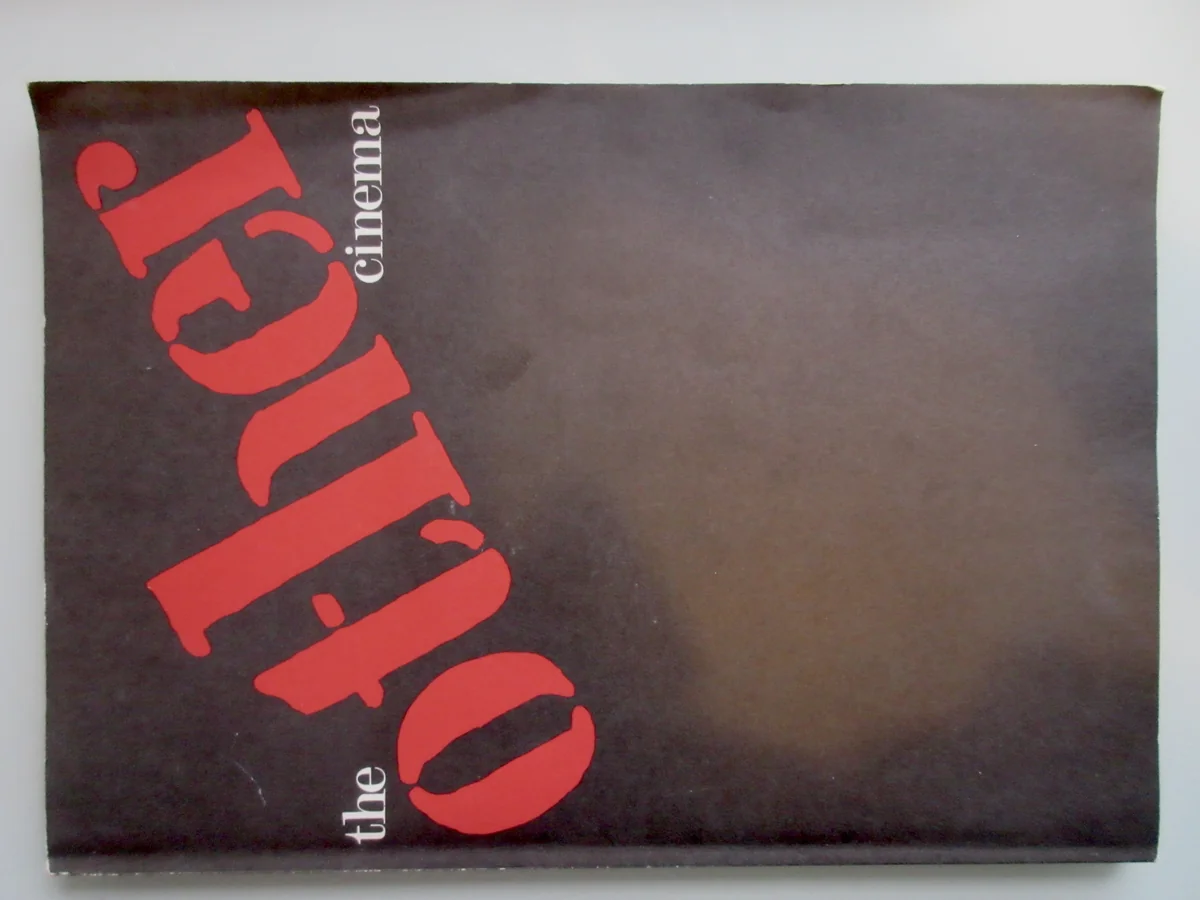
From 1975, there is The Other Cinema’s distribution catalogue, handsomely designed by the illustrator Oscar Zarate. The Other Cinema, as I didn’t know in 2004, was originally housed in Whitehead’s Soho flat, before moving to an office in Little Newport Street. From there, it took a leading role in the ‘alternative’ or ‘radical’ film culture in Britain in the 1970s. The catalogue includes The Bridegroom, the Actress and the Pimp, The Woman’s Film, The Hour of the Furnaces, Vent d’est, High School, Black Girl, and Penthesilea.All but one of these were shown in London or Cambridge (where I live) in November–December 2025, five of them as part of the Laura Mulvey season at BFI Southbank. In 1976, The Other Cinema opened an actual cinema in Charlotte Street, and it seems to have been there that Jeanne Dielman, 23 quai du Commerce, 1080 Bruxelles had its first non-festival screening in Britain, in February 1977.Time Out tentatively listed it as playing at 6pm on Monday 28 February 1977: ‘See Stop Press for confirmation.’ The Stop Press column says ‘Phone cinema for confirmation.’ If the screening took place (someone must know) it was for ‘Founder members only.’ Because it didn’t have a certificate? (Someone must know.)
The catalogue also includes two of Whitehead’s films – but not Daddy, the first film he made with Niki de Saint Phalle, in 1973. Daddy was shown by Spare Rib at the Electric Cinema Club on Portobello Road in March 1975, followed by an on-stage discussion with Whitehead and Laura Mulvey. No one in 1975, or 2004, referred to Whitehead as ‘collaborator of Penny Slinger and Niki de Saint Phalle’, as I just did above. I didn't know about the Slinger collaboration in 2004; the film she and Whitehead made together was never finished. But, by the time I wrote about him in 2006, I knew about Daddy. I just didn’t want to write about it. Whitehead called their film ‘a confession [of …] our mutual fantasies about power and castration, and our living out her primal scene of seduction, or imagined seduction by her father.’ Confronted with the results, I have to admit a certain pudeur.

22 November 2025: Laura Mulvey Symposium at BFI Southbank, marking the fiftieth anniversary of the publication of ‘Visual Pleasure and Narrative Cinema’ in the Autumn 1975 issue of Screen.
‘Forgotten by whom?’ asked Erika Balsom of the forgotten film ‘trope’. It’s true. The ‘forgotten’ film (or record or book or whatever) is one of the most annoying and omnipresent journalistic tics going. Like a lot of things, it feels like a product of streaming platforms. When so much seems to be available, you look for what isn’t. But it’s also a trite reflex, as when the Guardian hailed the ‘overdue’ recognition of Lee Miller on the occasion of the current retrospective at Tate Britain, a year after she was the subject of a biopic starring Kate Winslet. Still, there is a question of proportion; there are degrees of forgetfulness. Erika’s argument that nothing is truly forgotten could have been made in relation to the women’s film festivals of the 1970s, festivals that brought attention to figures like Dorothy Arzner, festivals that Erika referred to more positively. I hadn’t forgotten about Daddy. Online cinephiles huffing.mkv files have forgotten nothing. In the only slightly wider world, though, some things have been forgotten and some things have been lost. Or as good as.
One of Whitehead’s ways of telling his story was that, after showing The Fall at the 1969 Edinburgh International Film Festival, he decided to give up filmmaking for falconry. As I wrote in 2006, he didn’t remotely insist on this half-truth: ‘he’ll readily recount his abandonment of the camera and discuss the films he actually went on to make’ – e.g. Daddy. He was quite comfortable being called a self-mythologiser. Like most of us, he believed in stories, and for our purposes – not for others, since he did talk about Daddy and the others elsewhere – this particular half-truth had the proverbial sense of an ending. I just didn’t want to write about it.
November–December 2025: Fiftieth anniversary of the November–December 1975 issue of Studio International (‘Avant-Garde Film in England & Europe’).
Along with Peter Wollen’s ‘The Two Avant-Gardes’ and Peter Gidal calling Jeanne Dielman ‘a profoundly reactionary film’ (better than a shallowly progressive one), this bumper issue of Studio International features David Curtis’s ‘English Avant-Garde Film: An Early Chronology’, which ends with the London Film-Makers’ Co-op moving into premises in Fitzroy Street, NW1, after receiving a grant from the BFI. That move ‘confirm[ed] the avant-garde’s complicity in its own institutionalization, and [was] a further stage in its integration into the English pattern of education and patronage in the arts.’ Another ending.
Early December 2025: Fiftieth anniversary of the first LP release from Brian Eno’s Obscure Records, The Sinking of the Titanic and Jesus Blood Never Failed Me Yet by Gavin Bryars.Both of these were filmed by Stephen Dwoskin, and one of them is used in Akerman’s Letters Home (1986), one of numerous connections between the two filmmakers. The Bryars–Dwoskin collaboration ended with the record’s release.
In one of the loaned boxes is a file from Laura Mulvey to do with The Other Cinema, on whose Council of Management she served from September 1975 until the Charlotte Street cinema’s dramatic closure in December 1977. (Another ending, one I have written about in at least three separate publications.) In the meantime, in May 1977, her and Peter Wollen’s film Riddles of the Sphinx had opened there. The minutes of the first meeting to which Laura was invited, on 9 September 1975, read: ‘Marc’s paper was discussed. The remarks on corporatism were felt to be important and relevant. A proposal was made to support the ACTT [Association of Cinematograph, Television and Allied Technicians] proposal for nationalisation in the prospectus. This was rejected by means of a vote which was carried 6 “no” and 1 “yes”.’
Marc is Marc Karlin, part of the Berwick Street Film Collective, which had debuted Nightcleaners earlier in the year, and his paper was an analysis of the state of the cinema in Britain in 1975. According to Karlin, the Labour government of the time was enabling ‘a declining capitalist power to slowly change itself in the dull grey and icy quickstep of the corporate state’. By this he meant that, since the late 1950s, the Conservative establishment had ‘accepted that the laws of the market are no longer enough and that the state must take on the role of being a regulator’. Not only that, but amid the stagflation of the mid-1970s, there was an ‘emerging alliance’, he said, between capital and the unions.
This prognosis was written six months after Thatcher, mentioned in the same paper, became Conservative party leader, and it is too easy to point out its shortcomings. We all know what really happened next. (This is the shared understanding that the ending of High-Rise depends on.) A few years later, not corporatism but neoliberalism, supposedly, took hold, and to a bizarre degree this has become the ending to end them all; bizarre, partly because the epoch that is supposed to have ended, the so-called postwar consensus, was far shorter than the 46 not exactly uneventful years that have elapsed since. In this light, I’m tempted to say Karlin was proved right in the long run, but what we have is neither corporatism nor neoliberalism, and we would do better trying to name it than use the names handed down to us. Culturally and intellectually we are overdrawn on the Bank of Mum and Dad, reliant on the same theory, and much like them fifty years ago, we have no idea what is coming.