
Liars, Fascists, Drifters: the Cinema of Carolina Adriazola and José Luis Sepúlveda

There is one remark that perhaps best crystallises the filmmaking ethos of Chilean duo Carolina Adriazola and José Luis Sepúlveda, whose films stand in opposition to dominant modes of representation in popular Chilean social-realist cinema. In an interview, Sepúlveda quipped, “I don’t think I could eat a cake on Apoquindo Avenue and then return to film a scene about crack cocaine.” Repulsed by the idea that one could consume cake in an affluent area of Santiago then travel back to a less salubrious neighbourhood to create, with the same appetite, pornomiseria, they differ from those who believe that the work of filmmaking can be confined to the film set. They are dedicated to marginality, both aesthetically and politically.
Since 2007, Sepúlveda and Adriazola have made five features and five short films. Their work expresses an angst that has festered since the Pinochet dictatorship and eventually erupted into mass protests in 2011 and 2019. It is, however, not a cinema committed to revolution, but rather one ‘oriented towards absolute failure’, as the critic Vania Barraza observes. Sepúlveda and Adriazola’s ‘dirty materialist’ aesthetic strips the image of sentimentalism or romanticism to articulate a punk and nihilistic politics of refusal; deliberately ugly compositions, filmed mostly with handheld cameras, make clear the impossibility of producing an objective viewpoint within an inchoate world.
Sepúlveda and Adriazola scoff both at the salvation that other cinemas purport to offer, and at the possibility of change under a neoliberal system. Chile under Pinochet was one of the first nations in the world to undergo a transition to neoliberalism, when it was implemented through state policy from 1975 until the end of the dictatorship in 1990. Following the victory of the ‘NO’ campaign in the referendum of 1989, which came out against military rule, new hope emerged for political and economic change. But the foundations of the neoliberal economic model were never effectively dismantled, and the new democracy inaugurated with the centre-left Concertatión coalition of 1990 was marked by ongoing privatisation and increasing social inequality. Sepúlveda and Adriazola’s cinema is attentive to these failures. In Mitómana (2009), for example, the protagonist Paola (Paola Lattus) stands at a bus stop in front of an advert for a microcredit foundation; it reads, Es rico dejar de ser pobre (It feels good to stop being poor). This slogan is emblematic of a post-transition Chile where social responsibilities are continually offloaded onto the self-governing subject – an ethos promoted not only by the Concertatión welfare system, but also by a dominant cinematic model that privileges individual perseverance and personal redemption within a fundamentally broken system.
With Adriazola as producer, Sepúlveda made his debut film, El pejesapo (2007), in the wake of Chile’s cine de la transición movement. From the 1990s until the early 2000s, this post-transition commercial cinema often caricatured the popular classes or framed its subjects as victims; the trend was propelled by the box-office success of films including El Chacotero Sentimental (The Sentimental Teaser, 1999) and Taxi para tres (A Cab for Three, 2001). In these films, the atomised working-class subject that emerges stands in marked contrast to the el pueblo protagonist of 1960s New Chilean Cinema: an anti-imperialist figure embodying collective struggle. Sepúlveda’s Elpejesapo, by contrast, centres a deliberately unsympathetic protagonist – a troubled, unemployed addict who cheats on his disabled partner – and refuses to psychologise or redeem him, doing away with popular cinema’s easy sentimentality and progressivism’s condescending forms of empathy.
In Sepúlveda and Adriazola’s fiction films, drifters move across ruinous landscapes, traversing geographical, ideological, and class divides with desperate determination. For them, there is only the present tense; no future lies on the horizon. They often arrive at zones of deprivation, as in El pejesapo, in which the protagonist Daniel (played by Héctor Silva) travels from the countryside to Santiago following a failed suicide attempt. There, he gravitates towards spaces of social exclusion: a squat shared with other drug users, a construction site that exploits ex-convicts, and a circus. In Mitómana, the trajectory is reversed. Paola moves from central Santiago to the working-class suburb of La Pintana to ‘help’ the local residents, though her altruistic gestures are soon revealed to be extractive, primarily extended as research for a new acting role. The duo’s most recent film, Cuadro negro (2025), marks a sharp political turn by situating itself within the very heart of the Chilean state: its protagonist, an artist-documentarian named Sofia, integrates herself into a military training base. Here, and elsewhere in Sepúlveda and Adriazola’s work, chance encounters between individuals with vastly different worldviews and material realities expose asymmetrical power dynamics, in ways that are both bizarre and revelatory.
In loosely scripted documentary sequences across their films, actors interact with unwitting participants – a form of non-fiction that brings to mind the prank shows of 2000s reality TV, in so far as it elicits instinctive reactions and reveals prejudices that are embedded within well-mannered society. In El pejesapo, Daniel enters consumer spaces (shopping malls, a pet shop, a restaurant) asking the store managers for work, explaining that he has recently been discharged from prison. The responses he receives are marked by disdain: he is instructed to change his clothes, and even subjected to moralising from one manager who boasts of his own successes in the face of hardship. In Cuadro negro, meanwhile, Sofía directs soldiers in silly, spectacular tableaux for her film-within-a-film; Sepúlveda and Adriazola linger on their unquestioning obedience. As much as these strategies work to ‘unmask’ reality, what’s beneath the mask frequently remains oblique; there is little attempt to edify a singular truth.
I encountered Sepúlveda and Adriazola’s work last year at FIDMarseille, which hosted their first European retrospective. The programmers noted in their introductory text that these films are rarely shown outside of Latin America, but this seems at least partly by design. After all, what could be more neoliberal than the European festival circuit and its pick ‘n’ mix offering of national cinemas? Chilean festival features, developed through the filmmaking labs of major European festivals, have been critiqued by scholar Caroline Urrutia for encouraging an anthropological stance that delivers a very specific image of South American history. For critic and scholar María Paz Peirano, Chilean auteur cinema popularised by directors including Pablo Larraín and Sebastián Lelio is delocalised, made ‘exotic’, to appeal to as large an audience as possible.
Sidestepping the ouroboric structure of the global festival market – in which films financed by festivals return to screen at those same festivals, rarely escaping the circuit – Sepúlveda and Adriazola make their films on a small, self-financed budget. Although they exhibit at some festivals, including Chile’s FIDOCS and FICValdivia, they focus on showing work to rural and working-class audiences. In 2007, they created their own horizontal exhibition system through the Festival de Cine Social y Antisocial (FECISO), which brings ‘social cinema’ to the La Pintana neighbourhood and encourages debate among locals. In 2020, they established the Escuela Popular de Cine (Popular Film School), which has become an alternative site for collaborative filmmaking, free of charge for participants.

Mitómana seems to begin from a set of inquiries. What does it mean to embody another person through performance? What does it mean to represent a marginalised individual? Mitómana follows the making of a fiction film within a real environment, exploring two actors’ divergent ways of preparing for the same role. We never see the film that is being made, only the preparation before the shoot. Yanny Escobar (an actress who collaborates frequently with the directors) has been cast to play Nora Diaz, a nurse who makes house visits to working-class patients in Santiago’s southern suburbs in a bid to help people ‘live better lives’. Yanny then quits the film after she is asked to shave her head for the role. It is unclear whether this is real or fictional, but, either way, she disappears. She is replaced by Paola Lattus, an actress who had previously only performed in what Sepúlveda has referred to as ‘“concertación” cinema: the kind that doesn't hurt anyone, and which we wanted to critique.’Middle-class Paola goes full Method, attempting to immerse herself in her character’s working-class milieu.
From the beginning of the film, the first actress, Yanny, makes clear the ethical dilemmas of performance and the limits of empathy. “Being an actress is the ability to transform oneself. An actress doesn't lie; she puts herself in someone else’s shoes,” she says. “Anyone can become a pathological liar.” Yanny’s voiceover accompanies an image of her dressed in a nurse’s uniform. She walks along a busy street where, in the background, three large army men arrest a young protester. Passersby don’t so much as glance in his direction. The social script has been written, and they follow its mandate. Across multiple metanarratives, the film repeatedly questions the chasm between the individual and the way in which they perform their daily role in society.
Paola’s method acting similarly exposes the fictions that underlie institutional authority, as we watch her get away with posing as an actual nurse at a local clinic (the directors disclosed in an interview that she did so successfully for nearly a month before being discovered). After being ejected from the clinic, Paola then forces herself into the houses of locals, aggressively prying open their doors. She relentlessly insists that she will “help” before repeatedly being thrown out, seeking to inject herself into a marginalised community that continually rejects her. Through its exaggerated gestures, Paola’s outrageous performance could be understood as satirising the vernacular of a social-realist cinema that wants to enter into impoverished spaces and render them legible, but then leaves.
A new narrative emerges more than an hour into the film, after Paola meets a 12-year-old girl, Rocío (Rocío Hueche). In an interview, Sepúlveda explains that Rocío’s involvement came about as a result of an unexpected meeting, with the two encountering one another after a tragic shootout between drug dealers in the neighbourhood. “Rocío appeared, and we felt her presence, and the film started to go in a different direction.” Her entrance takes the film beyond an exploration of performance into more implacable territory.
Paola’s aim to access and interpret this unknown world is upended by Rocío, whom she follows around like an unknowing, bewildered child, in a strange role reversal. Rocío takes Paola through shantytowns, particularly those neighbouring the construction zone of a highway, a gaping valley of mud and concrete that segregates La Pintana from Puente Alto. Rocío is sceptical of Paola. She questions how this actress from La Providencia, an upper middle-class area in central Santiago, could possibly represent her reality.
One image remains etched in my mind: in the darkness of the night, lit solely by streetlights, Rocío and Paola stand against a wall, and Rocío raises a gun to Paola’s head. Paola then takes the weapon, raises it in the air and fires, light bursting forth from the muzzle. At the same time, faint gunshots can be heard echoing through the rest of the neighbourhood. Paradoxically, the closer the performance comes to the real event – both temporally and spatially – the more visible the mediation. Rocío does not appear affected by either the real or the performed gunshot, while Paola seems to anticipate that her act will expose some kind of truth. We wait for her gunshot to resonate, but there’s an emptiness to her gesture, and no consequence to her performance. If anything, this moment reveals that cinema is the ultimate mythomania, believing and indulging in its own creation. Yet, at this point, we have seen nothing, not even close.
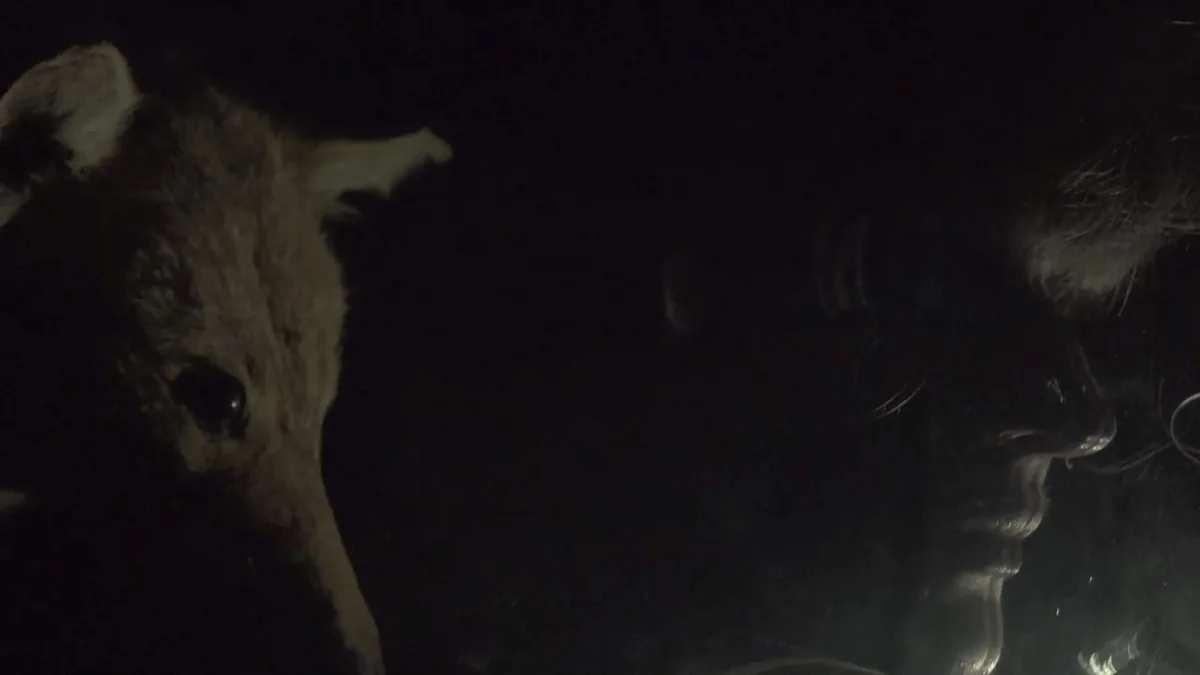
With Cuadro negro, Sepúlveda and Adriazola expand on thematic concerns of their earlier work. Like Mitómana, it centres on the making of a film – this time an artistic documentary about the Chilean Army’s cavalry. It is anchored by a brilliant performance from Sofía Paloma Gómez, who plays the documentary’s director. The film cross-cuts between Sofía directing the cavalry in her professional life while, in her domestic life, she lives across two strange set-ups: the film begins when Sofía is living with her paranoid, traumatised leftist grandmother (Elena Droguett) and ends when she is living, quite inexplicably, with an elderly Pinochet devotee (Marìa Muñoz). According to the filmmakers, the project emerged from their fascination with horses; this led them into equestrian circles, which proved – perhaps unsurprisingly – to be densely populated with nationalists. Made a year before the election of Chile’s far-right president, José Antonio Kast, the film captures the persistent nostalgia for a military state as Gómez’s character reproduces romanticised military iconography.
Sepúlveda and Adriazola’s handheld aesthetic is prevalent in the domestic sequences, while exterior scenes in northwestern Chile’s mountainous landscapes shift to static wide shots of extended duration. Such a stylistic departure works as a parody of the non-interventionism of certain artistic documentaries; it also enables Sepúlveda and Adriazola to probe how landscape has functioned historically in imaginaries of nationhood and belonging.
When Sofía belligerently herds the soldiers into wide shots, her intervention destabilises any association between landscape cinema and objectivity. She directs each of the men to lift a single arm into the air – a gesture of unconvincing valiance – while their horses squirm against their hold. This familiar pageantry of military men and horses posed heroically against sublime snow-capped peaks calls to mind Romantic battle paintings: in Discovery of Chile, an early 20th-century painting by Chilean painter Pedro Subercaseaux, an armoured knight on horseback lifts up his sword. (Sofía even holds up a battle painting she has found on the military base as a reference for the men to replicate.) The entanglement of aestheticism with nationalism is laid bare: the ornamental function of the cavalry and Sofía’s filmmaking both rely on a careful choreography of hierarchy. Any sense of mythic glory, however, is persistently thwarted by the pathetic.
Cuadro negro is pure showmanship. More instigator than documentarian, Sofía navigates landscapes of domination in ways that trouble ethical boundaries. In both public and private settings, people emerge as unthinking, unquestioning subjects, or as flawed individuals who fundamentally believe in their subjective narratives. Sofía enforces her dominance in comical but increasingly cruel ways. In one scene, she orchestrates a parade for the cavalry officer Alberto Larraguibel, who set the world record for equestrian high jump in 1949. She directs a woman soldier to re-enact Larraguibel’s half mount atop a metal equine statue on a moving truck decorated with skull-and-crossbone insignia (a symbol of the Prussian Hussars, then adopted by the Nazis). After the soldier performs for the public, forced to hold her half mount position for hours, we see her teary-eyed expression as she is pushed by Sofía to maintain that pose for a photograph with a higher-ranking army official – one final humiliating command.
At times in Sepúlveda and Adriazola’s films, political divides give way to oddly tender relationships. The second half of Cuadro negro follows Sofía as she moves from the home of her grandmother, who is still petrified that agents of the dictatorship are watching her, to that of another elderly woman, who openly worships Pinochet. In a house overflowing with fascist insignia and flags, María poses with Sofía. Both directly face the camera, the older woman wearing her husband’s military badge in memory of Chile’s ‘second independence’. When María finds out that Sofía is a leftist, she accuses her of betraying what she calls the country’s “true democracy”. Here, Sepúlveda and Adriazola point to how the language of revolution and strategies of resistance have been appropriated by the right. Rather than simply ridicule this elderly fascist, however, they reveal a strange camaraderie between the two women, somehow bonded despite their mutual distrust and disdain. They toast during a dinner date. María says, “Here’s to your ambition to outdo yourself, even though you can’t do this as well as me.” Sofía replies, “To your fascism”, and they both start giggling.

A decade earlier, Sépulveda and Adriazola had already demonstrated an interest in highlighting political contradictions in Crónica de un comité (2014).You can watch this film online for free, with English subtitles. https://cinechile.cl/pelicula/cronica-de-un-comite/ This non-fiction film resulted from their work with FECISO and their presence in the neighbourhood where a sixteen-year-old, Manuel Gutiérrez, was killed by a police officer during the 2011 protests. After Manuel’s wheelchair-bound brother, Gerson Gutiérrez, and the political activist, Miguel Fonseca, formed a political committee to challenge the acquittal of the officer responsible, that committee contacted the directors to document the group’s struggle for justice. The documentary shows the ways in which Manuel’s death was steadily co-opted by multiple external parties.
There are various points of view at play in Crónica de un comité. Sepúlveda and Adriazola continually contrast the public appearances and collective labour of the committee with personal desires and anxieties, revealing tensions that grew within the committee over two years of filming. As the government, the police and the church implicitly work together to quell political dissent, Miguel uses the case to challenge the broader justice system. Yet the immediate family focuses on the officer who they believe to be singularly responsible, and they also find themselves living through a destabilising paradox: Manuel’s death has led to an improvement in their material reality. They are rehoused by the council and receive media attention and regular visits from the local church. While public interest eventually wanes with the slow pace of legal bureaucracy, the church – which preaches a deferred, divine justice – is a contributing factor in the mother’s turn away from political action. Like Mitómana and Cuadro negro, the film fractures the idealism often attached to political documentaries, and exposes instead the material realities of its subjects, the divergent ambitions of its participants, and, in this instance, the painful reality of having one’s child turned into a symbol.
Sepúlveda and Adriazola’s editing foregrounds the distance between a politics of recognition – premised on media attention – and the attainment of real justice. In one sequence, the directors cut between different angles of Gerson’s appearance on the talk show Mentiras verdaderas (‘True Lies’): behind-the-scenes footage, Gerson’s confession to Sepúlveda and Adriazola’s camera before going on air, and the live transmission of the show on the Gutiérrez’s home television. This layered construction produces a disenchanting fragmentation of perspective; the filmmakers deliberately contrast Gerson’s hope with the empty seductions of spectacle. Speaking directly to their handheld camera, Gerson recognises the contradiction of his position: he is excited to appear on a high-profile show, yet admits that this “dream” is only made possible because of Manuel’s death. This is followed by Sepúlveda and Adriazola’s quiet observation of the surrounding absurdity on set: a chef lifts two skewers of meat in the shape of an X as he waits for his own segment to begin. Gerson’s moment of fame is clearly part of a media economy that short-circuits between cooking shows, pop music videos, and emotional anecdotes. The sequence culminates in a detached long take that includes only the final few minutes of Gerson’s television appearance and the host’s sign-off: “...we hope we don’t have any more Gersons here. We don’t want to continue listening to violent stories […] We want to listen to more stories of peace. Welcome to Ciberindependence!”
Elsewhere, Crónica de un comité combines cinema-vérité style observation with the subjective intimacy of community video. Although the work is mostly filmed by Sepúlveda and Adriazola, the filmmakers also distributed handheld cameras among the family and to Miguel, producing additional layers of perspective that slip between first-person testimonies from Miguel and Gerson, intimate domestic sequences, and direct records of public protests and committee meetings. The most interesting moments are the more diaristic: in one sequence, Manuel and Gerson’s sister, Jacqueline, takes the handheld camera to her room and confesses: “Sometimes I feel depressed when I go to these [protests] and see Manuel's face all over the place. [...] It’s more like Gerson’s world.” In another, Miguel takes a handheld camera to his bedroom and films his shadow against the wall, whispering: “I meditate everyday about what to do [...] to end the martial law system in Chile. […] This room is a total mess, but that doesn’t matter. The goal is to change the country.” Gerson’s diary arrives two years later, towards the end of the film. He records himself in the streets, with skeletal winter trees behind him: “It’s not that you left. It’s not that you’re not here. You simply died. And you died because they killed you.” Within these private tapes, individual, lived moments of trauma struggle against the broader telos of history.
By the end of the film, Gerson has contended with the contrapuntal pressures of his immediate world – family, neighbours, the local committee – and the larger ideological machinery of the media, the state, the police and the church. He is eventually disillusioned by his family’s religious faith and the fleeting allure of media attention. (At a self-organised press conference with no attendees, Gerson records himself saying, “The bourgeois media isn’t very interested in this topic.”) He has become markedly political. This narrative arc is perhaps the directors’ most definitive gesture: immersed in the process of reckoning, it compels us to navigate contradiction and assemble, piece by piece: an alternative framework through which to evaluate the struggle for political change.
Rather than applying fresh paint to tired, commonly circulated images, Sepúlveda and Adriazola scorch holes through them. They deflate a leftist cinema that generalises in order to present a unified message, reject the vague seductions of popular cinema, and instead engage with the discomfort of clashing aesthetics and ideologies. Rather than pretending that things are better than they are, these filmmakers begin from corruption – as a condition to imagine another form of cinema.