
Like the Rings of a Tree: Viktoria Schmid’s Three-Colour Separations
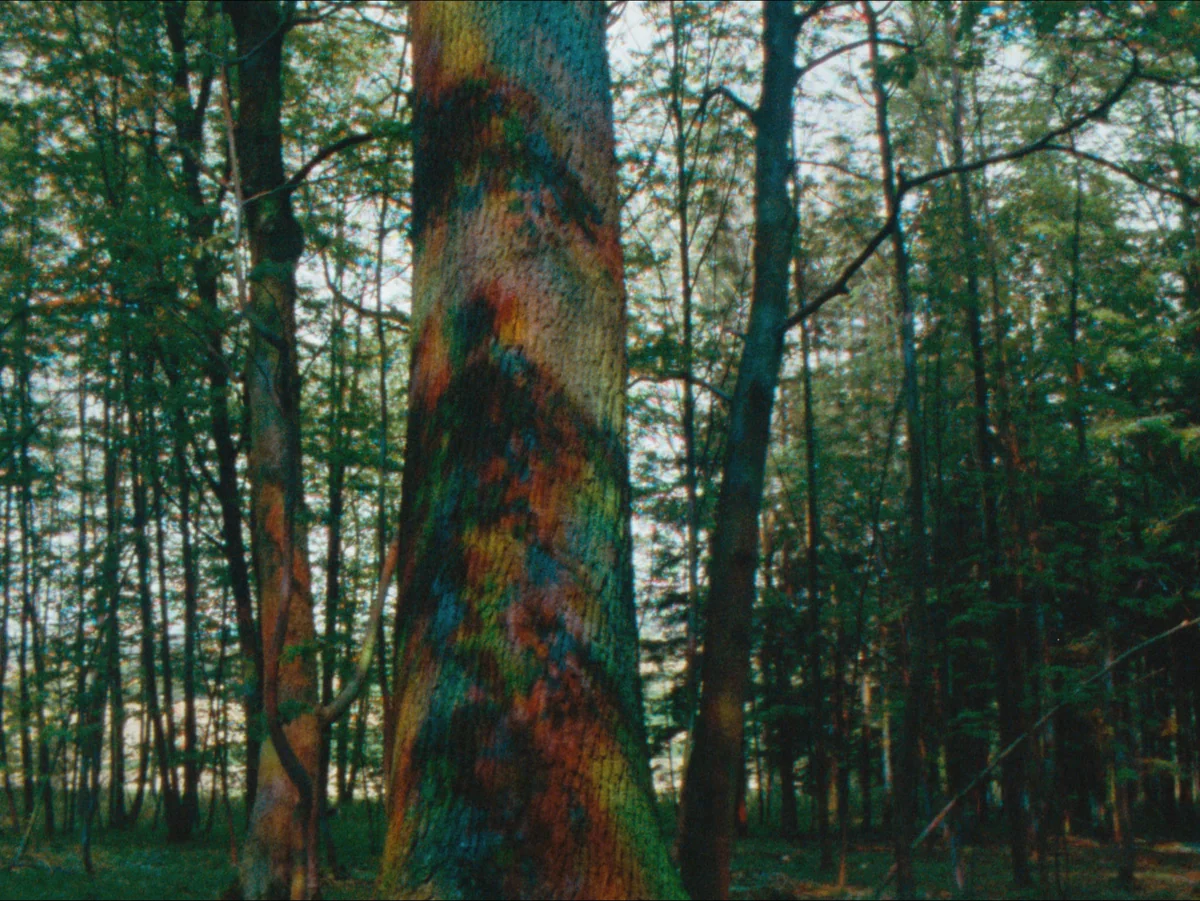
Viktoria Schmid’s latest film, Rojo Žalia Blau (2025), is an extension of the artist-filmmaker’s practice of recreating early film colour systems. The film is a triptych, shot across three countries – Lithuania, the filmmaker’s native Austria, and Spain, in that order – as she travelled to work on other projects between 2019 and 2024. The three-colour separation technique, based on three-strip or ‘glorious’ Technicolor, is an additive colour method which uses the constituent parts of light – red, green and blue – to create a full colour image. In Schmid’s own adaptation of the technique, she prepares a still shot and exposes the negative three consecutive times through different filters: red, green and blue. In doing so, she records three layers of time, slightly offset from one another. When these layers are superimposed, still objects in a given frame are rendered in full colour, while moving elements appear with prismatic auras known as chromatic fringes. In some shots, the effect is subtle: a leaf shivering in the breeze creates a flickering green halo; a tree trunk’s shifting shadow casts a single vivid red stripe across white snow; a distant figure walking along a seashore appears as a minute blue ghost. In other shots – dappled shade in a forest, or a glittering ocean – the whole image is suffused with rainbows as the three colours interact. Sometimes, when the frame is full of rapid movement, the colour fringing becomes so intense that it feels overwhelming; the sensation is similar to that of an optical illusion that prevents the eyes from resting. In shots with stable elements, the effect induces a feeling of transcendence, but one that tethers to the earth – as when surreally glowing, multicolour clouds float across a calm blue sky, grounded by a green forest.
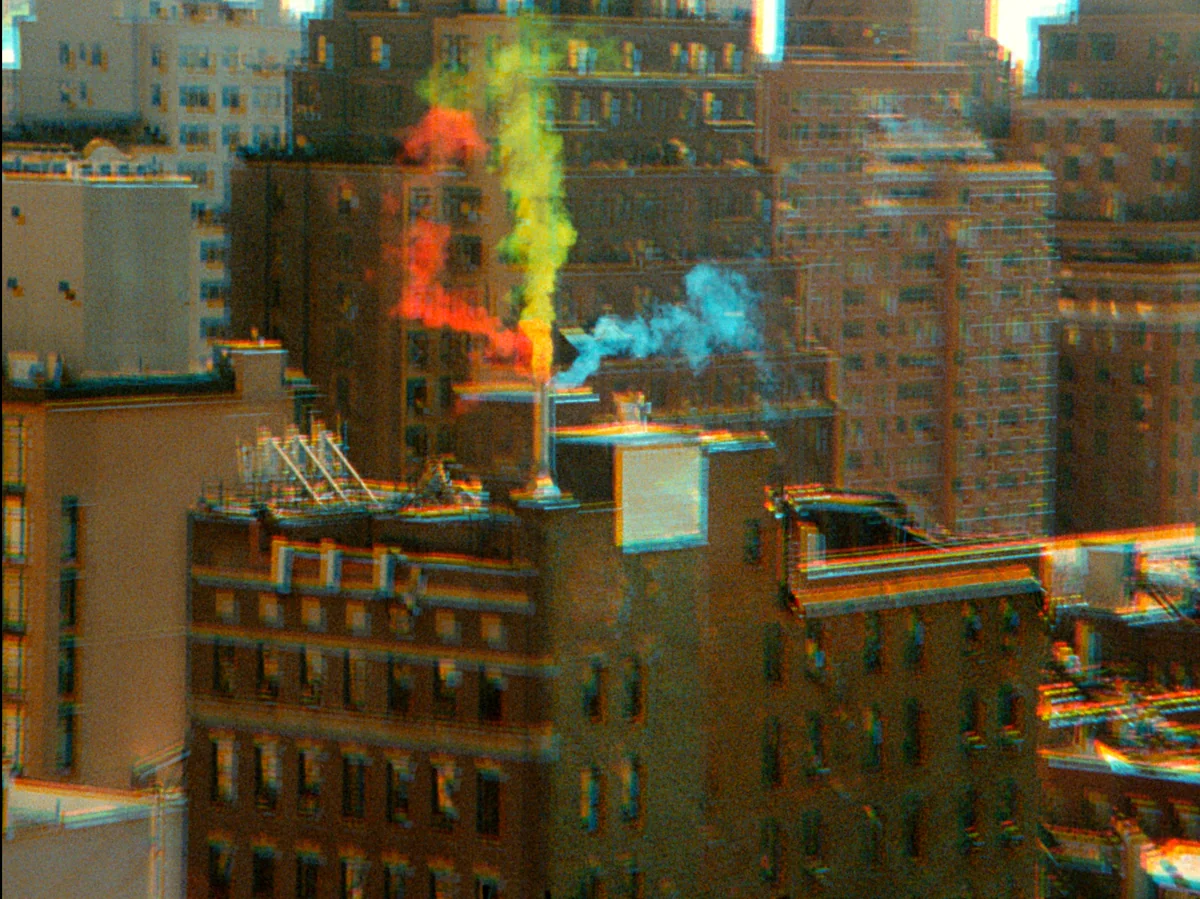
Rojo Žalia Blau (2025) was shot alongside Schmid’s other three-colour separation film NYC RGB (2023), which was filmed from a single high-rise apartment in Manhattan in 2020 and 2022. In 2025, for an exhibition at bb15 in Linz, Schmid exhibited the films together on two perpendicular screens, set to play on alternating loops: while one film played, the neighbouring screen remained blank. In one moment, on one screen: the vertical lines of trees in a forest, and a buzzing swarm of tri-colour flies. A few minutes later, on the other screen: the vertical lines of skyscrapers, and humans seen from above, like milling tricolour ants. Viewed in conversation in this way – each taking its turn to speak – Schmid’s works unsettle the concept of the ‘natural’ environment. Where the colour separation technique draws attention to the organic elements of NYC RGB’s manmade environment – humans, birds, wind, the movement of light – Rojo Žalia Blau renders the natural man-made through slippages that draw attention to mechanical processes. The shift from a winter to summertime forest is signalled with a bright flare marking the end of a reel; a few frames with a single filter create what feels like an unnatural monochrome burst between shots of crisp snow, reminding us that ‘white’ light is created through the stacking of intensely coloured layers. This technique is echoed in the film’s hybrid soundscape, made in collaboration with sound artists Liew Niyomkarn and Laszlo Umbreit. While the sound might be mistaken as being purely diegetic, Rojo Žalia Blau merges field recordings from all three countries with additional Foley to create a lush, layered sonic world. Filmic technique collapses time and place; the filmmaker and her recording devices are themselves a distillation, themselves a combined entity capable of extrasensory and extratemporal perception.
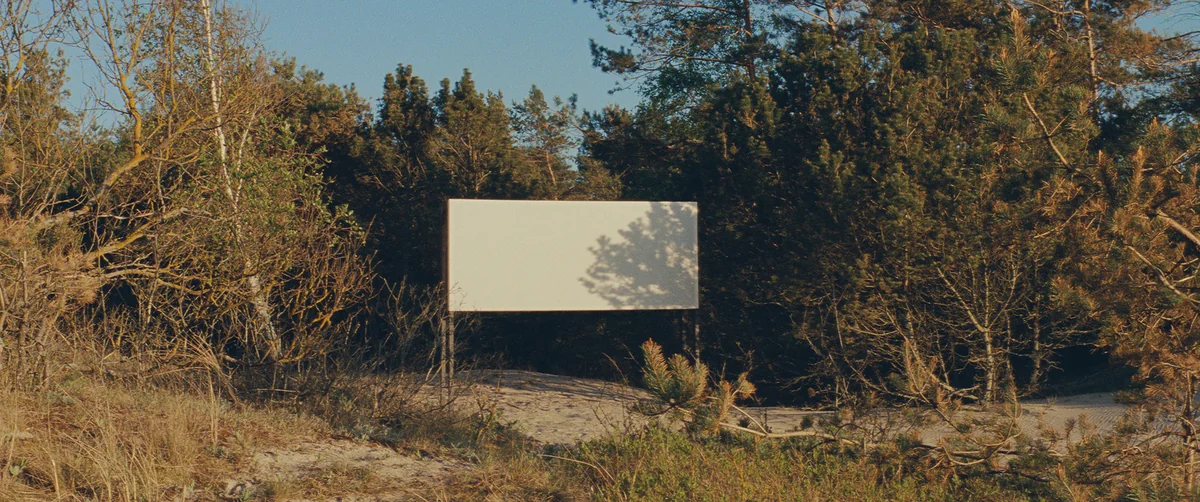
Much of Schmid’s work is concerned with the distillation of time and place, and with the techniques of early film – most notably in her beautiful practice of working with cyanotypes, a cameraless photographic printing technique that uses UV sensitive chemicals to capture the movement of light and shadow. Schmid is also concerned with the constituent aspects of film: many of her installations feature historic projectors, and in her Proposals to Project series, she installs blank screens of different aspect ratios – including her own, in 4:1, which she has charmingly named VIKTORIASCOPE – in natural landscapes, before re-filming the installations in situ. The resulting films duplicate frames within frames, drawing attention to the characteristics unique to each aspect ratio while centring the blank screen as a ‘protagonist’ – a desire echoed in Schmid’s 2025 staging of Rojo Žalia Blau and NYC RGB.
It would be easy to describe Schmid’s rigorous, precise, and curious methods through the lens of scientific process. More than many other experimental films made today, Rojo Žalia Blau does seem like it is genuinely testing a hypothesis. That said, Schmid is also a storyteller. When the film screened in a combined programme at Open City Documentary Festival, an audience question about narrative occasioned what was easily the most fascinating moment of the Q&A. After answers from the other filmmakers – among whom were documentarians working with more apparent narrative structures – the conversation started to move on. There was an unspoken assumption that an abstract filmmaker like Schmid would have little to say on this topic. Schmid politely but firmly interjected: “I have something I’d like to say about narrative.” She went on to enumerate her protagonists: clouds, trees, the sea. She described their motivations, and the motivations of her camera. She recounted the journey from place to place that underlies Rojo Žalia Blau, and indicated how those journeys are recounted in the film by making the processes of shooting visible. In each layered frame lies a miniature drama.
Hannah de Feyter: You’ve described this three-colour separation process as an homage to early colour systems. Could you start by telling me about some of your favourite uses of colour in early cinema?
Viktoria Schmid: [Laughs] How much time do you have? The starting point for me was when Kodak filed for bankruptcy in 2012. I became interested in whether it would be possible to make my own colour film, if only black-and-white film still existed. I did a little research, and I found out about these early colour film systems. I found out about the first colour photo ever made by James Clerk Maxwell, who was a physicist – so he wasn’t interested in taking a photo as such, but was trying to demonstrate how our eyes perceive colour. Our eyes also have red, green, and blue cones. And I thought the image was so interesting: it depicts a tartan tie, which Maxwell and his collaborator, Thomas Sutton, selected specifically because it was an object with complexities of colour.
When I came across this photo, I thought, Maybe I should just try this out, see if it works. I wanted to try it with moving image – 16mm film – and I was searching for some object that was always moving. Then I hit on clouds: the perfect protagonist. They are also similar to film in that they’re chemical and never stay still. So I made the 16mm three channel installation The Clouds Are Not Like Either One, They Do Not Keep One Form Forever [2014]. This was the first work in the series.
When you start to research it, you discover this amazing world of colour film systems. It’s kind of endless. And I really like that, all around the world, there were similar ideas. I enjoy seeing art with similarities to my own. I like that someone had a similar idea to me, but forty years before me, in another part of the world. Ideas: they float to you and to others. Next on my wishlist is to recreate bicolour, which is red and green, alternating colours and filters.
HdF: It sounds like a very scientific process – informed by a physicist! Was there a lot of trial and error with the techniques you used for Rojo Žalia Blau?
VS: Not as much as you would expect, actually, because I was already super happy with the first image I shot. I was like, Ah, wow, it works! And then I did a little bit of testing – like, experimenting with which filter to use. Blue is the trickiest. I once gave a talk after a screening and a cameraman asked me how many tests I did – not as many as a cameraman would do. This is partly because of my budget, but also, of course, because after doing it for a long time, I have some experience.
I do create a sort of storyboard with my iPhone: I take photos which gives me something to start with, the first image. Then, while I wait between the filters, I have time to wander around. And you quickly find new motives. And, of course, you always have a little bit of a rush against the sun as the light changes. So, I also collect memories of shadows with my iPhone, like, Okay, this shadow falls here at 7 a.m..
I am a visual researcher, but one with a lot of freedom. I enjoy a process that has some... that I cannot control one hundred percent. This is what keeps it exciting. When I shoot images, I kind of already know how some will look, I have a better feel for them, but some are still a surprise. And I still can be surprised when I re-watch my work, because I discover new things. In NYC RGB, for example, I still spot new humans in unexpected places.
HdF: What’s your relationship to these places: New York, Lithuania, Spain?
VS: They were all my home for a short period of time. I stayed in all of these places while working on other projects. It’s very much an inspiration for me to go to other places and shoot there. For Rojo Žalia Blau, I was in Spain to work on a project with cyanotypes, actually, and in Lithuania I made A Proposal to Project in Scope [2020]. And while I was in those places I shot these little postcards – three-minute 16mm postcards – and I needed a way to connect them. So at home, in Austria, I shot a longer letter. For me it was very wholesome to shoot in a place that I know quite well. The film is about how you perceive a landscape that’s very familiar to you in contrast to how our perception changes in a new environment. It plays with this idea of… a place of origin, in a way.
HdF: One film features man-made landscapes, while the environments in the other are more natural. Are you interested in that contrast when you screen them next to each other? Are you perhaps challenging the idea of what a natural landscape is?
VS: Definitely the latter. When I was shooting out of that apartment in New York, I was also doing a lot of research into early skyscrapers. I was fascinated by them. All these skyscrapers have names, mostly for the architects who made them. And observing the skyline from my window every day reminded me of how hikers look at mountain ranges. I never understood why everybody wants to name mountains, to own them in this way.
HdF: And is there a parallel for you, between a city and a forest? How is a building different to a tree?
VS: Trees are fascinating because they need a long time to grow, and when you cut one down, you cut many years at once.
HdF: Yes, I was thinking of the rings of a tree while watching Rojo Žalia Blau. There are the layers that build as the tree grows, and the layers of film.
VS: That’s really beautiful. I hadn’t ever thought about this.
HdF: But it also takes time to build a building. There’s an Australian filmmaker I love, Paul Winkler, who worked as a bricklayer. He made several films about building walls – my favourite is just called Brickwall [1975], but he returns to the image in several films. He compares rows of bricks to frames in a strip of film, marking the passage of time.
VS: Oh, I have to check this out.
HdF: But even if a building can be like a tree, it’s the more organic elements in NYC RGB that your technique draws attention to through the colour fringing. Like the movement of sun, the movement of people – there’s even a few birds.
VS: I shot all of NYC RGB in one apartment. I experienced the same things I like about filming in nature: you are there on your own, and you have a lot of time to observe things, to find the images that you want to collect. While shooting from the space of the apartment, I had a real luxury: nobody could come and block or tilt the camera. That’s why I had this special feeling for the city, and for the view I had there. And the sun provided my shooting schedule for me. I was there for three months, and I knew, Okay, at 7 a.m. the sun is illuminating the Empire State Building, so I shoot at 7 a.m. there. So this was a very natural element within this non-natural environment.
In the forest, the time I needed to leave between the three exposures is much shorter, because there is always movement – the trees in the wind, for example – so I didn’t need to wait for things to change. In a few shots of NYC RGB, I even waited an hour between exposures, depending on the shadow movement. Sometimes I have to be quick and rewind the film quickly to shoot again. At minimum, there is maybe one minute between exposures. With nature, it’s much more thrilling, because you probably can’t find the same image twice.
HdF: Is there something eerie about watching the synchronised film, about being transported back to the place you were shooting in, but with this new extrasensory perception – seeing these layers of time that you couldn’t see all at once while you were there?
VS: No, it’s actually the opposite. When I showed NYC RGB in New York a year after shooting it, a friend had the same stipend, so I could go visit her in the apartment I had filmed in. It was funny – you know ‘New York’ so well from its images in other films, and then I was able to have this same experience with my own images. It was like the work was completed at that moment, in a way, and it felt very comforting, because I spent a lot of time there in a collecting phase. And now, in the forest, because I walk there often, I also see my images there – but they also change. Some of the trees are not there anymore. It’s the opposite of eerie to have these companions, in a way.
HdF: Your work often experiments with collapsing time. I’m thinking of the two films you’ve made with your sister, both titled Katarina Viktoria [2011 and 2021]. In these ‘sister’ works, made ten years apart, alternating shots of your faces collapse years into seconds. This kind of interaction with time is often a topic in film theory. Are you consciously interacting with that theoretical world, or are you chiefly driven by experimentation with the materials?
VS: Yeah, I think so. I studied film theory and this must affect my thought processes. I really enjoy the fact that the three layers in NYC RGB and Rojo Žalia Blau create a new ‘time-space’, which is released when the film is projected. But for the three layers, I think it was more like something that came out of working, as I developed my method. In the beginning, I decided not to shoot the red, green and blue simultaneously with three different cameras – as this is another way of recreating the additive colour technique – because I really loved the colour fringes in those early colour systems, and you don’t get them when you film with three cameras simultaneously. So it evolved: I realised it would be exciting to shoot on colour negative film, and then put these three different time layers into one. So the medium helps you to think, in a way. With the ‘sister’ films, Katarina Viktoria, it’s a different way of working with time, but it’s a similar joy – that you can put many years into ten seconds of film. This distillation is very interesting for me.
HdF: What about the medium of sound? This film has such an interesting soundscape. Is there any synchronous sound in the film?
VS: There is no synchronicity at all. I record the sound before and after shooting. It’s really a separate process, and an artificial soundscape that is created: the idea was to take something real, through field recordings, and then make music with it. I started to work with Liew Niyomkarn because my wish was to work with field recordings as if they were instruments. I talked to a filmmaker friend of mine and she told me to listen to Liew’s music. Liew was doing that with her practice. So that was the starting point. For the musical elements in NYC RGB made by Liew with synths, I told her that I wanted a counterpoint to the three colours with this music in the form of triads.
I like that you can cheat with sound. In the beginning, when you see the Lithuanian image, the sound is the church bell of the Austrian village where I grew up. It’s a hidden thing, but it gives me a lot of joy. For me, the sound is even more fascinating than the image. But I think it’s because with the image I have a lot of control. Sound is also something that you cannot talk about so easily. With the image you can say, This is too red. Or: The framing, I want it to be different. Talking about sound is very difficult.
HdF: I think about that a lot. Everyone is trained to recognise and describe colours in such a detailed way, but we’re not trained to recognise an auditory frequency. People can say, That’s fire-engine red. But they can’t say, That’s a 60hz buzz. It’s a very specific skillset.
VS: Yes, it’s true. And it’s fascinating, then, to collaborate. Laszlo Umbreit’s ears are trained to hear so many details. I also have a background in music, but it’s very punk. I’m not trained. But because music was the creative starting point for me as an artist, it feels very important to me.
HdF: Rojo Žalia Blau is being screened at the festival on a 35mm print, blown up from the 16mm film you shot on. Is screening film important to you, and why did you choose 35mm?
VS: I really enjoy screening this work on film because the three-time layers are then, again, on one actual layer of film that is projected. But I chose 35mm for Rojo Žalia Blau because of the sound – some sounds like the crickets are harder to capture on 16mm prints, because of the range [16mm prints are only available with mono sound]. So, this time, I decided to do a 35mm print. I have a 16mm print for NYC RGB, and I love the sound, actually. It fits well in the range; the mono sound is something very unique. But Rojo Žalia Blau is surround: SR-D.
HdF: So screening from film is a practical consideration. You’re not a purist.
VS: No, I’m not a purist, because I think we have such a limited audience as experimental filmmakers and it would be strange to limit it even more. And it’s not, let’s say, very 2026. I’m okay to share the work digitally and to show it as a DCP as well. But because of the rich history of Austrian avant-garde cinema, there is funding for me to get a film print, which is really lucky, because it costs a few thousand euros. Otherwise I wouldn’t do it. I do think there is something so special about film. It’s also something that you cannot describe perfectly in words. It’s not something very rational, I would say, and I love that about it. And it is hard to get a good film print, to find a good lab, because so many things can go wrong in the process. I ask myself why I’m still doing it,but then when I have the finished film, I’m really happy. It’s something very mystical, in a way.
HdF: As in magical or almost romantic...?
VS: Not romantic. It’s very satisfactory.