
The Landscape Taught Me How to Look: A Conversation with Maureen Fazendeiro
Maureen Fazendeiro makes films that are comparable to fieldwork. She draws attention to stones, foliage, or the colours at dusk, but also finds layers of history, and considers memories and myths to be facts. Her earlier works, Motu Maeva (2014) and Black Sun (2019), are experiments in found footage and montage, using images that both anchor and unmoor what is spoken on the soundtrack: a woman recollecting the adventures and pains of her youth and Delphine Seyrig reading a Henri Michaux poem, respectively. In Les Habitants (The Inhabitants, 2025), Fazendeiro pits absence against abundance through the contrast between sound and image: while letters from the filmmaker’s mother detail the eviction of a Roma camp in the voiceover, plentiful Parisian gardens and kitchens appear onscreen.
Fazendeiro grew up in France, but moved to Lisbon twelve years ago – a decision that was partially motivated by the cinema she loves. “I found in Portuguese cinema a freedom that is very particular,” Fazendeiro tells me when we speak, evoking the names Pedro Costa, Manoel de Oliveira, António Reis and Margarida Cordeiro. As happens in Reis and Cordeiro’s explorations of the remote north-eastern region of Trás-os-Montes, Fazendeiro illuminates the alternating struggle and rapport between people, land, seasons and folklore in her solo feature debut As Estações (The Seasons, 2025), which screened at this year’s Open City Documentary Festival. She tells me that she spent years with the people in As Estações before filming them. Reis and Cordeiro never filmed people before getting to know them well; the same goes for Costa. Perhaps the ‘particular freedom’ to which Fazendeiro is drawn in Portuguese cinema lies in this time for intimacy.
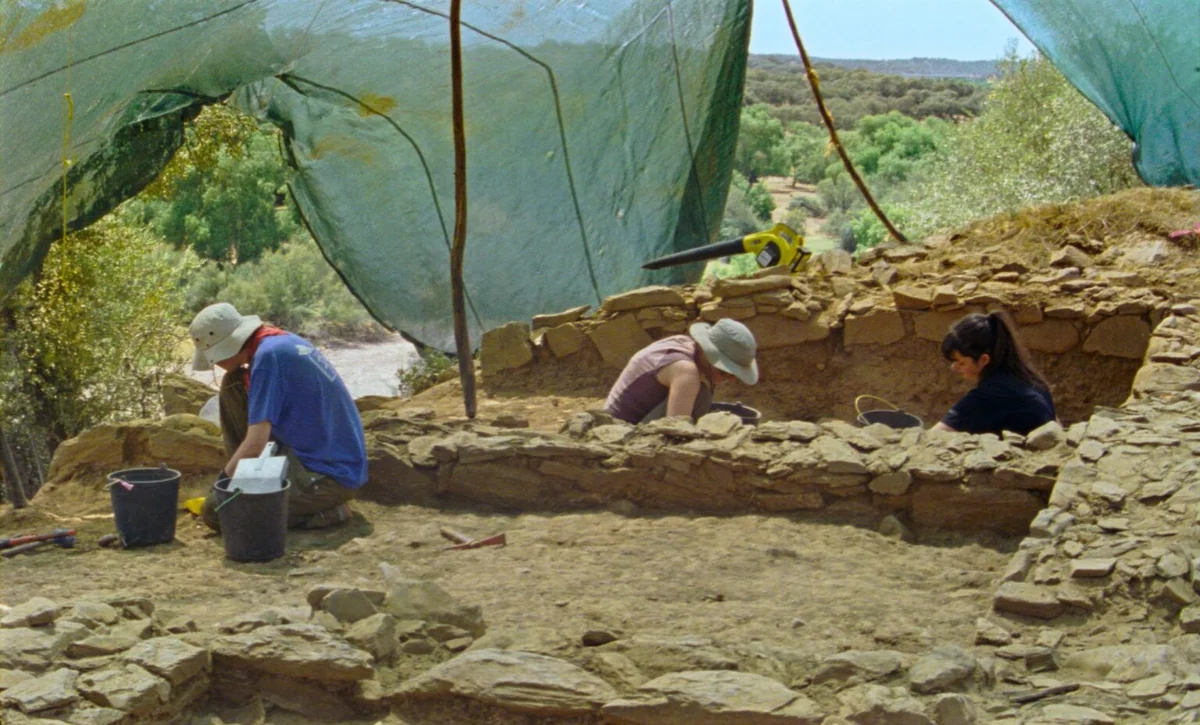
Fazendeiro became interested in Alentejo after reading about George and Vera Leisner, a German archaeologist couple who worked there in the 1940s. Their letters from that time are read in the film’s, interleaved with the voices of today’s locals. These present-day voices recall life during and after the fascist Estado Novo regime that governed Portugal from 1933 to 1974, a time of impoverishment under the quasi-feudal agrarian system. When the Carnation Revolution brought that regime to an end, workers occupied the agricultural estates, expelling the landowners and establishing utopian, albeit short-lived, farming co-operatives.
This may seem a deluge of revolutionary history – but it never overwhelms the film. It trickles into it through songs, poems, and memories. Sometimes, we see a person sing or speak; at other times, a voice floats over the landscape. As Estações offers its own fruits of the imagination as it pays homage to Alentejo’s enchanting traditions of poesia popular and folk music. In certain beguiling sequences, costumed actors bring to life siren, shepherd and outlaw alike. Belonging less with the film’s human subjects, these figures – on the border of myth and reality – sit better with the prehistoric megaliths and cave paintings. We’re left wonderstruck because, to use George Bataille’s words from his musings on Lascaux’s cave, “it is as though, paradoxically, our essential self clung to the nostalgia of attaining what our reasoning self had judged unattainable, impossible.”
This year’s Open City included a handful of films that could be called ‘pastoral’. Ann Carolin Renninger and René Frölke’s To the Left of the Fir-Tree (2025) – which featured in the same programme as As Estações – and Peter Treherne’s Matter of Britain (2026) offer beautiful escapes into rurality. Yet, the disquiet of mortality and degradation hammers away at the verdant and quiet landscapes of these films, largely through what is not shown. We see different ways of inhabiting land in As Estações, but there is no visual vocabulary for confrontation or tension. Little about the film is abrasive. Violence is related only through words; it is left to us, our imagination, to puncture the distance in between.
At the same time, questions linger. Whose land are we looking at? What will become of it in the future? These questions make me think of a line from the Michaux poem read aloud in Black Sun: ‘We see nothing, except what matters little to see. Nothing, and yet we tremble. Why?’ Fazendeiro reread this poem by chance shortly after her move to Lisbon. And beneath As Estações’s composed shots lies another aleatory journey; as the film moves through Alentejo, it puts fabulation before discursiveness, circuitousness before linearity, and never extracts as it digs into the history of the landscape.
Lily Peng: The natural landscape lies at the heart of all of your films. Can we start by talking a bit about your relationship to it?
Maureen Fazendeiro: I have been thinking about landscape for the last ten years, but I am only realising that now. I started to work on As Estações after completing my first film, Motu Maeva, and those beginnings became like a laboratory of sorts, in which I figured out how to make a film about landscape. I carried out years of research on archaeologists and people working in the fields; those who told me stories about the landscape taught me how to look at it. I am always interested in relationships between people and the spaces they inhabit. I was born in France, for instance, but never felt that I belonged there because I am of Portuguese origin.
LP: Do you spend a lot of time in nature? Is this an environment you naturally gravitate towards?
MF: I live in the city, but for the film I spent a lot of time in nature. I love being in nature. But I don’t drive, so I need to invent a way of being in nature. That’s why I make movies. [_Laughs._] So that people will take me to nature.
LP: Personal histories are folded into the landscape in your films, but sometimes the stories of the people and the land are not the same.
MF: Yes, for example, Les Habitants has this idea of a voice coming from inside the image, articulating what you don’t have at first look. Voice is something that can complement and also contradict the image. I understood that when I was making As Estações. The archaeologists who appear in the film took me to sites where there are no ruins, and they would say that this place was amazing, important – but I wouldn’t see anything. So I wondered how you can understand a place that you don’t see.
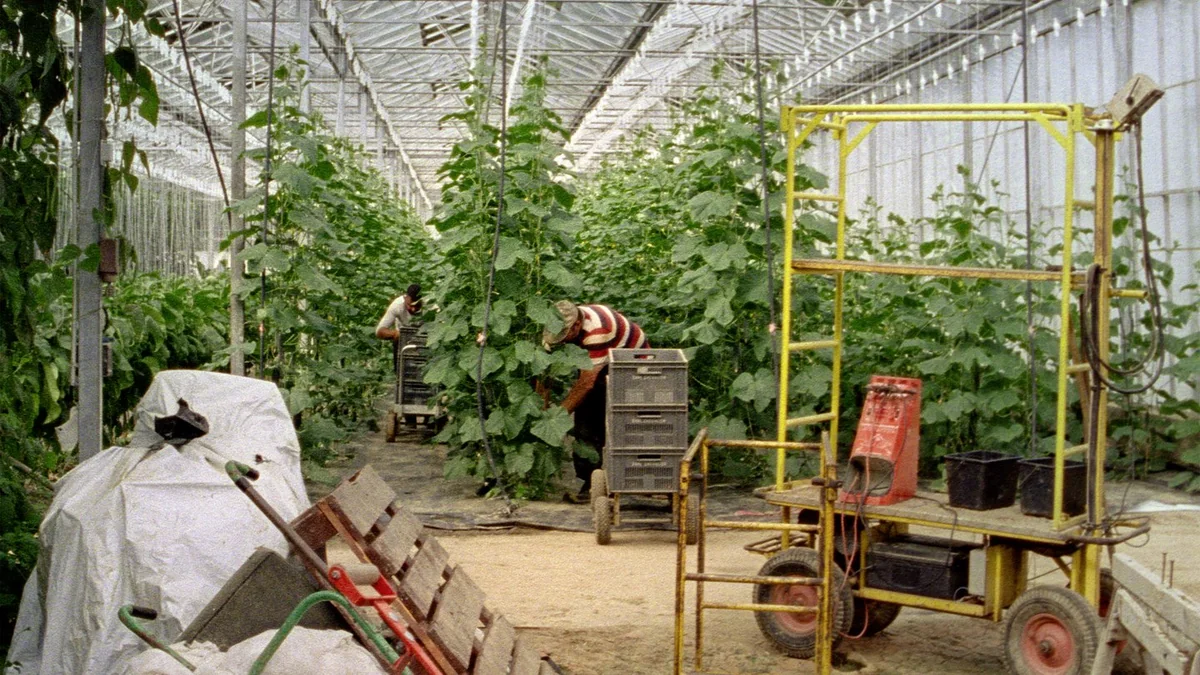
Most of the time, cinema is about what you can see. I started to use voices in the film to build knowledge. And I tried with the sound to recreate the sensations you have when you look at landscapes – whether it is dark or light, hot or cold, still or windy. I was also asking what the movement of a landscape might be if much of it is moulded by human actions. Archaeologists have a scientific approach to these questions, while a rural worker might tell me about how they fought to occupy this land, and a former landowner might tell me how hard it was for his land to be expropriated. By asking how I could compose all these ways of inhabiting a place, I started to build the film’s polyphonic story.
LP: Soundscape feels as important as landscape in your films.
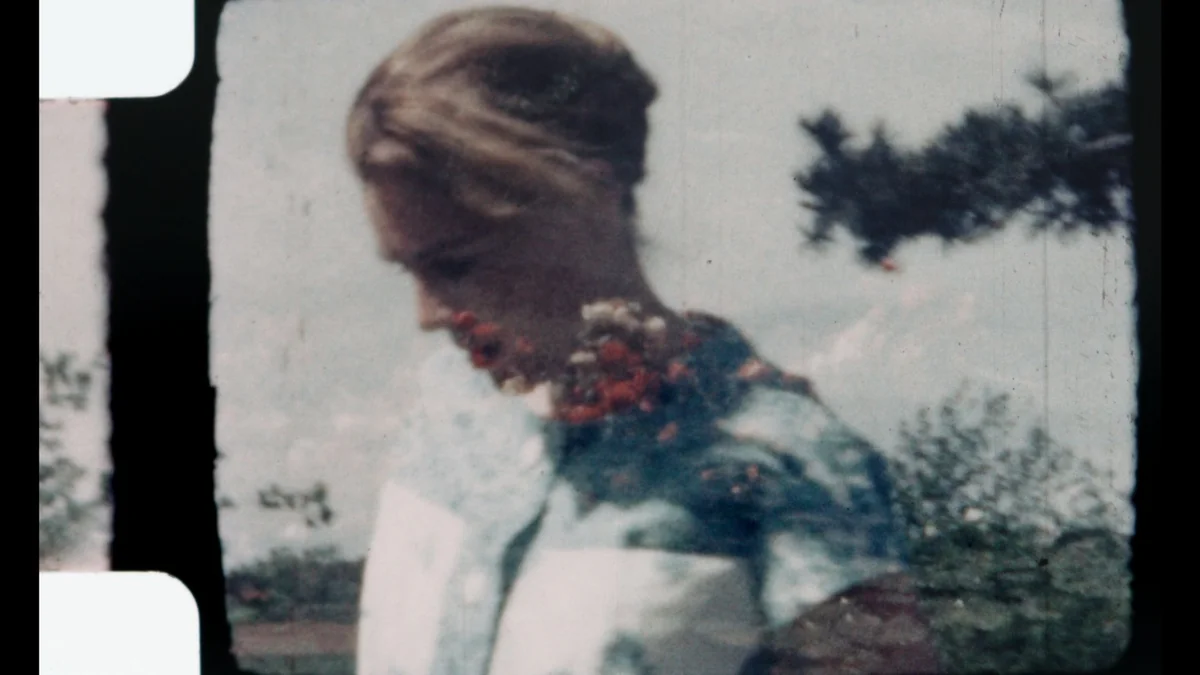
MF: Sound is a big subject for me; I’ve always worked with one sound designer and sound editor. I shot Motu Maeva in Super 8, so I couldn’t record sound at the same time. I understood that I could work with the sound, and not in the Straubian way. I watch a lot of movies by Jean-Marie Straub and Danièle Huillet, and they have been very important to my cinephilia, but they are very rigid with sound: it has to be the sound of the moment of recording. We recomposed almost all the sound for Motu Maeva and also invented sound for the archival footage.
When we worked on As Estações, we started to understand that those panoramic shots need a lot of sound to create not only the feeling of being there, but also this notion of a space that is not the same from start to end. I think sometimes we spent a week on the sound for one shot. One day we went looking for ducks for the sound. We added a lot of layers, and only stopped when we could say that it sounded like music to us.
LP: In As Estações, stories and myths are re-enacted and visualised. Why did you decide against simply telling them through voiceover?
MF: I decided this very early on. Before archaeology, we needed stories to explain the presence of things, and these stories have been in circulation for centuries. Now that there is archaeology and literacy and writing, those oral traditions are starting to decline. When I asked people to tell me legends, most said they didn’t know or didn’t remember. “You should ask the mayor or the authorities,” they would say. “Maybe they have something written down.” But those stories need to be alive and transformed by people. When they are only written, they don’t interest me at all. It took a while to find people who still remember all the stories, like a shepherd who said he had been to a place because he heard the story of an enchanted moor. “I went to that place,” he told me, “but I didn’t see her.” Having people who could reactivate these stories – for the young actors, for example, who got involved in listening to them – was important for me.
LP: There’s an amazing scene in the film in which these elderly women sit in a row, singing traditional folk songs and telling their stories. How did you meet the people you worked with in Alentejo?
MF: I met the old people many times. There is a red van in the film that is also this amazing, itinerant public library. The man who drives the van goes to a different village each day, and in the morning he talks with the old people, and in the afternoon, with the kids. He’s part of a project that helps old people to learn to read and write, because most of them didn’t go to school. I used to go along with him.
He was very special: a very good poet who had written down all the poems he knew since the 1970s. Poetry is a very important tradition in the region, and I met a lot of popular poets. It used to be very common for men to have poetry contests in the bars. The kind of poem they have to write for these contests is called the décima. It’s ten verses and involves repetition in some parts. Most of the time they improvise the poem, or have only thought about it during that day. It’s like rap, but the oldest rap. [Laughs.]
I also met that man’s sister, who said her late husband remembered seeing the Leisners working as a kid. Then she started to sing this song that people sing when they work in the fields. She was part of a group of women who would work in the rice fields and she knew many songs. I decided to join them, and filmed them in a way that was absolutely improvised. I just turned the camera on and let them speak and read the poems they wanted to read: a poem about a man looking at a tree and wanting beautiful things, for example. They also sing about the co-operative. It’s my favourite shot of the film, because what happened between them is very powerful and what it says about history is not completely direct.
LP: Were the Leisners a part of the story from the beginning?
MF: Yes. The Leisners were my door to enter this region, because I’m not from there and, when I decided to make the film, I’d never been there. I read about the Leisners in the newspaper: their archive was open and available to be consulted for the first time. It said in the article that there were letters in the archives from Germany during the Second World War. So I understood that there were already several layers of time here. Motu Maeva was already about a personal journey through the history of Europe in the 20th century, and I was interested in doing more of this, thinking about how personal trajectory crosses with historical moments.
I also started looking at this region because, in truth, it’s not shown so much in Portuguese cinema. So it was a combination of those two things: the fact that there could have been different layers of time present in the 1940s, prehistoric time, but also that there was a space that was virgin for me in terms of its representation of cinema.
LP: Their letters are very personal, but for you they opened up a collective history. I think the landscape changes the meaning of their exchange. The Leisners are not from Portugal. How do you perceive the way they’ve inserted themselves into the land?
MF: To me, it was interesting because I’m half Portuguese, but I’m also a stranger in Portugal. When I started working on the film, my Portuguese was not as good as it is now. The Leisners helped me, in many ways, by giving me questions to ask and an itinerary to follow. When I was shooting, we started to translate their field notes. We decided to go to the same place they had been. So there is a moment in the film when you see a car that is selling clothes. It is on the street of the village where the Leisners were staying when they were doing the excavation. They also talk about some oranges in the letters, and we went to the place with the orange groves, where they met this woman. The woman is not there anymore, but the oranges are. Reading their – very rigorous! – field notes, I was also looking for what’s still there and what’s gone. When I translated them, I felt the details about everyday life, about the things they were seeing, were closer to how I approached making the film than looking for dolmens. I was open to what was around, and to how people were living.
LP: I loved the scene with the oranges. In the scene directly after that, the camera is handheld and moves into this field. I think it’s the only scene in which the camera is not fixed – whether static or panning.
MF: It’s almost a kind of subjective shot of the ghost of the Leisners. [Laughs.]
LP: How does the camera mediate between the filmmaker and the landscape?
MF: I always think that the camera is an extension of the body. I think it has to do with the fact that I was a dancer until I decided to make films. My first film then started in a boat – I had no money, nothing, just a boat and a Super 8 camera – and with this idea of movement.
Recently, I was reading a story a French theorist wrote about his gardening, and he said something that caught my attention: the landscape is what you remember after you stop watching. This is like the way I shoot space: the image is not just the space, but what you remember of it after you stop watching.
LP: Could we talk a bit about intuition and coincidence in your practice, and about the natural movements of time and the seasons?
MF: I called the film As Estações because, in the beginning, the idea was to structure the film in four seasons. But in Portugal we have only a dry season and a wet season. My understanding of how to depict time also changed. I understood that I could mix in different layers of time, and didn’t need to organise things so much to create the sensation of time.
In the Escoural Cave, near the beginning of the film, there is this moment when the woman is showing a painting to the kids. She says it’s two animal heads looking left and right, but that the theory is that these two heads are only one, and that the painting represents movement in space. To me, this was also an idea I wanted to work with in the film – how to represent the movement of time in space.
LP: I read in an article that As Estações is titled after the Artavazd Pelechian film of the same name – which also happens to be showing at Open City.
MF: It’s a mere coincidence that not one, but two of my films – The Inhabitants too – take after Pelechian. [Laughs.] But I’ve seen all of his films and like them a lot. It’s great that they’re being shown here. I did think about Pelechian’s The Seasons when I started to make my Seasons – about the simplicity of the title and about cyclical time. Both films are also about pastoral life. While I was editing my own film, I happened to see them again. I thought the editing was genius, because he flips the same image many times – something I didn’t notice on the first viewing. The day after, we tried to edit ‘Pelechian style’, but nothing resulted from it. I think because my filmmaking is very different. [Laughs.] My films are not homages to Pelechian, but I would recommend every film he’s made.
LP: How do you feel about showing your work in the ‘non-fiction’ or documentary context of this film festival?
MF: Sometimes my films are shown in fiction film festivals, sometimes non-fiction. I don’t have anything against fiction; on the contrary, I think fiction is part of reality. That is why I included the legends. To me, the imaginary of the people is as real as the rest, because it’s something that is part of us, and part of the way we live. We humans have this brain that is always inventing things, so to show that reality in its complexity, you also have to integrate fiction.