
Destroying the Evidence with Jordan Lord
Concealed and Denied (2026), which filmmaker Jordan Lord describes as an ‘archival documentary without archival footage’, begins with a declaration of its own procedure:
The screen is black. Throughout this film, I will describe a series of films, audio clips, and writing. All of the words I quote will be read aloud in my voice. [...] When the source material changes, a fragment of sound will play. The colour on screen will change according to the type of media.
Then, the screen turns orange. Lord reads the transcript of a conversation between Christopher Rufo and Tucker Carlson, broadcast on Fox News in September 2020. Rufo claims the “occult indoctrination” of critical race theory is being weaponised against traditional American values and calls on the federal government to ‘stamp it out’ entirely. Lord uses a singsong sound effect to mark the transition to what is now a beige screen, and they read from another transcript in which journalists discuss Rufo’s outsized influence on the right’s causes du jour. From here, Lord continues exactly as indicated: another sound cue, another media fragment. The screen turns red.
The ‘series of films’ described are Diamond in the Dunes (2009), Age of Champions (2011), and America Lost (2019): all written and directed, and two of them edited, by Rufo. His unusual trajectory – from ‘leftist’ documentarian to conservative strategist – stoked Lord’s long-standing interest in the use of documentary tools to manufacture political authority. The films are concerned largely with traditional values, personal triumphs, and the ravages of post-industrial decline. By studying Rufo’s filmmaking techniques (defined by overwrought music, nostalgic narration) and funding structures (conservative foundations, corporate sponsorship), Lord reflects on the way documentary images come to be seen as incontrovertible visual evidence. Lord’s focus is not solely the medium’s illusion of objective truth, but the machinery by which right-wing media instantiates its political agenda. When contingent material conditions appear natural, reactionary ideology passes as common sense – in Rufo’s case, fanning the flames of both ‘culture war’ politics and state-legislated violence. For Lord, this is the trouble with documentary: the way it at once furnishes evidence and conceals in plain sight the violence that maintains those conditions.
Concealed and Denied constitutes Lord’s counter-strategy, and is part of a broader filmmaking practice that interrupts right-wing visual culture by reconfiguring the relationship between image and truth. In their work, both form and tactic emerge from the imperfect yet necessary act of description. Lord’s style of withholding is also a commitment to disclosure. Rather than reproduce their source materials, Lord privileges audio-described narration and the blank screen, embellished only with embedded captions. Their signature use of access features – which are more often tacked onto a film after its completion, if at all – renders their work accessible to Blind and Deaf audiences, while conveying the expressive possibilities of telling, not showing. At the same time, Lord refuses the fantasy that description is ever fully neutral. On the contrary, it heightens subjectivity. Simultaneous threads of narration – open captions, audio descriptions, quotations, and original analysis – create layers of mediated, often dissonant, realities. What results is the ‘narrative warfare’ of wresting evidence back out from the image.
Where Rufo’s images are sentimental, mercenary, and turgid, Lord’s counter-images are nimble, self-reflexive, and responsive to their environment. Lord often alters their films even after completion. As part of Open City Documentary Festival’s annual Ian White Memorial Lecture, Lord staged Concealed and Denied as a ‘performative lecture’ at the Institute of Contemporary Arts (ICA), elaborating on White’s notion of ‘liveness’: cinema as contingent and socially-situated. Lord appeared onstage, alongside British Sign Language interpreters and with CART (Communication Access Realtime Translation) services deployed on the screen behind them. After fifteen minutes, they paused the film to visit Al Jazeera’s homepage (‘Trump threatens to blow up whole country if Iran peace deal fails’) and reflected on spectatorship in real time. In contrast to White (and Lord), the audience for Rufo’s films materialised at their point of sale – to corporate buyers and conservative nonprofits – rather than before a body of people. In a manner at once sharply analytic and free-associational, Lord connects this crude economy to the way liberal cultural institutions (which, as they pointed out, includes the ICA) adjudicate on what constitutes worthy evidence in the first place. Confronted with livestreamed proof of Israel’s genocide, for instance, institutions that otherwise champion non-fiction stories cling to fictions of neutrality and self-preservation. And yet, as Lord reminds us, neither silence nor concession to right-wing demands has protected these institutions from the existential threat of defunding. Their refusal to divest announces their ideological capture – the logic of ‘audience as market’ – over any meaningful survival strategy. Put another way: it was never about truth to begin with.
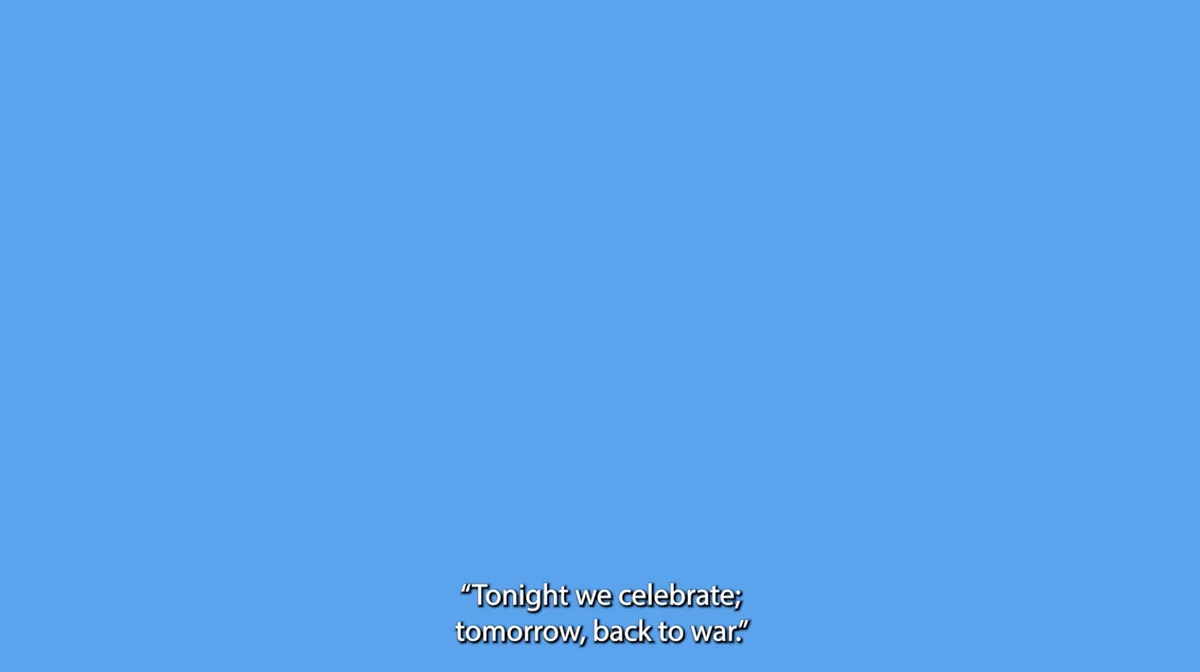
Lord exits the stage, and the last five minutes of Concealed and Denied are projected for ICA’s audience. The screen is now light blue. Lord quotes Rufo’s criticism of the Trump administration’s mass deportation campaign and crackdown on pro-Palestine protesters: “Force is often most effective when it is concealed and denies the left visual symbolism.” Can liberatory modes of image-making arise from the documentary structures that propagate certain images and suppress others – often in service of domination? If the image is one tool of many – only as powerful as its capacity to furnish or destroy the notion of evidence – then Lord's provocation is to move beyond the image, in a call to expand modes of sensory access and sharpen critical analysis. Their practice is animated by a rigorous dialectical politics that announces itself plainly, permissively, and encourages ongoing, collective participation. Images remain useful insofar as their spectators imbue them with contingency, contradiction, and liveness. Much like a political body, any given audience possesses the endless capacity to transform the conditions in which those images are understood and experienced.
Emily Rose Apter: There’s a line of narration in your film After… After… (Access) [2018] in which you respond to the way film students are taught to “show rather than tell”. You say that this “underestimates the performance capacity of telling”. I like how this line speaks to your formal approach, as well as your belief in the medium’s very rich capacity for telling. Can you speak about how you came to feel this way about making documentaries?
Jordan Lord: We often act as if the process of description or captioning is a one-to-one of putting images or sounds into this little access machine, with the description coming out on the other end. But so much of what I’m trying to think about in my work is what else comes out in the process. What does the way someone describes something tell us about them? What does the act of telling tell us about relationships of dependence? So, my interest in telling is not just about enriching the text – I mean, obviously it does also get richer when something is made for multiple kinds of audiences who have a range of different sensory capacities – but it is also about redistributing that dependency, or underlining the way it was already there to begin with. There is a relationship of dependency between the audience and the filmmaker, and the audience and the describer, the access worker. And also, reciprocally, the filmmaker and the access worker depend on the audience to be understood in a certain way. And within a film, there are many acts of framing which mean that things are seen or heard in a certain way.
I think the impulse towards telling came from some resentment I harboured in both undergrad and grad school – this idea that the best way to do something is the most concise way. I think ‘show don’t tell’ as an ideology is about being economical, which usually means the cheapest or the best value.
ERA: Putting the least amount in to get the most out...
JL: Yes, and I’m interested in the opposite proposition: what happens when you allow for the thing to balloon outward and take the time that it takes?
ERA: One thing I love about your work is that there’s a deep and rigorous relationship between making and thinking. The viewer can really feel the way you’re actively wrestling with ideas and making sense of visual reality as a daily onslaught of images constitutes and reconstitutes it. You’re also inviting the viewer – and maybe ‘viewer’ isn’t even the right word here – to participate in a shared process of meaning-making. At what point does thought enter the realm of making?
JL: I think it goes back to the question of dependency. Often when people talk about something being ‘performative’, they are talking about authenticity and power dynamics. By ‘performative’, I mean the performed relation of dependency between audience and maker.
We're doing something, thinking through something, together. Often that thinking starts from what appears to be a contradiction. For instance, I often make work with my family. They are dealing with the effects of disability and capitalism, while also being really attached to ableism and capitalism. Or we might think about the fact that we use the word ‘access’ to talk about something that could feel hopeful and liberatory, but is also deeply reformist and often re-instantiates barriers and limits. It is a process of rubbing two things together and asking, How can both of these things be true at the same time?
And the reason I need to parse this through performance is that it isn’t enough just to ask, What does it mean? For instance, in Shared Resources [2021], my mother says, “You owe it to us to be successful.” The film tries to make sense of this, while literally trying to make it happen for her, to pay off that debt through making something that really takes her question seriously. The film contains all of these conflicting ideas about debt, including things I really don’t agree with. This is one of the reasons I make films.
In Concealed and Denied, I’m trying to work through the magnitude of what we’re up against in terms of right-wing media and propaganda. I’m choosing to be the voice for all of these things that I find reprehensible. The initial idea came from a discussion with my producer and co-writer Abby Sun about how to work with an archive of material that is hostile to us without getting sued. Well, maybe we don’t show it. We just describe it. But then the decision for it to just be all me and my voice... Partially that was a practical thing because I didn’t want anyone else to have to do it – I created this mess, so I’m gonna be the one to do it! – but also it’s about thinking through things that are contradictory. Superficially, Christopher Rufo and I share some aspects of identity – we have both been socialised as white men and both work in documentary – which rubs up against the fact that our ideologies are very much opposed.
ERA: Yesterday you performed a live lecture version of Concealed and Denied. Before we get into the performance itself, can you set the scene a bit? What’s your relationship to Ian White?
JL: Yeah, totally. But, before we go further, it would be good to know: do you care about astrology at all?
ERA: Yes.
JL: I’m a Virgo.
ERA: Okay, I had a feeling! So would some more groundedness in the conversation feel good?
JL: Groundedness is great. But I’m an Aquarius rising, so I can go super far in the air.
ERA: I’m a Capricorn and a Leo rising.
JL: Okay, amazing. Yeah, I’m Leo Moon.
ERA: We definitely have some deep affinities.
JL: Yes! So a lot of how I came to this in-betweenness of art and film was through the institution Artists Space. When I was interning there after college, I joined a reading group that the artist Em Hedditch had started. It turned out to be all about questions of performance. We started with Fred Moten’s In The Break: The Aesthetics of the Black Radical Tradition and then, after many years of reading together, we also began to organise performances.
A few years after Ian White passed away in 2013, we started reading a book of Ian’s writing edited by Mike Sperlinger. Em and Ian had done this interesting project together called A Pattern about being an arts worker and making films at the same time. They gathered people working in film or around questions of reproductive labour, and they would make a film together that same day. I’ve never seen those films, but the idea that filmmaking could be a spontaneous act remained in the back of my mind. What really stuck with me about Ian’s writing or propositions about filmmaking – and maybe this sounds obvious, but it definitely didn’t sound obvious to me at the time – was this idea that, contrary to appearances, film is, in fact, a live art. And the cinema is a space of liveness. This has become really core to my thinking about audiences.
Ian quotes this novelist and film critic Dorothy Richardson. She was writing in 1927 about a woman at the movies – I think she was an archetype, not necessarily a specific woman – who is talking to her date during the movie and doesn’t really care about what’s onscreen. Richardson makes the point that she is teaching everybody else what cinema really is, that it has this capacity to disrupt. She’s changing the experience of the film for everybody. And so even though she seems to be the enemy of cinema, she’s actually its embodiment.
ERA: This is the anecdote you narrate at the beginning of your film, An All-Around Feel Good [2024].
JL: Yes. Ian cites it across his writing. Interruption and disruption were key aspects of his curatorial and performance practice. Apparently, he once had a friend call him in the middle of a screening. I think at times he would get more abstract with it, but there were also these very literal applications of the Dorothy Richardson anecdote. Later, when I started working with audio description, I was excited to think about how it might function similarly. Georgina Kleege is a Blind scholar, who first shaped my thinking about audio description. She talks about how she doesn’t even really like it very much. She actually prefers just to whisper to a friend when she wants to know why people are laughing or something. They end up describing the film to each other, rather than it being this paternalistic speaking-down-to about what’s happening on the screen.
ERA: It reminds me of one of my favourite anecdotes from when I was programming at Maysles Documentary Center. The Center has a long history working with the Black Panther Party Commemoration Committee on their annual film festival, which raises money for political prisoners and their families. At one point we were screening Theo Anthony’s All Light Everywhere [2021], and a bunch of veteran Panthers came to the screening. Maybe five of them were sitting in the back row of a 50-seat cinema. They talked throughout the whole film, adding this incredible additional layer of narration. At times they seemed critical of the movie and suspicious of Theo’s position, but at others they would cheer and laugh and seemed to really enjoy it. I was like, Oh, this is a better movie with the Panther live commentary – I mean, every movie would be, probably. I really love those moments of liveness that you’re talking about, even if there’s no capital-P performance involved.
JL: Yeah.
ERA: But this rendition of Concealed and Denied did have a capital-P performance element. You were onstage, pausing the film, bringing up the lights, and sharing information that has transpired since the film was completed. It made me think about the relationship between information and intervention. What was it like preparing a site- and context-specific version of the film?
JL: It feels really nice to have you thinking alongside me. This project has posed a particular kind of problem for me in the sense that it feels impossible to finish. This is the second version of this film. I presented a version at an exhibition in 2023, with the long title, I Didn't Set Out to Make a Film About Religion, which is a quote from Rufo’s America Lost. This was before Trump’s second term. After he was elected, the purpose of the film changed completely. It started out as trying to sound the alarm about something Rufo and his allies were planning to do. But, after Trump's re-election, it felt like it instead had to respond to all the things they've destroyed and how he helped them to do it.
Also, it’s interesting – and this is not just specific to Rufo – to think about what it is to live through different stages of any political moment, especially one in which the regime is changing. Our form of governance is fundamentally different in 2026 from what it was in 2023, and that’s not just because of the election of one president, but because of the broader rise in fascism as a very viable strategy that is conducted through narrative and cultural means. The disappearing of pro-Palestinian students from spaces of higher education, for instance, blends all of these strategies together. So, I think the film started out as being ‘just’ about the cultural sphere and what we are allowed to talk about, and has since had these different lives. In the performance, it felt generative to make space to take into account all this other stuff that happened after the film was completed.
ERA: It’s funny when you think about how unusual it is for a film to change shape after its completion. Creating a new iteration may actually reveal something quite fundamental about the filmmaker’s relationship to their own political reality. In this sense, the point of the film is not just to be finished and circulate, but actually to exist as some sort of living, breathing thing that should be flexible and dynamic in response to our ongoing political struggles.
JL: Yes, and I think that is my understanding of White’s focus on ‘liveness’. It’s about what is politically possible. What does it mean that we are experiencing this now, and what can we do with it?
ERA: Concealed and Denied does a great job of charting the way right-wing ideologies are cemented in Rufo’s documentary work, and then how those ideologies are achieved more materially through the passing of racist and genocidal policies. I think an important part of what you’re doing in your films is trying to lay out the material consequences or possibilities of art. It leaves me thinking about the role of leftist propaganda more generally. Could the left learn something from Rufo’s tactics?
JL: I’m glad this is the question you're asking. It’s something I’d like to think through with you and with others who are involved in leftist documentary. It’s important to understand these strategies precisely because they are so effective, and they’re also the opposite of anything we would ever want to do. The point of my film – I really want to be clear – is not that we should use Rufo’s strategies or realise the leftist version of these strategies. It is to understand that these strategies have been so effective in reshaping our political reality. It's not enough to say that Rufo’s films are fascist for the reason that they have literally helped to create fascist policies to create a fascist world. I think it’s our responsibility to come up with leftist counter-strategies.
One of those is the strategy of media literacy. I feel I have common cause with filmmakers like Tiffany Sia and her Do Not Circulate, and Payal Kapadia and her A Night of Knowing Nothing [both 2021]. They are trying to understand not just what it is to live through fascism or authoritarianism, but that the way to live through these things becomes instantiated through the use of cameras and documentary. We know, of course, that documentation of political violence can be used to build movements, but these films are also about the ways in which this documentation of political violence is used against a leftist politics. And so I think, for me, the task that we have then on the left – and sorry to lump you in with this ‘we’ – is…
ERA: I’m honoured to be included in your ‘we’.
JL: My preliminary strategy is to understand the way the right gains ground through tactics of restriction. I mean, you can’t organise a revolution if everyone’s in jail, or if people are deported or threatened with deportation and can't leave their homes. It’s not that the existing leftist strategies don’t matter or don't work. Of course they do. Direct action, mutual aid, all of these things… These are the things.
But what can we do as documentary filmmakers? Usually I’m not that didactic about who my audience is, but the audience for Concealed and Denied is specifically people on the left in documentary film. Those are the people I want to see it. It’s not about making us self-flagellate or suggesting that we’ve done something wrong. But Rufo used the exact resources that we compete for while we were focused on trying to make a better world. I still think it’s important to be able to use these tools on our side, not just for analysis but – and this is maybe a boring, passé thing to say – because facts do still matter. An account of what actually happened in the face of a thing that is precisely about dissembling the facts is still important. Something that Tiffany Sia does in Do Not Circulate is understand what it is to live in a world where the circulation of documentary evidence is also constantly put to work against us.
ERA: I have a couple of questions about translating or expressing these politics on a formal level. We were talking earlier about how we both like didactic art. I loved how, at the end of your performance, you were pretty explicit about what your intentions are for Concealed and Denied. The first: to try and understand, collectively, the way forms of violence that are concealed along economic lines undergird more explicit forms of militarised violence. You’re trying to put a finer point on how both types of violence bolster one another and create a fascist political reality. And, more specifically, how Rufo is supporting this project by helping to paper over images of state violence. You make a joke about how Rufo is politically successful despite not being a great filmmaker. I remember thinking, Oh, it feels good to laugh in this moment. But you’re also being serious. I’d be curious to hear you expand on his mediocre filmmaking.
JL: Yeah, obviously I’m joking about Rufo. If we measure success in terms of views or impact, he is really successful. And this is really fascinating, given the documentary field’s obsession with impact. By all available metrics, he’s been extraordinarily successful, while using the oldest, most racist tricks in the book. I don’t necessarily think we’ve been focused on the wrong things in trying to understand that because, from the get-go, documentary has been a deeply racist form. But I think Rufo’s been successful with bad films because he hasn’t been selling his films directly to audiences. Instead, he was making films that would circulate most smoothly through algorithms, through business transactions, through political bargaining. For instance, the Age of Champions film [about the National Senior Olympics] whose broadcast was underwritten by Aetna [a health insurance subsidiary of CVS] is so… cutesy. It feels like one of those Pillsbury commercials selling biscuits. In the way it represents elderly people, it has this very feel-good affect.
Maybe what I’m calling ‘bad’ in the filmmaking is that it is just advertising. There is only one way that it is meant to be read. Actually, it’s related to the stuff that I’m trying to work through in An All-Around Feel Good: media that is produced according to a narrow notion of common sense. I think that’s why Rufo’s been so successful. He’s trying to make his version of reality – elderly people are cute, for instance – self-evident. Self-evidence is the formal strategy. Maybe what I think of as good filmmaking is filmmaking that questions self-evidence and ‘common sense’.
ERA: I wanted to ask about your impulse to refuse the viewer an image. You’ve long experimented with withholding images in your work, sometimes cutting away or freeze-framing or, in the case of Shared Resources, putting your finger over the lens, often when your dad doesn’t want to be seen or filmed in a vulnerable state. In Concealed and Denied, it’s even more extreme. You withhold the image entirely – at least ‘images’ as we typically think of them, though I think you’re also sort of challenging those conceptions. It reads to me as a deep but generative ambivalence about the utility of images.
JL: It’s not that I don’t like images, or think that images aren't useful. If anything, I think this film is about the fact that these images are so useful, but for all the wrong things. And that’s why I felt they needed to be denied.
The practical reason for this denial is Rufo’s racist representations of people of colour, especially Black people. At first I thought these images were all dog whistles for acts of racism. But actually, there’s something in the way the story accumulates: when we see this representation of race here, it is a) a representation of race, and b) a representation of what Rufo wants the audience – who he assumes to be white, I would guess – to feel angry about. And so that was the real reason for not having images in this film: to interrupt that, to prevent these images from circulating again. Abby has been developing this language to talk about Concealed and Denied, which I think is very useful. It’s not just against self-evidence, it’s against the very idea of evidence as the thing that documentary has historically offered us, which is a very juridical formulation – this idea that documentaries should be building a case or something. But why do I need to build a case for you? Of course, I don’t want you to just take my word for it, but I don’t see much point in showing you that Rufo portrays blackness in racist way. It is racist. It is a racist portrayal of blackness.
It’s interesting because it’s very different, actually, from the impulse to withhold the image in Shared Resources. There, I’m actually responding to my dad’s own theory of representation or self-determination. He’s saying something like, “When I see this image of myself, it makes me feel as if I am worthless, and so that means other people will too.” Of course, I think it’s ableist for anyone to be seen as worthless. But just because I think that doesn’t mean that I get to suddenly make him feel better about it. When he sees those images of himself, that is still his reality. And so I chose to withhold those images, specifically the ones where I represented him in a vulnerable state. It prompted such an interesting set of negotiations between us. For me, it’s a really big concession to ableism to say that a sick person is inherently worthless, or that representations of sickness are evidence of someone being worthless. But, for my dad, that is what it is. I still have to respect that in some way. The reason that it’s not a black screen or that there’s no image is that it was important to me to show that I’m occupying an in-between there – literally, but also politically or conceptually.
ERA: Regarding this ambivalence about the power of images, it’s really difficult not to immediately think about the genocide in Gaza, which is something you often address in the live additions to Concealed and Denied and An All-Around Feel Good. We’re so inundated with visual evidence of brutality against Palestinians that, if images had the power to stop a genocide, they would have done so already. It makes you wonder if these images of monumental state violence end up doing something closer to the opposite: entrenching it, naturalising it.
JL: Absolutely. And that’s the confusing thing. We have so much evidence that images of violence cause people to shut down rather than take action. I think it’s important, though, to think about the many factors that have made that true, which go beyond the images’ existence and are more to do with how they are seen. I’m thinking of the obstacles that mediate and interfere with their circulation: their censorship in mainstream US media, their algorithmic sorting (itself a kind of surveillance) for a self-selecting audience, and their filtering behind blurry grey windows that warn of explicit content. But then we also have evidence that images of certain people dying in certain ways on camera can literally start and mobilise movements – some of the most active and organised that I’ve experienced in my lifetime. Journalists have also been murdered for documenting the genocide; their murder shows that these images remain threatening to those in power. So it can go both ways.
But what falls under the responsibility of documentary filmmakers? This is the central question. And I think that when we only think about it from the side of images of death, or of things that either cause people to turn off or to turn on, we miss all of the ways in which images are being used to turn our enemies on. Whether we call that a dog whistle or not, these are images that are meant to activate. They’re images that are meant to flip a switch in an audience’s mind to act in a certain way. And they’re extremely effective at doing that. I usually get annoyed when people call Rufo an activist – it’s a common way that he gets covered in liberal media – but to the extent that he actually causes people to do something, he is one.
ERA: It makes me think about what we were talking about earlier. If we, on the left, are not really concerned with why people believe the things they do, why they get deeply attached to the things they get deeply attached to, then we’re not going to be able to expand far beyond the people who are already with us. I had a conversation with a friend about abortion recently; about how those of us who are pro-choice see ourselves as having the correct position: it’s self-evident that people should have autonomy over their own bodies, etc. But for someone who believes abortion is literally committing murder… This is such an intense and deeply felt belief. And that is not a belief that I have to feel, or even contend with, very often. And you can’t convince that person otherwise just by saying, “No, you’re wrong. Don’t feel that way.” And I think there’s a lot of resistance on the left to engaging seriously with oppositional points of view. To me, doing so obviously doesn’t mean you’re endorsing their beliefs or compromising your own.
JL: Yeah, absolutely. Someone came up to me after the talk yesterday and asked me about the part in Rufo’s America Lost where he says, “I was born into the American dream.” They asked me, “Do you think that this is all because of the American dream?” I said, “I actually do, yeah.” Their question might have seemed oversimplified, but I think there’s a very real and simple answer to the question of why hundreds of thousands of people watch videos full of flagrant anti-immigrant lies and think that this is true. What allows someone to form such a preposterous faith in poor evidence? How do people come to defend the things that hurt them? And I’m not trying to let racism off the hook, but I don’t think we’re going to eliminate it until we understand how it comes to be entrenched and defended.
In the case of Shared Resources, that’s the debt system, the banking system, the idea that there are good and bad debtors. In the case of my father, when you’ve invested 50 years of your life into trying to be the good kind of debtor, you also start to believe that there is such a thing as a bad kind of debtor, and then you start to feel angry at the thought that other people need things. And even when you need things, you decide that that makes you bad, rather than that making the system bad for making you feel like you need those things in the first place.
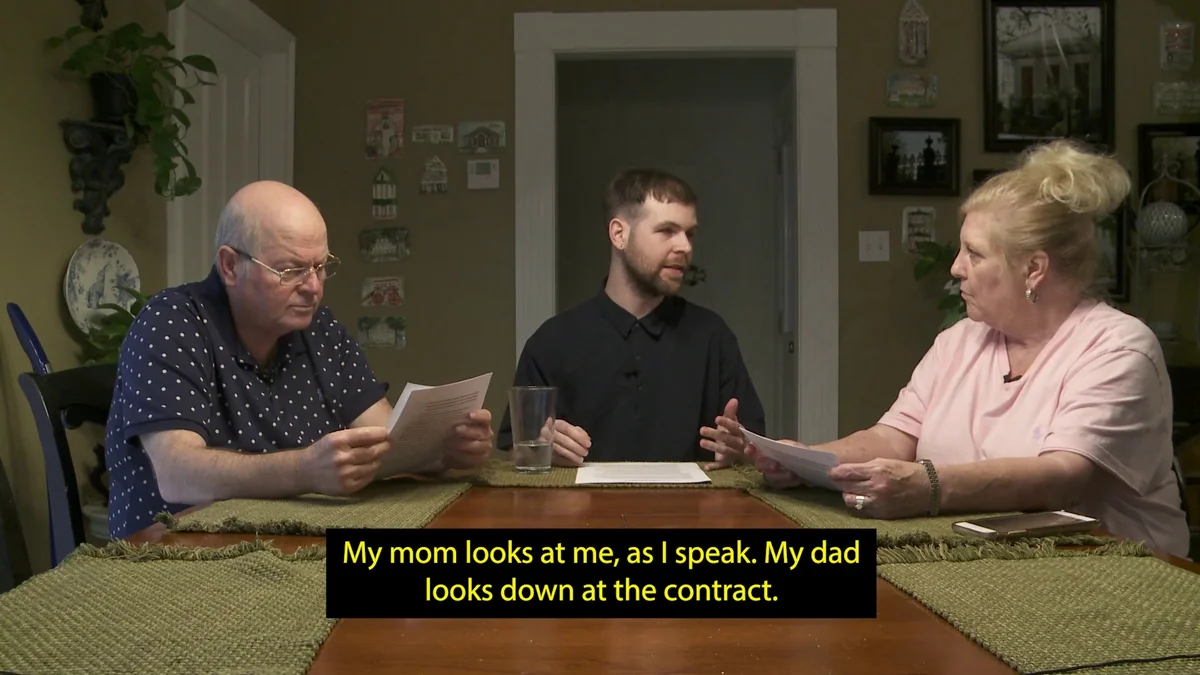
ERA: I was hoping to talk a little bit about your parents; I think it is very connected to what you’re saying. In Shared Resources, there’s such a deep, palpable stream of love and care – and indebtedness – that flows between you and your parents. Narratively, they play a role in offering differing perspectives that present tension around what you believe to be true and how your audience receives information. I’m thinking about your mom’s audio descriptions. You have her describe the images that the audience is being presented with, and her descriptions are just… totally incredible. Not only do they offer an additional layer of subjectivity, but she’s actually describing things that the viewer can’t see: her own deeply personal thoughts, feelings, memories, etc. And then your father presents a more challenging, stubborn perspective. He represents refusal. His impulse is often to deny what you’re saying or what appears on screen. It’s such an amazing foil.
JL: Yeah, that's accurate.[Laughs.]
ERA: In Concealed and Denied, your parents don’t explicitly have a role but, in your performance, you do invoke your father as a way of talking about right-wing influencer Nick Shirley’s debunked viral YouTube investigation about immigrant fraudsters. This was something that your father had seen and believed to be true, and this leads you into your own line of inquiry. In your films, how do you balance your parents’ desires and beliefs and the deep ideological disagreements you have, while also caring for the relationships and honouring your own political and artistic commitments?
JL: Yeah… Aggghhhhh!
ERA:[Laughs.] Do you need another Negroni?
JL: Maybe, but I don’t know if it’ll help me answer the question any better! I think this is the question for me. I think you’re perceptive in saying this question is in all of my work. In An All-Around Feel Good, my parents are there because I’m trying to ask almost utopian questions about who we could be if we expand this idea of 'common sense' into an ‘uncommon sense’: into many different ways and abilities of perceiving things.
But then there’s also a really dystopian version of that: experiencing media with people you're deeply ideologically opposed to, which was often my experience growing up. So much of what has made me a filmmaker is that much of my relationship with my parents, who are conservative and Christian Zionists, and who really have such a diametrically opposed worldview from mine, has been watching things together. That’s what we can do together. Either we can fight about politics, or we can try to find something that we can all watch. In An All-Around Feel Good, it is about the deep feeling of confusion and conflict that comes up when it feels like you’re watching something wrong: something that feels good to everybody else and to me could not feel worse. I guess that probably happens to my parents too. So, yeah, they’re in everything.
When it comes to political work, I often feel this drive to think about an opposed political position. What could convince somebody to change their mind or think differently about this? I think this was the very naive impulse in Shared Resources. But that was the reason I made the film, to respond to my mother’s remark about me owing it to them to be successful. So, the question for me became: What if you didn’t have to feel like you were a moral failure for being in debt? That really was the simplest, most basic question. And then, of course, that film became just this big lesson in humility, in that it’s an absurd thought that you could change anyone’s mind about that – especially by making a film with and about them. So that shifted the terms of how my parents appear in the work. The drive is no longer so much about trying to change their minds – and, you know, it stopped being that by the end of Shared Resources – and more about the fact that I love them and they are a deep part of me and I don’t ever want to stop being in relation with them in spite of how difficult that can be.
I don’t think that Rufo is right that leftists don’t understand anything about what conservatives think. On the other hand, I do think that it is dangerous to lose sight of why they think what they think. And why they think what they think includes how they get their information. And how they get the information that has convinced them of these lies. So I actually really need to learn about how right-wing media makers like Nick Shirley and Christopher Rufo get hundreds of thousands of views on extremely poorly made documentaries full of absurdly flagrant lies about immigrants. And my dad believed them. That tells me something important about what we’re up against.