
Hiding in Plain Sight: Jenny Brady on The Glass Booth
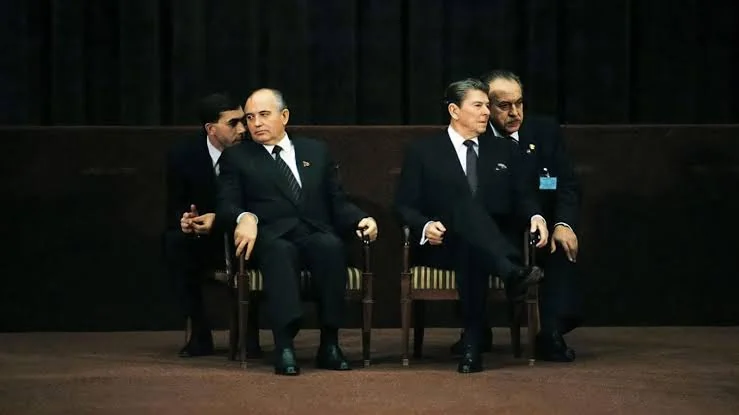
Jenny Brady’s The Glass Booth (2025) opens with archival footage of Mikhail Gorbachev’s motorcade arriving at the Geneva Summit of 1985. A cluster of paparazzi cameras burst to life with the staccato sound of rapid-fire clicks, while an anxious electronic pulse reverberates like a radar on the soundtrack. That year, at the height of the Cold War, the world’s eyes were firmly fixed on Reagan and Gorbachev, as pressure mounted on these diplomatic negotiations to de-escalate the arms race and diffuse the threat of nuclear war. As the two leaders take to the stage in Brady’s film, the viewer’s gaze is redirected towards the figures behind them. But that effort of refocusing actually frustrates clarity: the camera’s zoom distorts the features of these background figures, rendering them blurry and indistinct. We see them in fragments and glimpses: faces alert and watchful, hands clasped together or clutching the edge of their chairs, mouths whispering into the ears of the more recognisable interlocutors.
The Glass Booth contemplates the duality of the interpreter, ubiquitous yet concealed. Brady’s film grounds us intimately in the sensory world and perspective of this figure, whose labour can be found imprinted not just within the margins of political history but across many of society’s foundational institutions. Its sequence of vignettes comprises archival and contemporary footage, the more recent material including interviews with interpreters who operate in all corners of contemporary civic life: government offices, schools, shops, banks. These interviews gesture at the breadth of responsibility and jeopardy that the role can encompass, with a sense of strain and fatigue apparent in many of the responses. “Sometimes I don’t find the right words… and it’s stressful,” admits one of several child interpreters in the film. Together, the testimonies amount to an evocative and thoughtful study of a figure whose hidden labour is performed in plain sight.
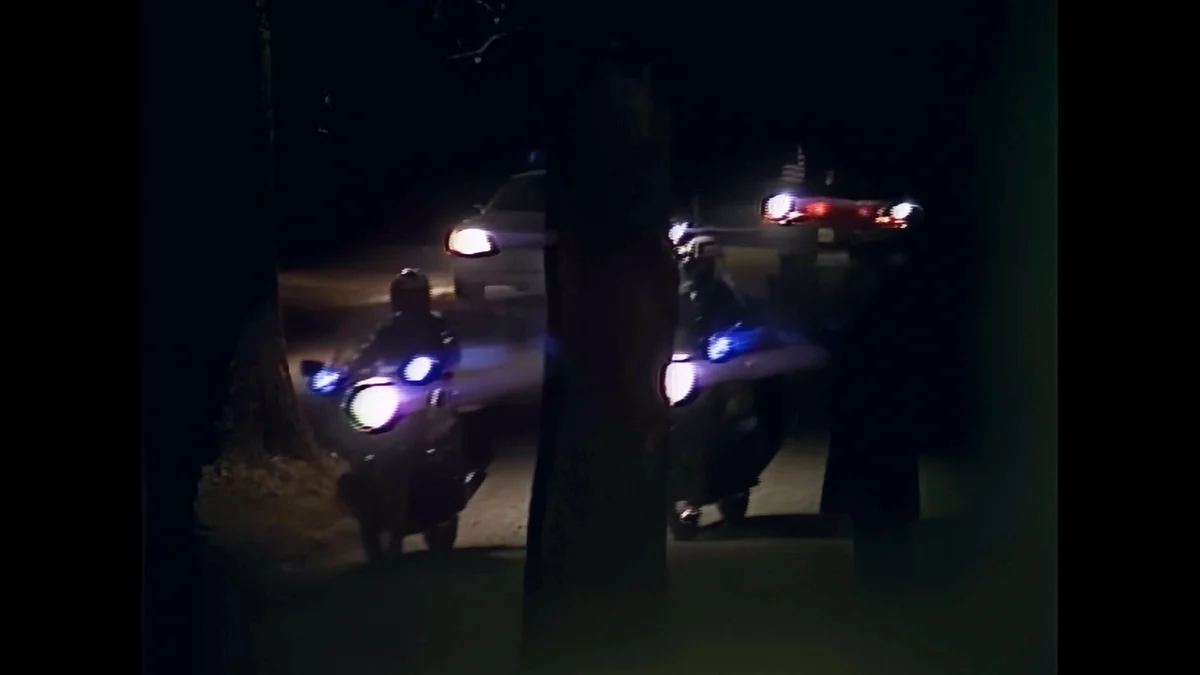
Amid Brady’s careful assemblage of portraits, the image of the car emerges as a somewhat unexpected motif. It appears in the opening and closing frames of the film, beginning with the footage of Gorbachev’s blockade and ending with a dashcam recording of a car accelerating at breakneck speed down a pitch-black country lane. Cars also appear in brief interludes between the interview vignettes, but this time moving in slow motion on everyday streets. These images are scored by the reverberant swell of a lone orchestral note from a saxophone or viola. The resonance of the car is extrapolated by one interviewee, a NATO interpreter and rally car driver, who describes a system he has devised to allow interpreters to perform under stress, similar to that of a car operating with reduced function to avoid total breakdown. Additionally, he advises interpreters working in difficult circumstances to “build as many automatic reflexes as [they] can” so that interpreting becomes like “an automatism” or “muscle memory”. Brady’s film examines speech as labour performed under pressure and considers the toll this effort takes on the figure at the centre.
Brady’s body of work reveals a preoccupation with the limits of speech and language: in her films, something is often ceded in the fraught negotiation of understanding, and communication frequently arrives at an impasse – is interrupted or broken down. “What constitutes a possible language?”, the voiceover of Irene Pepperberg, a scientist who taught human language to a parrot, considers in Wow and Flutter (2013). This film is one of several early portrait studies that feature animals or pre-verbal babies and contemplate and interrogate what language can do. Receiver (2019) and Music for a Solo Performer (2022) take patchwork forms, assembling archival footage and found audio with abstract imagery. They both feature systems of technology that mediate communication, such as telephones and vocal synthesisers. Receiver exposes the frailties of such systems through the inclusion of found audio in which the crossed wires of a telephone precipitate a tense confrontation. The Glass Booth continues these inquiries, examining speech as an act of labour that is often performed under pressure, susceptible to volatile environments, technological frustrations and human vulnerability.
The Glass Booth screened as part of a combined programme at Open City Documentary Festival in April 2026, alongside Sophie Sabet’s Return of the Bright Night and Basma Al-Sharif’s Morgenkreis. Jenny and I sat down to discuss the film in between the first and second of these screenings.
Deidre McAteer: What inspired you to make a film about interpretation?
Jenny Brady: In 2019, I made a film, Receiver, that was looking at the history of the telephone; it touched on Alexander Graham Bell and his contentious relationship to the Deaf community. I was working with two young Deaf girls on a film set and we had an ISL [Irish Sign Language] interpreter facilitating the shoot. I was really struck by the three-way interaction we had. It was probably quite imperfect, and it was frustrating at times. We had to slow down the pace at which we were communicating. As I often speak very fast, it made me aware of my own communication style. This encounter sort of distilled communication in a way that was humbling and which asked for patience.
After that experience, I knew I wanted to think about this figure of the interpreter and the incredible work of interpretation; I wanted to think about making it visible through film. Dramatically speaking, it’s an interesting challenge to bring this figure – who is usually hidden but embedded in so many of our public institutions – to the foreground.
As I began researching interpreting as a profession and practice, I realised just how central it is to everyday life. Interpreters are present in courts, police stations, hospitals, schools, banks and social services. They make these institutions function. What’s fascinating is that interpretation operates on such different scales – from high-level geopolitics to the most intimate domestic situations.
A lot of interpreting happens informally. Sometimes, children from migrant backgrounds translate for family members at doctors’ surgeries, banks, or when accessing social services. A friend of mine, who’s a nurse, said that she would never allow a child to interpret in a clinical setting; she would always insist on a professional interpreter because it is simply too much responsibility to put on a child. But these things happen out of necessity.
In Ireland, we have significant problems when it comes to state regulation of interpreting. The courts often contract large translation companies and there is no guarantee of quality. In terms of dialect and specificities, someone has to be versed not just in the language but also in the context. Things can slip – and in situations where the stakes are high. A few years ago, for example, a couple were accused of FGM, and were later cleared after it emerged that large parts of their defence had been mistranslated.
DM: The Glass Booth is composed of vignettes that allow us to access different contexts of formal and informal interpretation. How did you approach sequencing the vignettes in the film?
JB: I often want to cover a lot of ground. While these different vignettes by no means capture the range of interpreting contexts or styles, I wanted to have a sense of the various scales on which this work is operating. And they really are quite wildly different, from the super domestic to the super public.
When it comes to editing, I tend to work in quite a linear way. I often think of the opening few minutes of a film as a kind of statement of intent – they establish, or at least hint at, the dynamics that will unfold over the course of the work.
When I came across the archival footage from the Geneva Summit, where Reagan and Gorbachev met to discuss nuclear disarmament, I was really struck by the tonal quality of the interpreters’ voices. There’s an almost staccato rhythm to them, and I’m always drawn to the musical qualities of speech. But the footage also makes visible – or perhaps audible – the very particular position that interpreters occupy on the political stage. They’re the bridge between different languages and cultures, but because the medium in question is a human being, there’s always the possibility that they could intervene, however subtly, or distort the message.
Layering Morton Feldman’s Voices and Cello [1973], featuring the American vocalist Joan LaBarbara, over this archival footage introduced another competing voice into the scene. I was interested in what happened when those different voices began to overlap, both sonically and within the political context of the meeting itself, with its many different actors and competing forms of communication.
DM: I wanted to talk to you about creating the soundscapes of your films. Do you collaborate on the soundtrack?
JB: I generally build up a bank of sound and music as part of the research for each film, and I also keep a document where I note down pieces that might be useful for future projects. Sometimes I'll create the sound design from scratch with my partner, but since having a kid, that's become something of a luxury.
For me, sound is as important as the visual and textual elements of the work. It grounds the film, gives it weight, and can open up its world in unexpected ways. There's still something extraordinary about what happens when the right piece of music is combined with the right image.
DM: Do you work from a mood board when you’re building a soundtrack?
JB: Yeah, I do. They're never particularly elaborate, but I think of them a bit like a jigsaw. I might start with three pieces of music that capture a particular scene, tone, or feeling and then ask myself what else the film needs, allowing different tensions and relationships to emerge.
I felt incredibly fortunate to be able to re-use Delia Derbyshire’s music, originally commissioned for About Bridges (1975) by Madelon Hooykaas and Elsa Stansfield. In that film, the artists interview the workers who clean, paint and repair Amsterdam’s bridges. As well as the sonic qualities Derbyshire’s music brought to my film, I was interested in the subtle thematic connection between bridges and interpreters. Both create connections between people and across cultures. Licensing the music from Madelon Hooykaas also created a relationship with her, and I was interested to hear her thoughts on how Derbyshire’s work was being used in a completely new filmic context.
DM: We see the image of a car recur throughout The Glass Booth, sometimes in slow motion, sometimes speeding down the road. What inspired these images?
JB: I was actually preparing for my driving test while making the film. I’d left it pretty late in life to start driving, and honestly, I never thought I’d pass. But I did – first time! So outside of filmmaking, this idea of achieving some level of mastery, or even just competence, at driving was very present in my mind.
There’s also something inherently cinematic about driving. You’re looking out the car window, a particular piece of music comes on the radio, and suddenly the image and sound connect. I started thinking about the car as another kind of ‘glass booth’.
It became a device to move through different scenes and interpreting contexts in the film. When Chris, the NATO interpreter, told me about his hobby as a rally driver and how the intense concentration and split-second decision-making involved feels so closely related to interpreting, it all started to fall into place.
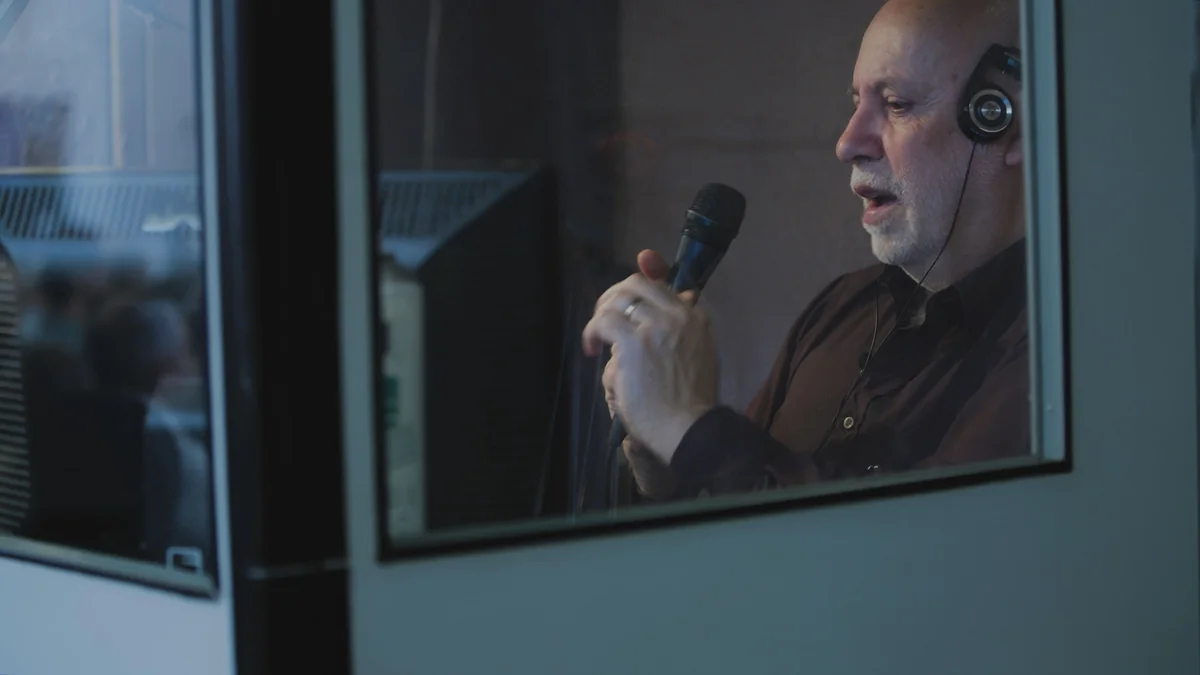
DM: The car allows you to explore the relationship between cognition and muscle memory, which Chris discusses at the end of the film when he describes interpreting as becoming like an automatism. Is that his footage at the end?
JB: Yeah, that is his footage. He showed me it when we met, and I knew it was the missing piece. He is an amazing person. He also runs a charity that offers free legal and financial aid for refugees in Brussels, and he knows there’s a direct link between his life experiences, including being a rally driver, and his interpreting work. He’s an amazing mediator of his own life.
DM: Can you talk to me about the decision to include the children taking part in the Young Interpreters Programme: the buddy system that pairs school children who have recently arrived in Ireland with a child who speaks their home language in an effort to help them settle in.
JB: I could make a film just about child interpreters. When I started looking into the different spaces where interpreting happens, I came across the translation work done by children, often from migrant families, on behalf of adult family members. I hadn't realised how common it is. They might interpret at parent-teacher meetings or help family members access social services, set up bank accounts, or navigate healthcare. It's work that happens informally and it's generally not recommended because of the responsibility and emotional pressure it places on the child.
During my research, I watched a documentary about teenagers who interpret for their families. The filmmakers measured their cortisol levels and they were through the roof. So this is a complex and, in many ways, contentious aspect of interpreting, but it felt important for the film to capture it.
When I came across the Young Interpreters Programme in Dublin, it offered a very different way into this area. Here was a school-based programme where children support newly-arrived classmates who share their home language, but within a structured environment where they're supported and protected, and where their linguistic skills are recognised and celebrated. I worked with the programme for several months, and the children became central to the film. They also helped deepen my thinking about how interpreters are represented in visual culture and how you might begin to develop a film language for interpreting itself.
I was thinking about L. P. Hartley’s novel, The Go-Between. In it, a kid who stays with this very wealthy friend from school for a summer unwittingly ends up being a messenger for the friend’s sister, who’s having an affair with the local farmer. It ends quite tragically. It’s all about the loss of innocence. Thinking about the child go-between was really central to this film.
DM:I wanted to ask you about the moments when you are in the film – during the interviews with the Young Interpreters, for instance, when your voice interjects from outside the frame. Can you speak about your decision to include those moments?
JB: So there are two interviewers in that scene: me and the person who runs the programme. As often happens with children, a lot of the answers to the interview questions were just one word. In trying to coax more out of them – sometimes even suggesting how they might answer – it became clear that we were, at times, reproducing the same power imbalance that exists in child interpreting, where adults are literally putting words into children's mouths. In the edit, I wanted to draw attention to that dynamic, and to acknowledge my own role in it. As the filmmaker, I’m not outside of those power relations.
DM: I think there is also a sense of implicating, or at least involving, the viewer as well. There’s a moment in the middle of the film when a woman is applying for international protection and, as a viewer, I was wondering whether I was intruding on a real, private moment. Then you reveal that it’s a practice run.
JB: Yes, I think part of this dynamic comes from the fact that so much interpreting happens in extremely intimate and private situations. That was certainly a challenge when it came to finding places to film, but it also raised larger ethical questions around whether cameras should be in those spaces at all. The staged role-play scenario allowed me to explore the tension within that. I wanted to create a moment where the viewer might initially feel they were witnessing something private or intrusive, and then disrupt that assumption by revealing that it was a rehearsal.
DM: During this training, they explain how they have to adopt the ‘I’ when interpreting. It’s an interesting moment of reflection on subjectivity, and how it relates to the labour, and emotional labour, of interpreting.
JB: Yes, I found the use of the first person really fascinating. It creates a kind of ambiguity around the interpreter as a figure or character, which I thought was really interesting from a filmmaking perspective. The first person is primarily used to improve accuracy, because it helps the interpreter maintain the speaker’s tone and intent. But I immediately started thinking about the psychological and emotional impact of doing that work – particularly when interpreters are retelling accounts of traumatic experiences. Chris was telling me that therapy is routinely accessed by interpreters because they can experience secondary trauma through their work. They are constantly absorbing other people’s experiences while also having to maintain a professional distance.
Interpreting is an incredibly old practice, but its professionalisation is closely tied to the Nuremberg trials and the development of simultaneous interpretation technology. I discovered that one of the interpreters at Nuremberg was a woman who had survived Ravensbrück concentration camp. I found that extraordinary: the ability to return to a situation like that and perform that role seems almost unimaginable. There must be such a complex split in subjectivity happening there. How can you remain neutral and objective in that kind of situation?