
Things That Can Never Be Assimilated: Basma al-Sharif on Morgenkreis
In Basma al-Sharif's Morgenkreis (Morning Circle, 2025), the camera adopts the point of view of an immigration officer, circling an Armenian father in his flat in present-day Berlin. “WHY DID YOU COME TO GERMANY?” demands an unidentified voiceover in German, its hostility amplified by the capitalisation of the subtitles. “HAVE YOU TRIED LEARNING GERMAN, MR ABRAHAMYAN?” The interrogation continues. The camera tracks the father’s movements as he carries out his morning routine, and scans the flat for evidence of his (un)successful assimilation into German culture. It pauses on a framed photo of his son. “YOUR CHILD… HE IS IN KINDERGARTEN. IT MUST BE TIME FOR HIM TO GET UP.” As if in response, a second disembodied voice shouts out in untranslated Arabic; “صحصح وإوعى تنام، بنحييّ البغبغان”. The camera swivels to the television, which plays aerial footage of Gaza from before October 7.
Such collisions between seemingly disparate timelines and geographies have become hallmarks in the work of Palestinian artist-filmmaker Basma al-Sharif. Raised between France and the United States, but a frequent visitor of Gaza for most of her life, al-Sharif examines the long, ongoing occupation of Palestine from up close and from afar, toggling between these modes through disorienting formal ruptures. In O Persecuted (2014), hushed fragments from a Palestinian militant film climax into a super-speed montage of bikini-clad Israelis partying against a brash techno track. Al-Sharif’s films refuse to represent violence directly. While images of violence may provoke empathy in the viewer of other films, absolving them of responsibility, al-Sharif instead creates sensorial experiences that elicit a lingering discomfort and unshakeable sense of complicity.
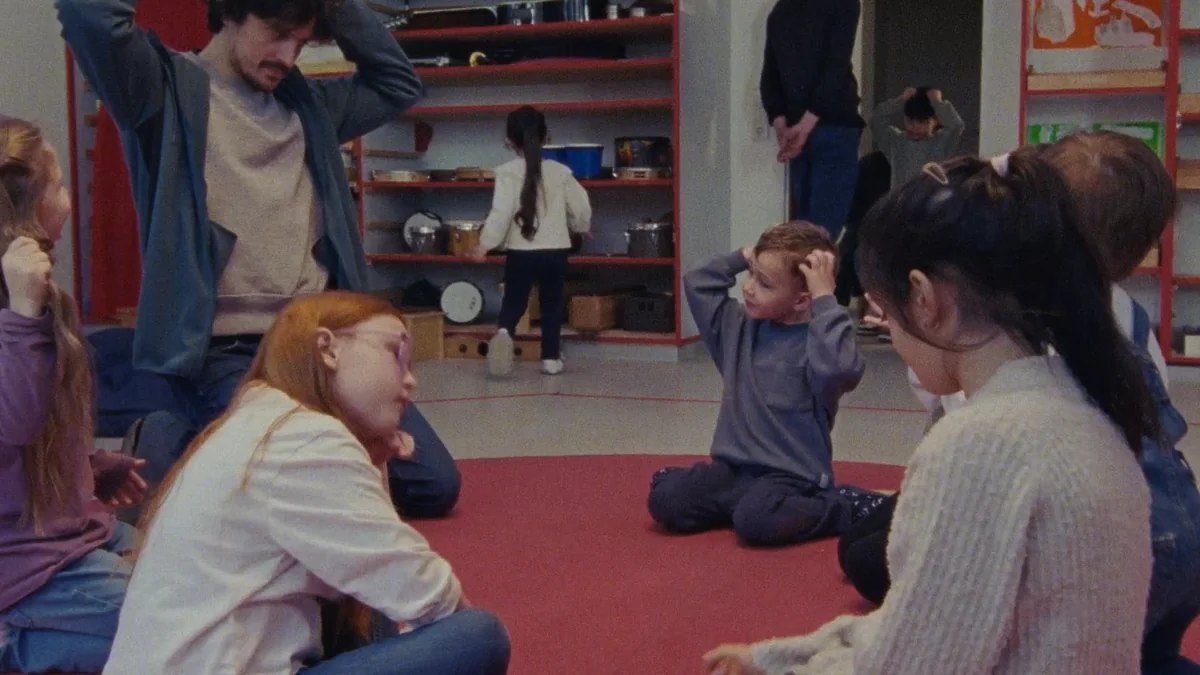
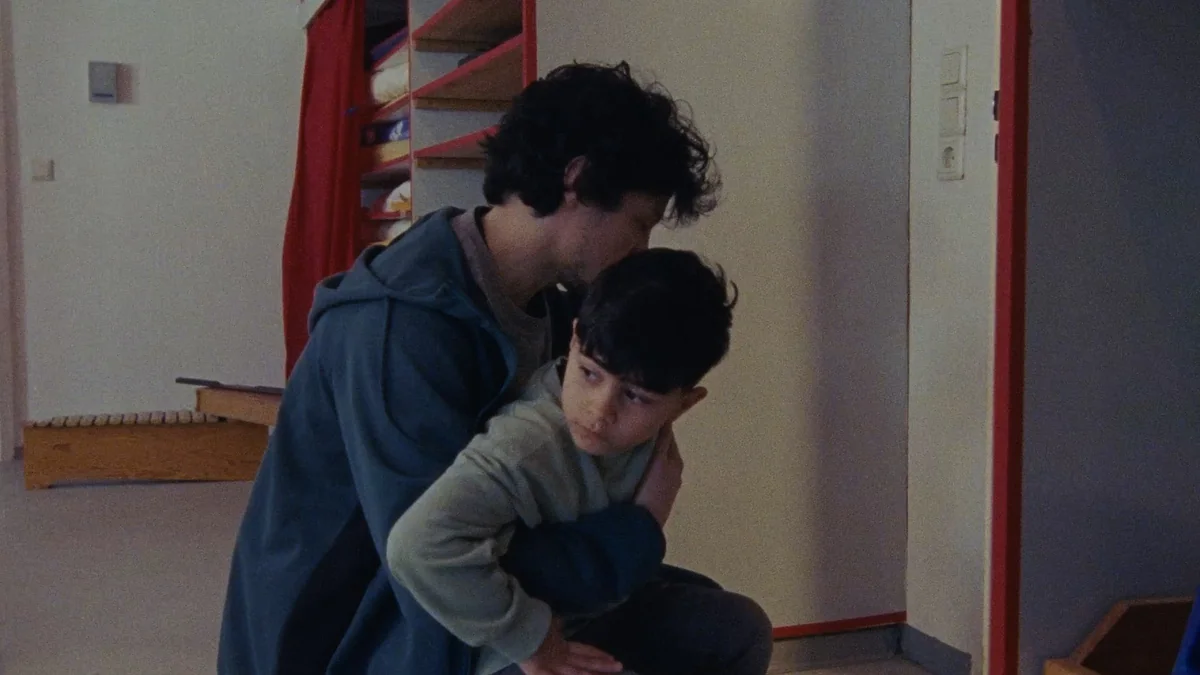
Morgenkreis widens its frame from the genocide in Palestine to locate a cognate form of dehumanisation in the treatment of migrants in Germany. As Abrahamyan and his son, Adnan, leave their apartment and arrive at kindergarten, the interrogation persists. Scenes of children playing are cross-cut with a black screen emblazoned with questions. “DO YOU IDENTIFY WITH GERMANY?” evokes the German state’s requirement for citizenship, which, as of 2024, requires applicants to declare their belief in Israel’s ‘right to exist’. It came as no surprise that the screening of Morgenkreis at Kunstakademie Düsseldorf in January 2026 was met with protests from public officials and a pro-Israel advocacy group, who were outraged not by the film but by the artist speaking out against the genocide on Instagram. In the film, conditional belonging to the nation state extends to the seemingly benign institution of the kindergarten, where the titular morning circle takes place. Morgenkreis in German, is a daily ritual in German daycare centres in which children and teachers discuss the forthcoming day as a way of transitioning from free play to more structured activities. As such, it represents an ostensibly softer form of assimilation for the immigrant into the dominant culture.
In Morgenkreis, resistance to hegemonic ways of seeing and listening finds its form in opacity. When father and son watch the news in Arabic, al-Sharif refrains from translating the newsreader who is reporting on the bombing of Gaza; non-Arabic speakers can comprehend only the image, the glittering expanse of a coastline. It’s an alternative approach to the one taken in her film, Farther than the Eye Can See (2013), where she dubs over a woman’s account of her family’s forced displacement during the Nakba with an American voiceover that butchers the Arabic words. In Morgenkreis, intimate details are reserved for those more likely to know these atrocities intimately, in a rejection of the incessant broadcasting of that violence to the wider world. As such, this film, which contextualises the genocide in Gaza within larger cycles of European colonial violence, can be seen as an extension of a statement al-Sharif made about her work in 2015, in which she said that she was ‘shifting away from looking at Palestine through the world, to look at the world through Palestine’: connecting the Palestinian struggle to other struggles against imperialism.
While Morgenkreis marks a more narrative turn in al-Sharif’s filmmaking, its narrative gives way to formal experimentation in the film’s climactic finale. Abandoning the German ideal of morgenkreis, she assembles her own morning circle. As Abrahamyan leaves Adnan at kindergarten, Maurice Louca’s electronic track ‘Salute the Parrot’ creeps in. The Egyptian musician’s lyrics might be recognisable to the viewer: it is the same line of Arabic that seemed to respond to the immigration officer. This time, however, there are subtitles: ‘WAKE UP, DON’T FALL ASLEEP, WE’RE SALUTING THE PARROT.’ Percussive beats pierce the camera’s 360-degree pans around the room, building up to a kaleidoscopic carousel in which superimposed images of Palestinians returning to North Gaza intersect with the children, who are running and dancing, unable to be contained. An ouroboros with defiance as its centripetal force, its dizzying jubilance outpaces clear definition: a potent assertion that there are things that can never be integrated or assimilated.
We sat down with al-Sharif at Open City Documentary Festival, where Morgenkreis screened, to discuss the film and her approach to making such luminous and confrontational works.
Emily Jisoo Bowles: How did Morgenkreis come about?
Basma al-Sharif: I live in Berlin, and my son was entering kindergarten. In the beginning, you’re supposed to bring your child to the kindergarten and slowly acclimatise them to the environment. When you eventually leave, they often have a very dramatic moment of separation anxiety, where they scream or cry. It’s just part of early childhood development. We had immigrated to Germany from Cairo when my son was a year old, so separation anxiety is very real for the both of us. But I was really stunned that there was no sensitivity on the part of the kindergarten caregivers towards us as foreigners. I don’t speak German, and I grew up moving around a lot, and now my child is experiencing something similar. Kindergartens, which are funded by the state, receive extra money for every child of parents who are foreign, in order to help them integrate better. But I found that we were treated as invisible and homogenous. So I started developing this film around the idea that separation anxiety mimics the process of migration in which there’s the impossibility of returning to our home countries, usually because of conflict. Not that adults have separation anxiety in the same way children do, but as immigrants we have internalised it. I started doing research on this, and then the genocide started. I didn’t really want to make this film anymore; it seemed really stupid. I needed to figure out how to deal with what was happening, but I also didn’t want to deal with it.
Rebecka Öhrström Kann: How did you feel about working in the cultural sector after October 7?
BA: I felt very discouraged by the way the cultural sector betrayed Palestinians from the beginning of the genocide. But, slowly but surely, with encouragement from friends, I started to see how much this film had to do with the genocide. I kept thinking, How is it possible that people are being massacred? Before October 7, news of what was happening in Palestine wasn’t always reaching the mainstream. Now it’s very much in the mainstream, but dehumanisation isn’t just happening there. It begins somewhere else. I could see the connection to how Europeans homogenise everything, pretending that there’s no racism and that they treat everyone equally. They don’t acknowledge if someone is coming from a war zone, and all the work of integrating into society is put on the immigrant. So I started to develop the film with this in mind; to show where dehumanisation begins and how we can look at it as the function of the state, and how that invades our most intimate spaces, like the home, as well as seemingly benign spaces, like the kindergarten. I wanted to make a film that wouldn’t necessarily show violence, because we were already seeing so much of it everywhere. Instead I thought that it was important to show how that violence begins in Europe, and to do it in this poetic, choreographed, and lush film that would be very visceral; something you would experience rather than have it explained to you.
RÖK: The shift into a more linear narrative is a change from your earlier films like Home Movies Gaza [2013] and Deep Sleep [2014] which take a more non-chronological approach in their structure.
BA: The film is still quite experimental, but it was my first real attempt at doing something much more narrative and at really starting to work with actors, while still being informed by the visual language I’ve been developing for the last 20 years.
Before the genocide, the purpose of my work was to make things more coded and experimental; it was about requiring more from the audience to engage. I don’t want to invalidate work that is informative and descriptive – that can have immense value, too – but, for me, it has always been important to create lyrical work and things that were more satirical and poetic. It was a political decision because I felt like I had privilege and access to all these languages and resources. I could go inside Palestine and outside – at least before the genocide escalated. I have a particular position that I can operate from. So I didn’t want to make a straightforward documentary or a militant film. I wanted to make something poetic and conceptual that forces people to engage and bring discourse about Palestine into spaces like the art world.
When I started making work, there weren’t many Palestinians working in the experimental film scene and there are tons now, which is great. Experimental film was the form that made sense for me at the time. But, after the genocide started, I felt like there was no need to be so obscure. I want to be much more straightforward, to tell this story and be clear about what I'm getting across. I think the moment of being obscure is over now that everybody knows what's happened, or where our struggle was born. It's important to use narrative to tell the story that I want to tell.
EJB: Did you script everything in advance, since you were working with a bigger cast and crew? Was there still space for improvisation there?
BA: We shot the film on Steadicam, which is much more complicated to edit because the camera is constantly moving. My DP, Simon Veroneg, with whom I’ve worked before, allowed me to improvise and was the key to how the film found its form. I had a firm vision but didn't know exactly how to execute and he was brilliant at bringing that to life. I scripted the dialogue and camera movements simultaneously. A scene would unfold and the camera would move around it, and then I would decide how to edit it. Morgenkreis is definitely my most scripted project to date, but we could still throw out an entire scene if we didn’t need it, or reorganise how it unfolded. Especially with the last scene. I always say that it was scripted like a dance, which sounds cheesy. But I needed to give myself more flexibility because it was the first time I was directing and I had to think more about the finished form and not have it be as process-based as most of my work is.
RÖK: I like that you describe the final scene as being “scripted like a dance”. Earlier in the film, the camera has this cold and choreographed control to it as it pries into the family’s morning.
BA: That insidious feeling of the state always watching us immigrants, is something that I really wanted the audience to feel. You enter and move through the city in this lulling trance. You feel passive, and then suddenly that shifts and you’re in someone’s apartment in the perspective of the interrogator. You’re never quite sure if this person is actually in the room or not, but as the viewer you are in their position regardless, and it doesn’t matter whether or not they’re there. You’re now in this person’s apartment. You’re now listening to these questions. You’re now aware of the kind of lens people are put under because they have moved from one place to another. None of the questions have to do with that person’s background; they all have to do with whether or not they get to stay, or how well they’re assimilating into the culture.
The decision to use Steadicam was very much based on this. The camera’s constant fluid movement can very quickly shift what our perspective is on a scene. At times, the viewer might feel they are floating without a fixed sense of someone being behind the camera; at other times they are at a child's height; at others in the position of the interrogator. When you’re in the kindergarten, the camera is almost invisible. It drops down to the level of the children, to their perspective, and suddenly it’s caught up in the whirlwind of that scene. So, it was very intentional, and so was shooting on film, because film is just more lush. There is more grain, so your eye is more willing to sit and linger. It was very important to have the space be alive in that way through the grain of 16mm.
EJB: There’s an interesting tension with the 16mm being used to create this surveillance aesthetic, since the medium isn’t normally associated with that. There’s a similar effect going on between the sound and image too. In the first part of the film, the camera takes us through Berlin, passing famous monuments and immigrant-owned shops, while this unsettling elevator muzak plays. Or that’s what I thought it was: watching the credits, I saw that it’s actually the theme tune of Al Jazeera, which threw me for a loop.
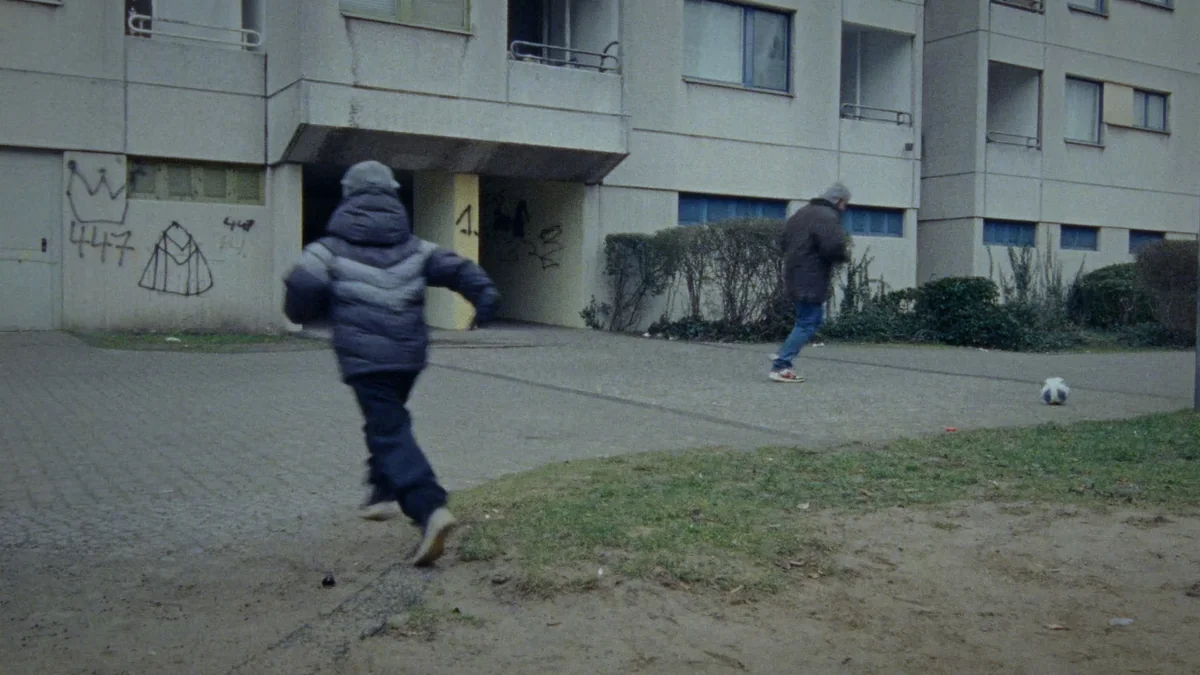
BA: The opening shot follows the route from Potsdamer Platz to the housing complex where Adnan and his father live, even passing the kindergarten on the way. It was important that the chronology of the journey was accurate, but that I also had the possibility of choosing which buildings would be shown in the film. I didn’t know what the sound would be for this, I was working a lot with trial and error while editing. At some point, I decided that it should sound like the opening of an ’80s crime show or a television drama, something sinister like Twin Peaks. I was listening to the news constantly at the time, and the Al Jazeera theme song always plays at the top of the hour, and that sound is so familiar, it’s almost like home. I slowed it down and suddenly I realised that was it. No one who watches Al Jazeera – not my family, nor anyone else – could recognise it instantly. I think there's something in its tone that has a sinister resonance.
Sound is another element that is working in the film to draw your attention to something, or to startle you. When Adnan and his father leave the flat, the camera remains in the room and floats over to the window to watch them walk out, while a sinister sound plays. It enhances this feeling that you’re being watched even when you’re alone, because you’re always told you’re not welcome unless you fit in with what the state demands. You have to stay within your bounds if you’re an immigrant in Germany. The sound informs that paranoia, and then with the song ‘Salute the Parrot’ that comes in later, we shift to a mix of joy, rage, and a bit of release.
EJB: I love how you used ‘Salute the Parrot’. It’s so jubilant but you’ve also made it feel unsettling. Could you talk about how you peppered in this song throughout the film to play with the viewer’s expectations?
BA: I write all my films with music in mind. With Morgenkreis, I realised quite early on that I wanted to use Maurice Louca’s ‘Salute the Parrot’. I named the Kindergarten group the Parrot Group, and I named the son after the common mishearing of the lyrics ‘ تنام’ (tanam, ‘go to sleep’) as the Arabic name ‘Adnan’. I was using all these elements of the song in the script before I’d even asked Maurice for permission. I didn’t know him very well, and it took months to set up a meeting with him. I was very nervous when we sat down together, because what if he said no? His music is very well-known and he was tired of people asking him if they could use it. I thought that my project was fucked, because I’d designed the whole thing around this song. So I pitched the film to him in detail, going into its political motives, who was going to act in it, who was going to film it. He’s intimidating; he’s very sweet but doesn't talk much. He was initially expressionless, but then he said that no one had ever explained why they would want to use his song to this degree, and of course I could use it. He also gave me the stems, all the different sounds that go into making this electronic track. His suggestion made me embed these sounds earlier into the film before you hear the actual song at the end, which was also a way to conceptualise how a riot doesn’t just materialise out of nowhere; there’s a whole history of invisible violence that has instigated it. October 7 didn’t happen out of nowhere, which is what Israel wants you to believe. That subtext isn’t necessarily meant to be read into the film, but I wanted to pepper in these sinister moments that embed themselves in your psyche as you’re watching it.
RÖK: Pairing the integration interview with the daycare brings together different aspects of state violence and control. We often view daycare as a place of care, but in the film it is also a highly institutionalised space.
BA: That’s where the project originated. In Germany, daycare is subsidised by the state, and you pay almost nothing. This is great, you shouldn’t have to pay. But there’s an aspect of it that feels really sinister to me. Since the state provides it, the state somehow thinks it owns your child, or that you’re indebted to it. You have no say in how things are done. Of course, there’s care, but to have your child, who you’ve birthed and spent every waking minute with, suddenly in the care of complete strangers, who don’t speak the same language, feels violent to me. You have your child ripped from your arms screaming and everyone’s telling you, “I know it’s hard, but this is good for him.” Is it? I’m not really sure; is it good for children to be raised by complete strangers in countries we’re not from so that we can work? Wouldn’t it be better if we got paid leave instead? Is daycare replacing something that has been broken down in family and community?
The state control that we see in the integration interview extends to the space of the kindergarten. Is your child learning the language? Are they learning the culture? Are they behaving in a German way? Basically, they’re being indoctrinated in these spaces from a very early age. The daycare is another way of colonising the immigrant. As soon as you can teach the child certain ethics or values or behaviour, they go home and enforce that with their parents, telling them “We don’t do things like that,” or “Don't speak like that, don't be too loud.” So that’s what I hope the audience gets, that the interview and daycare are essentially doing the same thing – and with the most vulnerable members of our society.
EJB: In the Q&A after your screening, you mentioned that the children you worked with were actually quite obedient, but this posed a problem for the film. How did you find working with them?
BA: It was really tough, and we had very little time. We cast child actors, and they were cranky and hungry. In the script, three kindergarten teachers are supposed to bring the children into a circle and the kids are supposed to escape. Amid this chaos, Adnan would run off back to his father, while the other children would keep dancing. The final version is not that different, but the problem was that when we rolled the cameras, the teachers would tell the kids to get in a circle and they would sit there and not escape, even though we kept signalling for them to. After three attempts, we were almost out of film, and realised we had to come up with something else, which I’m happier with. It’s more ambivalent now; we don’t know why Adnan escapes. School is an institution that disciplines children and forces them to conform, but it can’t fully contain the joy and resilience and resistance that comes naturally to them.
RÖK: What has the reception of the film been like at different festivals?
BA: I didn’t want the film to travel the festival circuit at first, because I felt so betrayed by the cultural sector. The initial screening was at a triennial exhibition in Norway. It was very small, and I was surrounded by like-minded people, and I had my son with me, so that was nice. That was last summer, and then the programmers at the Wavelengths section of Toronto International Film Festival asked to see the film and invited it to screen. I was initially hesitant, but as far as festivals go, TIFF feels pretty solid. I knew the programmer and I felt like it would be in good hands. At first, I wasn’t sure that anybody would understand the work or that it would resonate widely. It felt really personal, since I had made it for myself and my son to mark the experiences we had.
TIFF was a really powerful and humbling experience because there were so many people who connected with the work who didn’t have children and who weren’t migrants. That gave me a lot of confidence and encouragement and I allowed it to be screened more widely. I sent it to the London Film Festival and they showed it in the Experimenta section, and then it just took off. It’s being received really well and I’m happy that it’s showing. It’s giving me the courage to continue making more narrative work.
RÖK: At Open City, the film was shown in a programme on language within and in relation to state control alongside Jenny Brady’s The Glass Booth [2025] and Sophie Sabet’s Return of the Bright Night [2025]. Could you speak a little about how the film has been framed as it’s been doing the festival run?
BA: The film was shown in Cinéma du Réel in Paris where Jumana Manna, a friend and a lovely filmmaker, was invited to programme a focus on Palestine. It was titled ‘Palestine: Ways of Refusal’ and the lineup was incredible. But the festival basically told me, “We were considering premiering your film in competition, but since this focus on Palestine is happening, why don’t we put it there?” It was like they were segregating the international films and the films on Palestine. The latter felt like they were for a very specific audience, and that felt terrible, actually. We were expected to be grateful that the festival was making space for us, which is a very colonial and hierarchical attitude. I told them that our work should not only be programmed when we’re being massacred, and that we should also be placed in conversation with other non-Palestinian artists and filmmakers.
I knew that Open City was a good festival, and I was really happy to see how my film was programmed with others that have such different subject matter yet connect beautifully on a formal level. It’s really important not to follow state media agendas and pigeonhole radically different Palestinian films into one category.
EJB: I feel like your films resist exceptionalism. That’s really evident in the final scene of Morgenkreis where the image of Palestinians returning to the North of Gaza in early 2025 is superimposed over the kindergarten, implying that these histories and institutions are not separate. Could you talk more about this scene?
BA: I try to make things feel visceral, especially what we can’t describe in words. There’s so much violence, but there’s also a fierce resistance to it from younger generations that I wanted to represent. One of the most incredible things I’ve witnessed in the past two and a half years is the struggles of young Palestinians, many of whom have never set foot in Palestine. There’s also solidarity from many other diasporic and oppressed groups who can identify with the Palestinian struggle and other forms of systemic violence.
I didn’t want to make a film that would make a viewer pity us. The subject matter is difficult, but it’s not just about Palestinians, because it happens to any migrant that is not welcome in Europe. I didn’t want to end the film on a depressing moment, but instead show the life and force that is being born as a result of this despair and defeat. I envisioned the film as three choreographed circles, and the last one would be this dizzying, exciting burst of energy. We don’t really know what it means, but it’s there.
EJB: Even though your films make us feel this violence, there’s still so much humour in them. Rebecka and I were talking about how hilarious Capital [2023] is, with this woman writhing in ecstasy over a luxury housing development. In Morgenkreis, the immigration officer corrects the father’s pronunciation of Papageiengruppe [parrot group] in a very condescending manner, which you emblazon in all-caps on the screen. Could you talk about the function of humour in your films?
BA: I think it’s really necessary. I try to do it in all my work. Sometimes it doesn’t come across very clearly, and some films are funnier than others. I feel like satire and humour are really important and political, and making someone laugh shows that you have agency. I’m obsessed with how a stand-up comedian can disarm an audience and make them feel like they’re in on something, and then suddenly make them uncomfortable because they’re laughing at something that incriminates them. It’s such an art form and I would love to engage more directly with it.
My films are less laugh-out-loud funny, closer to satire. I think using satire signals to the audience that you respect them, and you think that they’re intelligent. If you drop in a clever joke and the audience gets it, then they feel more engaged; they’re on this journey with you. I never want to spoon-feed you information or convince you of my struggle. I want you to realise that you’re in on this, that this is good for all of us. A joke is a diplomatic move to disarm the viewer and establish common ground, rather than dogmatically insist that we’re in the right.
EJB: Like jokes, your films work on multiple levels and have different meanings for different viewers depending on language and context. Rebecka and I live in England, and during the Brexit campaign the media was fearmongering with imagery of hordes of migrants arriving at the UK border. That’s what the image of the Palestinians returning to the North of Gaza reminded us of, before the credits informed us of its context.
BA: It’s funny you say that, because Palestinians are often represented as ant-like, like little black dots densely populating the occupied territories. On the other hand, Israelis are depicted as individuals who have histories and names. Every Hamas hostage had their own story, but when Palestinian prisoners were released on packed buses, their stories are rarely covered by the foreign press. What’s really powerful about the image of the Palestinians returning to North Gaza is that they look just like ants. It was devastating to Israel, they thought they had massacred any hope for people to return. It was so powerful for us Palestinians to see these Gazans returning in large numbers. Their houses have been reduced to rubble but they’re going to pitch a tent where they used to be. It proves that no matter how much Israel has dehumanised us, we don't dehumanise ourselves.