
On Deborah Stratman’s Last Things (2023)
The silent constellations and the space which is time which has nothing to do with her and with us. So that’s how the days went by…life sprouted from the ground, cheerful amidst the stones.
—Clarice Lispector, The Hour of the Star
A digitised star ray scintillates against a churning cosmos before the galaxy dissolves into sand. Ocean waves seethe. The star continues to glimmer, now suggestive of a sea creature or calcite crystal. Hallucinogenic blue, blindingly bright, the ray pulses, as if breathing. This celestial, computerised image from Deborah Stratman’s short film Laika (2021) recurs in her feature, Last Things (2023). In both films, the star from up above tethers to the earth through superimposition or montage. The vertical axes of the ether and of the screen become dynamic fulcrums from which to explore natural environments and time.
For more than thirty years, Chicago-based artist and filmmaker Deborah Stratman has straddled modes of documentary and essay film to explore faith, science, technology, and geology. Born in 1967 in Washington, DC, Stratman received her MFA at California Institute of the Arts and now teaches at University of Illinois Chicago’s School of Art and Art History, where her classes include ‘Topics in Audio’, ‘Psychoecology’, and ‘Science Fictionals’. Genevieve Yue designates Stratman as having made the first film to be called an ‘experimental documentary’. More recently, in an interview with Film Comment, Stratman admitted to struggling with the term ‘experimental cinema’, preferring ‘nontraditional storytelling’. She elaborated: ‘I want the film, always, to tell me what it wants. I don’t want to place categories, limits, or expectations on the content.’ Rather than pigeonhole herself, Stratman takes a capacious approach to storytelling that makes her work difficult to articulate succinctly.
What we can provisionally say of Stratman’s films is that they tend to be as emotive and ludic as they are intellectually rigorous, while also decentring human perception as a way to expand our understanding of the world, rather than foreclose it. Specifically, Last Things explores interscalar logic and the extinction of humanity from the perspective of rocks. Extreme, microscopic close-ups of minerals, crystals, chlorophyta (green algae), and other minute matter lend the film a psychedelic sheen, further amplified by the electronic and synthesised music of artists including Olivia Block and Thomas Ankersmit. Drawing on fiction by Clarice Lispector and J.-H. Rosny (the pseudonym of brothers Joseph Henri Honoré Boex [J.-H. Rosny aîné] and Séraphin Justin François Boex), Stratman’s oneiric, collaged script is read by Valérie Massadian, a French filmmaker known for depicting ferocious women characters as they move through nature and society.
Last Things weaves J.-H. Rosny aîné’s stories Les Xipéhuz (1888) and La Mort de la Terre (1910) into an amalgamation of science fiction and documentary. Stratman's resulting story of discovery is a narrative of the world according to rocks. In an interview with Notebook, Stratman explains,
In both [texts], we’re introduced to intelligent non-organic life as alien Others who are cast as villains, though not because of malicious intent. The Xipéhuz and the Ferromagnetics are just following their nature, which happens to be antithetical to human life. My Others are a mashup of the geometric Xipéhuz with their internal glowing stars and the crystalline, iron-eating Ferromagnetics.
The film begins with a black screen while Massadian gives a toneless reading of the opening of Lispector’s A hora da estrela (The Hour of the Star, 1977): “All the world began with a yes. One molecule said yes to another molecule and life was born. But before prehistory there was the prehistory of prehistory and there was the never and there was the yes.” The text helixes back on itself, beginning and ending with the same affirmation instead of progressing narratively. The structuring logic of Lispector’s sentence mirrors Rosny aîné’s project of collapsing temporality as a way to understand evolution, specifically the geologic time scale. Rosny aîné’s story and Stratman’s film span wide swathes of time, yet promiscuously fold the past and future into one another, nostalgia and futurity moulding into a brilliant Möbius strip.
Massadian’s voice-over pauses as an eighteenth-century drawing of the Milky Way fades in on screen. While this drawing’s typical orientation is horizontal, Stratman turns it vertically to suggest an advancing, alien figure. Stratman cuts rapidly from the drawing to galactic darkness four times before subsequently cutting to the Xipéhuz: those digitised star rays who tremble and wink. This vertical Milky Way resonates with a series of images that appear in rapid succession, each suggestive of verticality and oscillation in scale: a NASA simulation of a vermillion dust ring; a timelapse of growing crystals on a microscope slide in cross-polarised light; a translucent diatom, known as the Bacillaria paxilifer, silver as birch bark, its single algae cell twisting under a microscope.

Allsea-dwelling diatoms, not just Bacillaria paxilifer, drift to the sea floor when they die and, conditions permitting, eventually become sedimentary rock. Their trajectory as living microorganisms drift from the water’s surface to its depths below where diatoms as a whole are responsible for producing more oxygen than all the world’s rainforests. Within these silica shells, an additional convergence among, and polarity between, sea and air emerges. In Last Things, the bejewelled diatom shines like objects in a later scene in which actors portraying the Xipéhuz, hold mirrors in front of their faces which glitter like a chondrite in various microscopic close-ups against an otherwise black screen. Though the scales between these subjects are heterogeneous and vast, Stratman generates repetitive linkages through this montage of close-ups.
From sea, to air, to space: soon after the galactic and geological montage, we hear structural geologist Marcia Bjørnerud describing close-ups of chondrites as pieces of the sun. Unlike the sleek, affectless voice-over of Massadian, Bjørnerud sounds warm and unscripted. Bjørnerud goes on to say that, while some of these stony meteorites have remained virtually untarnished from the early solar-nebula days, others have partially re-melted and recrystallised. In a way, rocks are an archive of geology’s evolution, and chondrites suspend the past like amber fossilises insects. They hold within them the perfectly preserved memories of an unfathomably distant history. As Stephen Jay Gould writes in Time's Arrow, Time's Cycle: Myth and Metaphor in the Discovery of Geological Time (1987), ‘Deep time is so alien that we can really only comprehend it as metaphor.’ Chondrites predate human consciousness, and Stratman prioritises the perspective of deep time in stone’s metaphor and materiality. Bjørnerud continues, “Chondrules are little worlds that have different stories to tell.” Last Things illuminates these worlds and these stories in order to decentre human sight while also utilising the tools of figurative language so that humanity can comprehend otherwise unfathomable oscillations in scale.
Last Things fulfils Bjørnerud’s “polytemporal worldview” in which remnants of glaciers exist alongside rain-imprinted stones alongside sidewalks scuffed by sneakers. There is an elasticity to time and scale through Stratman’s montage and soundtrack; Massadian’s voice comes back in towards the conclusion of Stratman’s film to narrate the beginning of the world. And yet, while Massadian chronicles the evolution of minerals, plants, dinosaurs and, finally, man, she goes beyond our present moment to foretell future destruction. As she describes our inevitable collapse, the camera moves across an ocean floor. These aquatic images of the present coupled with descriptions of futurity create something akin to a Zeno’s paradox: an impossible double motion, existing outside of time as we know it. 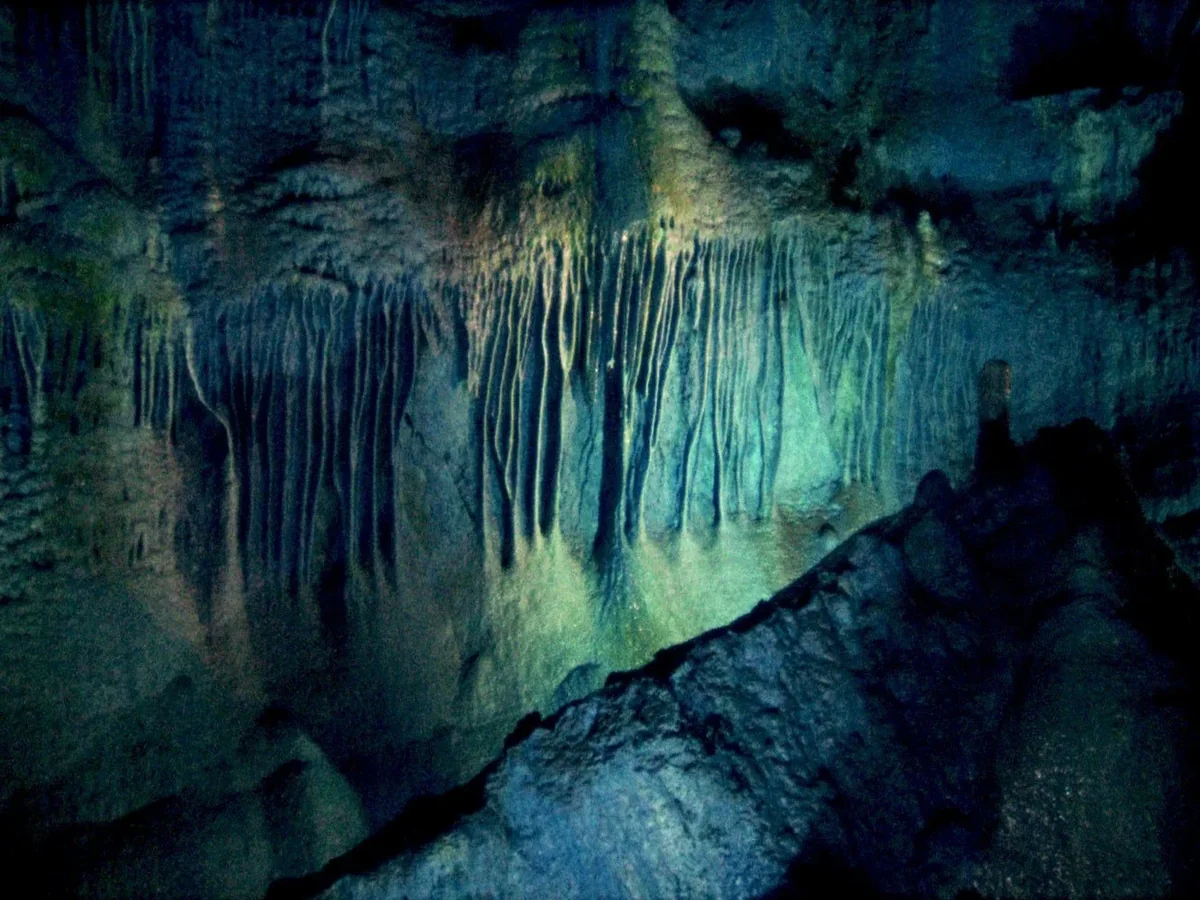
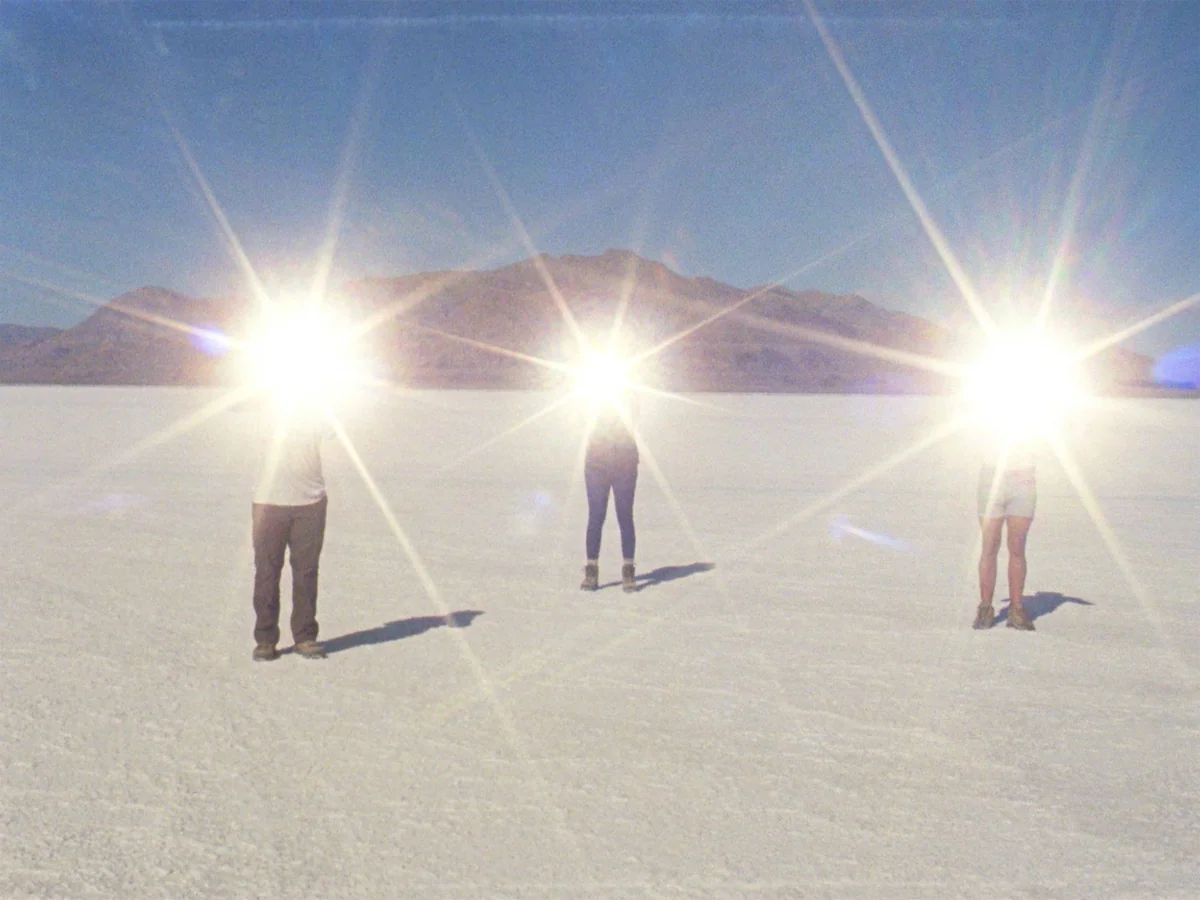
While, in Rosny’s book, the Xipéhuz are, as Stratman puts it, “antithetical to human life”, they become embodied and earthbound in Stratman’s film, depicted as people holding mirrors in front of their faces like the hooded harbinger in Maya Deren’s Meshes of the Afternoon (1943). Reflections of the sun flash like stars within these props. In a field at midday, the Xipéhuz no longer tremble ethereally in outer space, but are rooted, fleshy entities in a world that looks much like our own. In other words, they become human actors. While, early on, Massadian’s voice-over states that this story is “unfinished because it’s still waiting for an answer”, the human forms of the Xipéhuz in a windswept plain towards the end of Last Things underscore the emergence of the Anthropocene, a new narrative thread. The mineral kingdom is no longer alone in determining or depicting geological time. The closing sequence of breakdancers undulating to a percussive drum beat further underscores Stratman’s gravitational narrative pull towards a living, pulsating humanity on earth. Stratman revels in the athleticism of these bodies in the final sequence, cutting rapidly on the beat to complement the frenetic movements on screen.
In what is otherwise a posthumanist project, the shift back to humanity feels unexpected, despite the groundwork laid by Bjørnerud’s conversational and metaphorical descriptions of chrondrites as “the old ones” and chondrules“as little worlds, that have stories to tell.” Indeed, Stratman's project is more anthropocentric than the film initially suggests, precisely because these oscillations of scale create metaphoric linkages that can be activated only by the mind and the eye of the viewer. What is poetry, metaphor, and association, if not an explicitly human attempt to understand parts of the world not readily available to us? Metaphors make human comprehension possible, as does literature, from which so much of this film’s text is collaged.
Even prior to Stratman’s terpsichorean conclusion, in the film’s penultimate song, there is a verbal insistence on the sacredness of a living, breathing humanity. The members of a Sacred Harp chorus clears their throat collectively before bursting into a capella. The lyrics ‘I am born to die’ come in as the Xipéhuz shine their mirrors into the sun. Though an anthropomorphic perspective is not always prioritised visually in Last Things (after all, these images would be too colossal or microscopic for a human eye to comprehend) the chorus and the embodied, corporeal Xipéhuz concretise human life’s rise and fall. Stratman doesn’t do away with the human in her effort to expand perception but, rather, puts us into conversation with these other-than-human figures. We are, indeed, born to die. But what happens in the interstice of a planet or person’s life perpetuates an ecology of feeling from which Stratman constructs her vibrant and geoaffective film.