
Staging the Impossible: A Conversation with Suneil Sanzgiri
Darkness gives way to a tempestuous seascape as the camera glides over choppy waters, gradually tilting towards a distant cliff. An ominous cloud swells over the landmass. Its presence is unsettling, yet something else feels amiss. The waves are too evenly spaced, their white foam overly sharp. The billowing clouds have an unnatural geometry. A subtle dissonance begins to emerge from within the fabric of the image. Is this footage real or computer generated? This question is perhaps futile. Concerned less with clear legibility and more with the affective possibilities that irresolution can provoke, Suneil Sanzgiri’s moving image practice finds its rhythm in moments of slippage. His work blends experimental and documentary modes to create layered compositions in which biography brushes against the undercurrents of history, and where the evidentiary status of the image is kept deliberately unstable.
Screened together at this year’s Open City Documentary Festival, Two Refusals (Would We Recognize Ourselves Unbroken?) (2024) and An Impossible Address (2025) extend Sanzgiri’s ongoing exploration of Afro-Indian solidarities under the Portuguese Empire, addressing questions of loss and the politics of imaging technologies in relation to anti-colonial struggle. Both works confront the entangled afterlives of resistance movements across Goa, Angola, Mozambique, and Guinea-Bissau, whose legacies remain suspended between revolutionary fervour and disenchantment. Grounded in extensive research, Sanzgiri’s formally inventive work has a spellbinding poetic sensibility. The artist-filmmaker's distinctive intermedial approach – spanning 16mm film, CGI animation, archival materials, and photogrammetry scans – mirrors the fragmented realities mapped throughout his body of work. His latest films and installations attend to what pushes at the limits of language and representation, of fact and fiction. The image glitches, and so does history.
In the opening sequence of Two Refusals, a woman’s dreamworld is disrupted by Adamastor, a mythical character who embodies a storm. Drawn from the Portuguese epic poem Os Lusíadas (1572) by Luís de Camões, the titan represents an early expression of resistance to imperial expansion, as it aimed to destroy admiral Vasco da Gama’s fleet on its voyage to India. Although unable to halt the expedition, Adamastor persists as a spectral counterforce to colonial conquest. Its unruly presence is especially significant in the context of Goa, the homeland of Sanzgiri’s ancestors, which remained under Portuguese rule for 450 years until its incorporation into India in 1961. Through Adamastor, Sanzgiri mobilises mythical time to draw unseen forces into the fabric of the visible world. Evoking a speculative past, the film asks what Goa might have become had colonisation never taken place.
While Sanzgiri’s earlier Barobar Jagtana trilogy – comprising At Home But Not At Home (2019), Letter From Your Far-Off Country (2020), and Golden Jubilee (2021) – navigates diasporic experience and Goan identity through conversations with the artist’s father, Two Refusals expands to trace broader trajectories of anti-colonial resistance. Attentive to matters of inheritance, Sanzgiri uses citation to invoke traditions of emancipatory filmmaking. Extracts from Ruy Guerra’s Mueda, Memória e Massacre (1979) and Sarah Maldoror’s Sambizanga (1972) underscore the fact that revolutionary struggle does not arise in a vacuum, but circulates across borders in continuous relation to earlier movements.
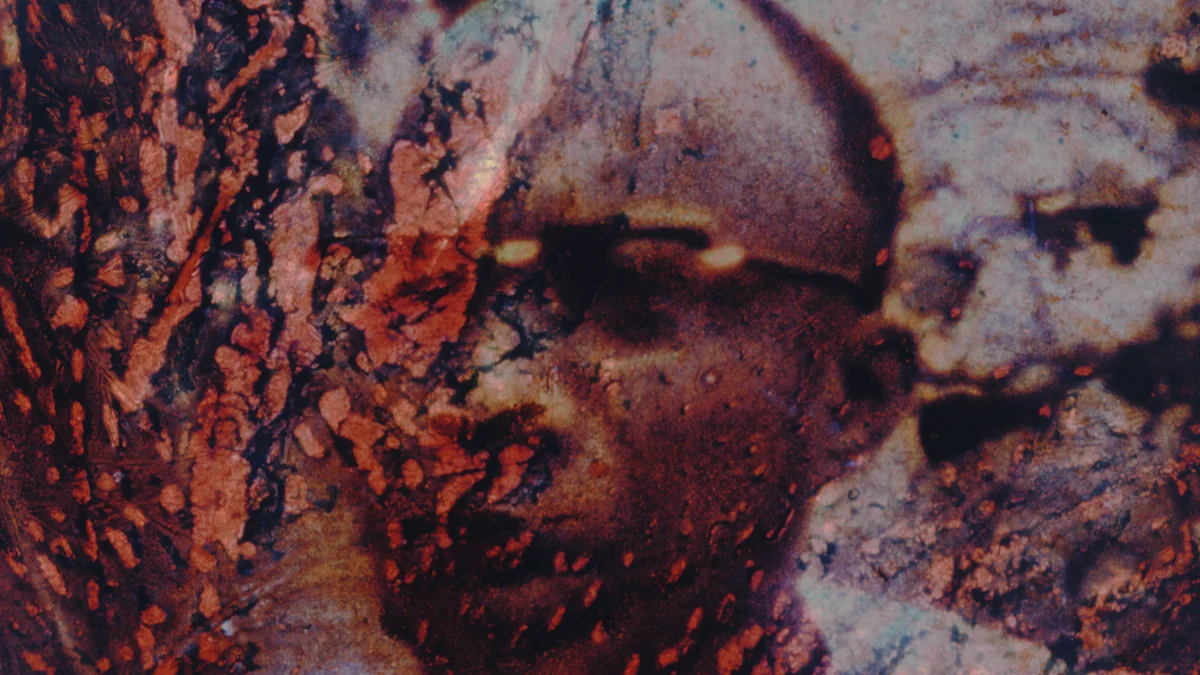
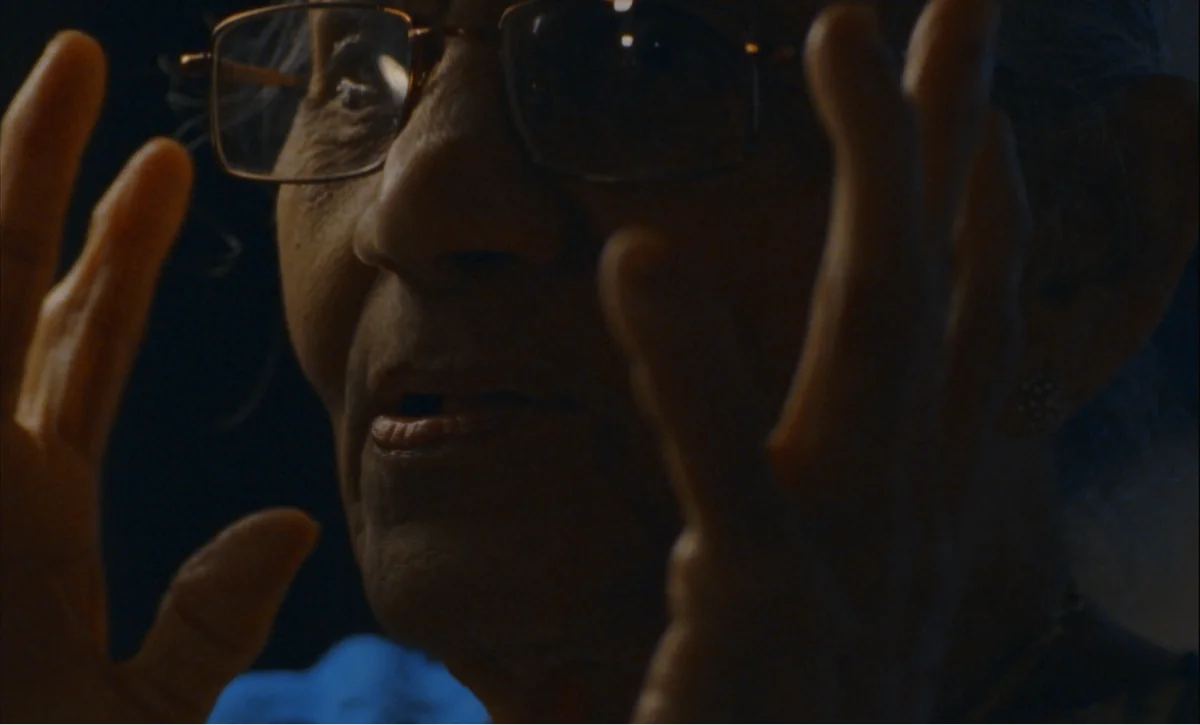
Two militant women constitute narrative anchors within Two Refusals’s splintered historical landscape: Angolan doctor and communist revolutionary Sita Valles and Goan liberation fighter Sharada Sawaikar. Sanzgiri interlaces archival and contemporary footage to trace their stories alongside the liberation movements they fought for, adopting an elliptical form to chart a networked, cross-continental geography of resistance. Crowded market streets, Sita’s family photographs, Angolan guerrillas, and lush jungle landscapes appear in prismatic superimpositions, at times saturated with colour filters or distorted through heavily manipulated celluloid. The film’s drifting atmosphere is heightened through evocative passages penned by poet Sham-e-Ali Nayeem, who collaborated with Sanzgiri on the script. Delivered with a somnambulistic cadence in Konkani, reflections on memory and utopian desire are interwoven with Sharada’s testimony, which surfaces intermittently through filmed interviews. Ideals of national liberation sit in tension with sequences that illuminate the troubled, often violent aftermath of postcolonial transition. Resisting romanticised visions of the nation as a parental figure, Two Refusals complicates identity formation along nationalist lines. Belonging emerges as a fraught and fragile condition, as unmoored as the images themselves.
Sanzgiri describes his practice as being in communion with the past, which is conceived as a latent force that ripples into the present. This sense of transhistorical intimacy feels especially palpable in An Impossible Address, which expands on the brief but remarkable life of Sita Valles, who fought for Angola’s liberation from Portuguese rule before being forcibly disappeared in 1977. Unfolding as a letter addressed to her, the film trades voice-over narration for onscreen text, allowing its confessional tone to resonate inwardly. The title takes on a double meaning, evoking both a failed attempt to communicate with the dead and the unknown location of Sita’s remains. While this unbridgeable gap is difficult to bear, the artist treats it as a catalyst. Sita’s memory becomes a guiding presence, animating encounters beyond the limits of the colonial imagination.
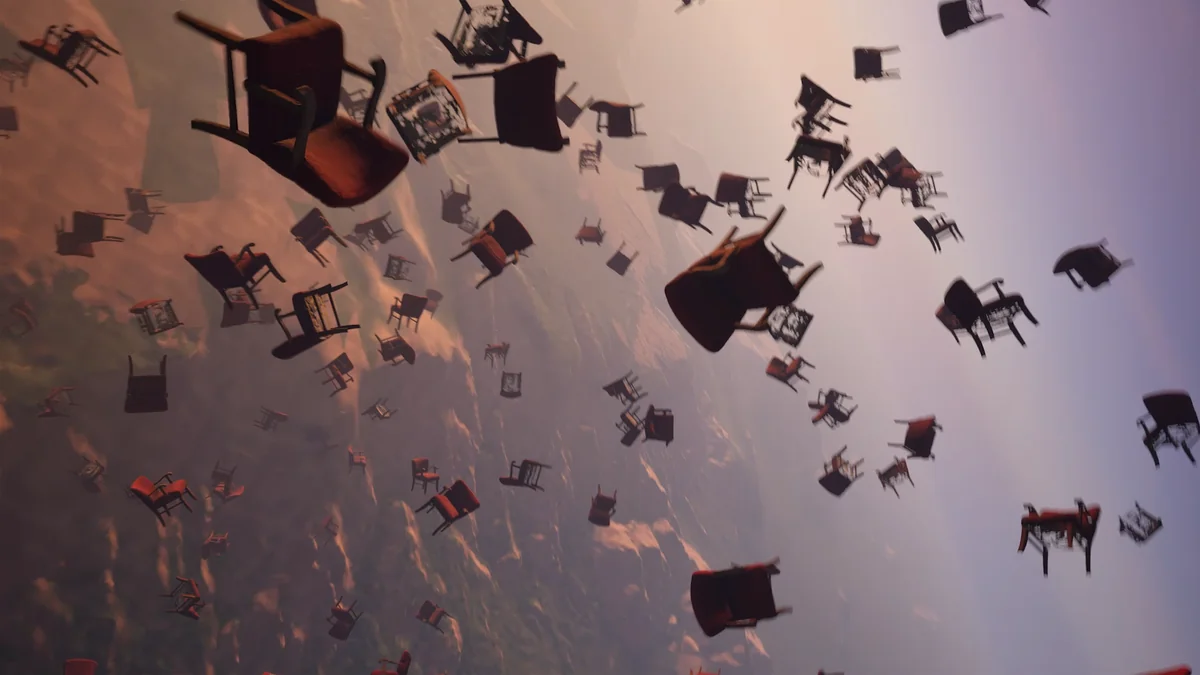
Dislocation is employed as a structuring principle, with linear chronology eschewed in favour of a kinetic collage set to a jazz score. Handheld shots of Luanda’s vibrant nights are intercut with images of Lisbon’s streets, while interviews and documents depicting different moments of anti-colonial insurgency are brought into relation. Sanzgiri revisits the legacy of the 1955 Bandung Conference, a landmark summit of Asian and African nations aimed at promoting cultural and economic cooperation, self-determination, and decolonisation during the Cold War. In one of the film’s most arresting sequences, dozens of digitally rendered red upholstered chairs fall from the sky into the hazy abyss of a virtual landscape. The camera tumbles with them, whirling uncontrollably through pink and orange-toned clouds. Scans of the original chairs used at the conference, these pieces of digital furniture stage a scenario at once impossible and historically specific.
This way of conjuring detail lies at the heart of Sanzgiri’s practice. The artist frequently manipulates the material properties of digital and analogue media to perform piercing cine-exhumations. Blurring, scratching and warping emerge not merely as iconoclastic gestures, but more significantly as acts driven by a reanimatory impulse. To unearth the past, however, is also to accept the possibility of reactivating its pain, especially when it involves stories marked by failure and unresolved grief. Navigating the points of friction within resistance movements, Sanzgiri’s films ask what it might mean to “work through the pain of coalition”, as cultural worker Jemma Desai put it during the post-screening conversation at the Institute of Contemporary Arts (ICA). Solidarity is thorny, and to practice it is to inhabit its contradictions.
Sanzgiri’s commitment to thinking through the interrelated nature of collective struggle extends beyond the screen. He seeks to align the politics of his films with those of their exhibition and circulation, a principle that also informs his public interventions. The artist prefaced his conversation with Desai by expressing solidarity with Palestine and calling on the ICA to sever ties with entities complicit in Israel’s ongoing genocide against the Palestinian people. If cinema holds the capacity to shape a shared relation to the world, it may also reassert our connection to realities in which we remain implicated.
Lola Lemke: Poetry plays a significant role in your practice. Do you see your work as relating to traditions of revolutionary poetry that were central to anti-colonial educational initiatives, particularly in Angola and Guinea-Bissau?
Suneil Sanzgiri: Poetry has been essential to my work in many ways. I’m not sure I would describe my practice as an extension of that tradition necessarily but, thinking about how those forms function, poetry has often served as an educational tool. In Guinea-Bissau, for example, it became a core part of the curriculum in clandestine mangrove schools after the Portuguese bombed educational centres. Poetry was essential in this context because it was able to distil class, revolutionary, and anti-colonial consciousness into succinct ways of understanding the world and, more specifically, of relating to the land. Cinema, especially experimental cinema, also utilises poetic offerings. The difference, I think, is that written poetry explores language intimately, while the visual form defies language. In many ways, it does so much more. Yet both are ultimately about feeling.
Thinking about revolutionary poets, most anti-colonial leaders had a poetic practice. Agostinho Neto and Amilcar Cabral met at the House of the Students of the Empire in Lisbon [Casa dos Estudantes do Império], where they began writing. They used poetry to bypass the censorship of the Portuguese colonial entity, as it was not seen as a possible site of anti-colonial consciousness. But students were communicating with one another through poetry. This is how they were able to circulate their messages, tying notions of land, belonging, suffering, ancestry, and slavery into the coded language of poetry.
LL: In ‘Un-Meshing The World’, a text you wrote for Open City’s Non-Fiction Journal in 2023, you suggest that ‘the lacunae of the image is perhaps our best chance to escape our already hyper-meshed world.’ Could you speak more about your understanding of opacity as a formal and conceptual strategy?
SS: When I wrote that I was thinking a lot about gaps and aporias, and understanding images in that way, specifically in Golden Jubilee. In his performance at the festival, Miko Revereza talked about sneaking meaning into images, about packing as much meaning as possible into them and then sneaking them across borders, which I really loved.
I think the question of opacity is interesting because I’m a very privileged filmmaker. I have an American passport and I don’t really face censorship in the same way as many other exilic filmmakers do. I don't necessarily have the same burden, so it becomes a question of why I am not more overt sometimes. I often am publicly and definitely online – probably too much – but the work is something else. I think more than anything opacity is an opportunity for abstract thought. I was very much raised in the tradition of conceptual art. I studied conceptual art but I’m not a good conceptual artist. I’m too much of a maximalist.
LL: Who were you influenced by?
SS: I don’t think she would consider herself a conceptual artist, but my mentor Renée Green was a big influence on me. I’m interested in ways of documenting gesture and simple poetic acts. Art gives us the opportunity to do things we might not otherwise do. When I think about the opacity of images, for me it’s really about the possibility of thinking outside rigid structures and of denoting meaning. I’m also more interested in what the audience brings to the work. A lot of it is about collaborative meaning-making. Even though I have an interpretation of each image, and each image has a really robust story behind it, I ask myself: what combinations of sound, text and image can be co-created with the audience?
LL: In terms of opening pathways to abstract thinking, your work problematises the idea of the impossible: what is impossible, and according to whom or to what logic? It invites viewers to reflect on the limits of their own imagination. How do you engage with these horizons of possibility?
SS: Certainly, the goal is to get us outside of the realm of the impossible. I think it’s tough because things are changing so quickly and naturally my thoughts are changing constantly. There has been a lot of focus on speculative futures, or, as my friend Tausif Noor puts it, the thinking-otherwise-industrial-complex. I’ve been heavily influenced by scholars like Saidiya Hartman and Christina Sharpe. The question of what could have been is central to Two Refusals, which partakes in the kind of thinking-otherwise-industrial-complex to some degree. It’s complicated because we need to focus on the present. We can’t think otherwise if we can't also think in the present tense. Speculation on the past sometimes replaces action in the present, and we must confront the present in moments of rupture if we are to preserve the possibility of shaping a different collective future.
LL: Your work experiments with montage, with pushing against the slicing of time into discrete notions of past, present, future, and against narratives that excise us from past struggles. How does this collapsing of timelines allow you to reconsider the writing of history?
SS: I’m a Benjaminian in that sense. It’s interesting because the Frankfurt School has really fallen out of favour recently. Many people have been very critical of it, perhaps rightfully so in terms of its proximity to Empire. But Walter Benjamin has been one of the biggest influences on my thought and practice; I often think of his Theses on the Philosophy of History. I recently went to a talk by Benjamin scholar Eduardo Cadava, who offers a close reading of The Work of Art in the Age of Mechanical Reproduction, with the underlying assumption that it’s often been misread. It’s actually a very anti-fascist text, specifically because he argues that nothing is original. The entire idea of originality is fascist. Everything that he does within the text is a reference to the limits of language; for Cadava, every word has a meaning that can be traceable. Everything has a lineage to it. This is what the Zionist entity and all settler-colonial projects seek: a permanent present – continuous and fixed – that obliterates the past to secure a settler-colonial future. The Palestinian writer Adam Haj Yahia writes about this in his essay ‘The Principle of Return’.
Film can open up a different temporal logic in this context by disrupting the distinction between past, present, and future. Especially in the installation of An Impossible Address. That is what the images are doing in this kind of setup. An Impossible Address is really trying to confuse those time periods and frustrate them in ways that are disconcerting.
I think what film, and montage in particular, can do that is interesting is to place two things that are unlike next to each other and force, in a true dialectical sense, some sort of synthesis. There were people who critiqued my film, Letter From Your Far-Off Country, because I experimented with this kind of proximity, placing Ambedkar and the Dalit struggle next to the communist movement, which was led by ‘upper caste’ Brahmin intellectuals. Some viewers pointed out that the communists never did anything for the Dalit struggle. This tension is generative for me, it reveals certain contradictions that must be confronted.
LL: Sharada Sawaikar and Sita Valles, two militant women, are central figures in Two Refusals. Sharada’s songs, which bear witness to enduring suffering and the need to remember despite the pain of doing so, are especially moving. What led you to focus on their stories?
SS: It was a result of how few accounts of them exist. I actually interviewed another Goan militant who was considered the Che Guevara of Goa. But as soon as Sharada started singing, I thought, this is it. This says everything. With Sharada, it was all about the songs. They are so evocative. She told me that she had written these songs on scraps of food wrappers and bits of paper while she was in prison. She was a schoolteacher and, at the same time, taught girls military skills, including how to wield rifles. While sharing the story of her torture, she also said, “I survived because you needed me.” That, to me, was important.
When I rewatched it at the screening last night, I wondered if I had focused too much on the torture. Maybe it felt a bit gratuitous. But then I realised I did that because she includes these throwaway lines that are so powerful and important to me within the same sentence – the same breath – as she describes her torture. She knew she had an obligation to the future, to the generations that came after her to stay alive.
LL: I noticed that Two Refusals and An Impossible Address use the same interview footage with Sita Valles’s brother, Edgar Valles…
SS: There is a very practical reason for this. The films were made for different contexts, for installations and exhibitions. I wanted An Impossible Address to stand alone, to be able to be seen without having seen Two Refusals, because I knew there would be audiences who hadn’t encountered the previous film. There are also specific expository passages from Edgar's interview that I needed to include. These are moments that bear repeating. I think it’s important for Edgar and Sita to be reintroduced as core figures. “She was a doctor of medicine and she was also a revolutionary,” Edgar says. I love the statement and the way it introduces her. When I rewatched it, I wondered if audiences might think that I'm going to reuse the entire interview. There are so many parts I wish I could have reused, especially where Edgar talks about Stalin and how, back then, they had no idea the USSR was committing all these crimes. It is interesting to think about how information used to flow, compared to how inundated we are with information now.
LL: Thinking about how this overload shapes what we come to understand as ‘real’ today, what are your thoughts on the artist-filmmaker as a mediator, someone who observes, researches, and makes connections, filtering reality through film?
SS: Maybe that’s giving me too much credit… Maybe I shouldn’t be the one filtering information, although my films do come from a place of trying to make sense of what I encounter on my newsfeed on a daily basis. But it is me thinking publicly. I’m not necessarily asking other people to listen. The goal for me is for everyone to be the mediator, for the audience to be able to negotiate information for themselves. We shouldn’t ask artists to do that. I really want people to develop their own consciousness, and I hope that the film can be utilised as a way of thinking personally, even if you disagree. Last night, Alia Syed [an artist who was in the audience] had a problem with some of my choices. I thought: fantastic, I hope you do.
LL: There was a panel at the festival called Political Films/Making Films Politically, which you attended. How do you respond to that idea?
SS: I mean, it’s an unanswerable question. There’s never going to be a satisfactory answer. I think if you're already asking yourself that question, then you’re probably starting in the wrong place. You’re perhaps a bit lost. People know what it means to be in struggle. You know when you’re in it. I think we understand that culture plays a role, but I think we’ve maybe overestimated it. We’ve made ourselves a bit too self-important. Still, culture certainly does play a role.
The panel did make me think about the way Palestine is coming to be co-opted, aestheticised. This happens to all political struggles. To evoke the Frankfurt School again, I think about the politicisation of art and the aestheticisation of politics. They discussed how the aestheticisation of politics lends itself to being digested by capitalism. I was worried about that. I was also working with Sarah Maldoror’s daughters, Annouchka and Henda. Their father is Mário Pinto de Andrade and I was using images of him and Amilcar Cabral, who was his best friend. I asked for their permission to use these images because I know they’re very careful with them. They’re incredible images, really phenomenal, but they became too aestheticised for me – too fetishised, too romanticised.
It’s the same thing with the relics of my ancestors. There are guns and swords in my grandmother’s ancestral home that still have the dry blood of the Portuguese colonisers they killed. That’s incredible, but why is that incredible to me? Why am I so obsessed with the fetish object? I think a lot about how resistance appears onscreen. The camera as a gun is an adage that has been around for quite some time.

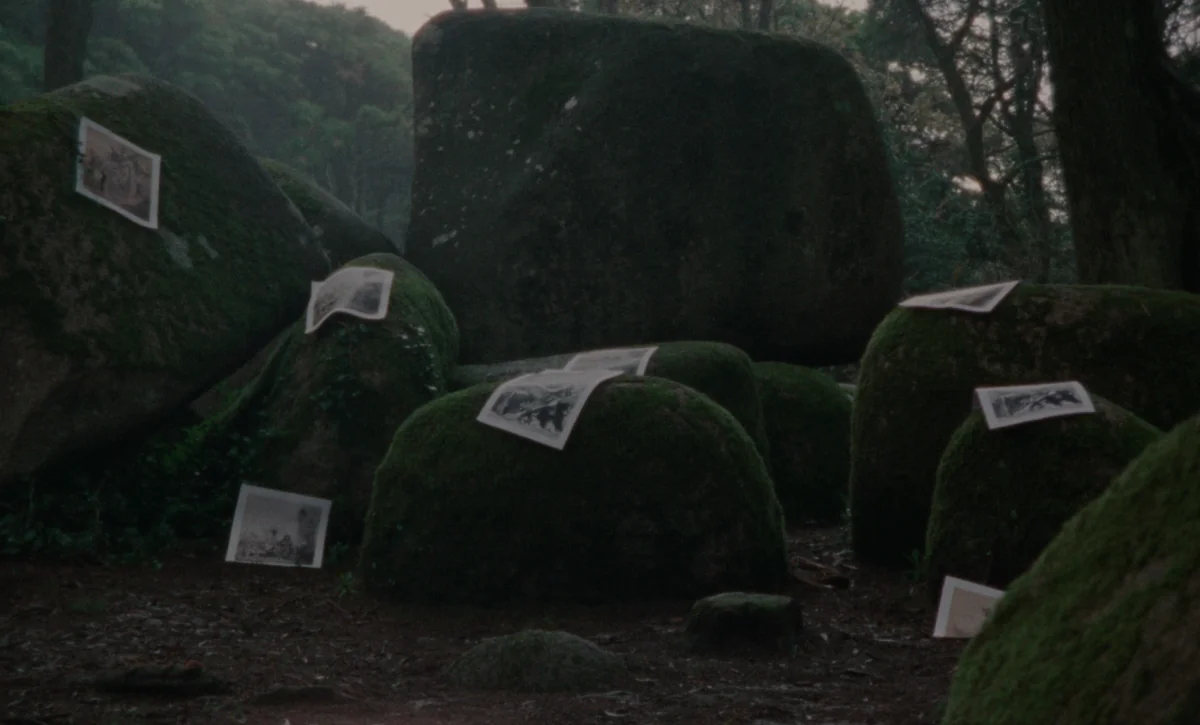
LL: In An Impossible Address, we see you standing inside a dark space arranging photographs of various sizes. In this sequence, which constructs a kind of image forest within a set, you engage in a deliberate act of staging, yet you later scratch the celluloid, blocking photographs from the camera’s view. Could you speak more about this impulse to show, and how it can come into tension with a desire to withhold?
SS: I scratched out the images on the 35mm print, which eventually dissipate, to further create a sense of hindrance and obstruction for the viewer. I wanted to provoke a sense of visual frustration by not revealing everything. Sometimes images aren’t meant for everyone.
LL: I’m interested in your thoughts on exhumation as an approach, both conceptually, in terms of unearthing past histories, and materially, in relation to how you engage with the film stock itself. I understand you buried some of the footage depicting Sita Valles in upstate New York. What did this process allow you to explore?
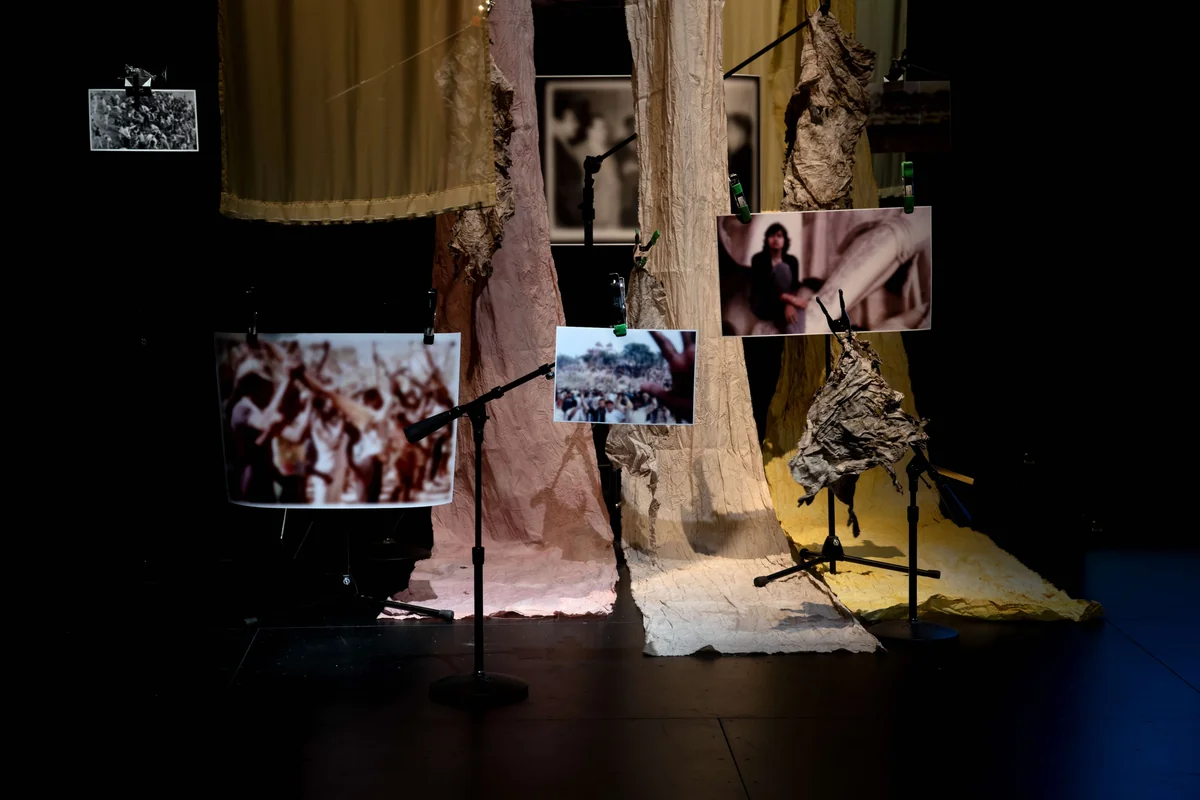
SS: I did this beyond the film stock too, for the installation of An Impossible Address presented at EMPAC [the Experimental Media and Performing Arts Center in Troy, New York]. The forest of images scene was projected onto muslin fabric, which really lends itself to projection. I buried 40 feet of fabric in a farm upstate, underneath a massive compost pile. I wanted it to rot in the same way that the film stock with the images of Sita had. The buried muslin took the shape of a shroud, unintentionally. Images of children and bodies wrapped in fabric in Gaza immediately came to mind.
It became a much heavier emotional process than I had anticipated. I waited for about a month before returning to unearth the images and the fabric. When I went back to the farm, which was run by an old man who was unfortunately dying and was not very protective of the place, someone had stolen all of the compost. I only found shards of the fabric in what remained of the pile. Death, decay, and disappearance followed me everywhere it seemed.
There was a doubling of disappearance, a doubling of the burial. What we ended up doing was hanging the fragments of the rotting muslin fabric on C-stands next to the images. Speaking to your question about obscuring and not obscuring, for the installation I reprinted those same images from the scene, but heavily blurred them. So when you walk into the gallery, you might think that it kind of looks like that image, but then the closer you get, the more you realise it’s heavily blurred. It looks censored. One last point about the muslin is that it originated in the Indian subcontinent, but its name comes from Mosul, a city in Iraq.
LL: Folklore and the spectral recur throughout your body of work. What draws you to mythology and to the realm of unseen forces?
SS: I think a lot of artists are interested in what the spiritual realm can offer. There is definitely more focus on it now across different genres, in film, but certainly in a lot of contemporary art, particularly in work from the Global South and practices that are focused on identity. Many artists are turning to myth and spiritual traditions these days. It’s almost become a trope now for diasporic artists to engage in mythology, grandmothers and folk tales.
What interests me is thinking about Sita as a disappeared person, and about the role the dead have in our lives. This kind of unresolved death has a haunting effect. Sita is very much present. She’s not here to speak, unfortunately, but her life continues to have a profound effect on other people's lives.
What is the veil between the living and the dead? It exists in the realm of the unseen, but also in the way we visualise it through the camera. What does an image capture that I may not have noticed at the time, but that reveals something to me later on? It’s as if there is a presence informing the image, something not immediately perceptible.
LL: You embrace chance in your work. Some of the blurry nighttime sequences in Luanda, as you have mentioned, resulted from you forgetting to charge your camera, and the muslin process also unfolded unpredictably. But you also use technology like 3D rendering, where everything seems carefully constructed. How do contingency and control interact in your practice?
SS: Sometimes, even with renderings, you can’t get things perfect. I remember there was a whole scene where I wanted all these flags from the Bandung Conference to fall from the sky, but we couldn't get it to work. We ended up scrapping it, even though it looked beautiful. It was kind of glitchy.
And then when it comes to the scenes in Two Refusals with the water and Adamastor, some people ask me: why is it a smoke cloud? And I say, it’s a storm cloud, not a smoke cloud! Others ask why there’s all this dust billowing. It’s not exactly what it’s supposed to be, but at a certain point you relinquish as much control as you can, because you know it will never be perfect. We didn’t have a huge animation budget, so the animators did the best they could. I’m not great at animating either, so I started outsourcing it. There’s only so much I can teach myself at this moment in time.
LL: Does this connect to your impulse to print your renders on 16mm?
SS: Yes, I think it also produces a confusion between the real and the possible, the real and the virtual. Many people think that the water scene at the opening of Two Refusals was filmed, and at a certain point they realise it isn’t. It’s not a digital image, but it produces a sense of the uncanny, and within the uncanny there is so much potential for making the familiar strange and the strange familiar.
LL: Remembrance often inscribes a past-ness, yet your approach to memorialisation departs from that.
SS: I think about what it means to live alongside the dead. In An Impossible Address, there is a quote from Amilcar Cabral, speaking at Kwame Nkrumah's funeral, where he says: “We Africans, we're a society of the living and the dead. The dead live alongside us.” That is how I practice thinking about Sita. She’s not just a historical figure.
I decided to go to Palestine in the summer of 2025 to work on a farm and help cultivate the land outside of Bethlehem. It was land defense work. We were protecting the farm, which was surrounded by five different illegal settlements that sought to burn it down and kill and dispossess the family living there. They needed international volunteers 24/7 for protection, deterrence. It was a dangerous decision. The people preparing us told us: you have to prepare to die. There was no guarantee of safety because settlers would often come and shoot at volunteers. The reason I mention this is because I had emailed Edgar and Che to tell them that working with your Sita’s memory had been one of the main inspirations for me to do this. This was right after I finished An Impossible Address.
LL: How did this experience affect your relationship to art and making work?
SS: Things are shifting. How does one carry on after such an experience? It was a time when I couldn’t really understand or fathom the value of art. I’m still deeply questioning it. But I think it’s ultimately a good thing that I haven’t completely abandoned making and showing work. At times, I’m still amazed by art. I don't want to talk about the power of art, but simply how much I love various forms of it. Every once in a while you have an experience that reminds you why you started caring about it in the first place.
Why do we need to make at all, when so much already exists? Why make? A comrade and I were talking about AI art slop. There’s so much bad art out there, but that’s exactly why you need to keep making, because there’s so much rot out there. There’s so much that is rotting our brains and those of future generations, especially on our phones. There are things the younger generations are not thinking about, and are unable to think about, because of the cultural wasteland around them. This is why it is even more important to put something out there, to reach audiences.
I think about one of my biggest influences, cinematically and politically, Gillo Pontecorvo’s The Battle of Algiers. It has endured and will continue to find relevance. Many of us are questioning our roles as artists and intellectuals. How do we engage beyond our artistic or scholarly output?
LL: Thinking about the politics of distribution and circulation, what are your thoughts on platforms such as Solidarity Cinema [an open-access online database of radical films]? I understand you’re open to your work being available on it.
SS: For me, the goal of making art is for it to be seen. There are many artists who are very litigious and protective of their work. Some operate from a scarcity mindset. I don’t believe in scarcity – it’s artificial.
Generally, if someone asks to see my work and they have a convincing reason, I’m happy to share it. And if someone is already doing that, then I am absolutely fine with people finding a downloadable link. The interesting thing about Solidarity Cinema is that the person who runs it somehow ended up at The New School faculty encampment. We did a lot of organising work together, so I was glad when I learned they are behind it.
In terms of thinking of the material ways you can act – the moves, the refusals, the withdrawals – this is eternally shifting. But ignorance is not a legitimate answer. What Basma al-Sharif said at the panel earlier resonated: you have the information available to you, you can make your own decision. People have done the work of making visible and legible the connections between the culture industry and the institutions that we have – that some people continue to choose to uphold – and their intertwinement with imperialist violence and profiteering. So you act with your heart, and if your heart tells you no, then that’s your answer. Otherwise you’re betraying yourself, and then there’s nothing left. If you’re betraying yourself, you're lost. This is what the world does to us: we wake up one day and we no longer recognise ourselves. Some people are fine with that. It is hard to ask ourselves these questions. But they keep me up at night.
LL: Regarding refusal as a strategy, elsewhere you have talked about engaging in creative ‘fugitivity’. Could you elaborate on what that means to you?
SS: It’s a politics of being deliberate about the ways in which something becomes a strategic refusal. We could talk about it in many different ways. On the cultural front, there has to be a coherent strategy to how cultural organising happens, and to when one does or doesn’t participate in something. I have seen effective organising that many people might not consider a success. I think about Strike Germany. Only four of us withdrew our work from Berlinale in 2024, and more from Berlinale Talents and the like, but it set a foundation. There were many people mobilising in the background leading up to it, and the impact of that campaign is still felt very much to this day. Strike Germany laid out the contradictions very plainly, brought them to the forefront, and forced a confrontation with them. They asked people to take sides, which you do have to do. That was not easy. People did not want to take sides. They wanted to have their cake and eat it too. They wanted more complexity, more room for conversation, all that. But where are you in this moment? Everyone wants nuance, but why are you asking for nuance right now? There is a very clear line. Of course there’s nuance to things. But one should go with their heart when they have information.
There's a frustrating level of malaise right now in organising spaces, but people are still mobilising and organising in different ways. I've chosen the realm of culture, which doesn’t mean I don't also have a responsibility to practice forms of frontline engagement.