
A Conversation with Mary Helena Clark
The edges that separate things are conventional rather than inherent or inevitable. While it may make use of these edges in passing, the work of desire is borderless. Once set in motion by a site or an image, swervelike, the line of recollection simply continues, and in multiple directions, intensities, and temporalities, becoming surface, becoming ornament. I feel it in my body as I write this.
—Lisa Robertson, The Baudelaire Fractal
American filmmaker Mary Helena Clark has made nineteen films to date, working across a range of media – 16mm, digital – and with found footage and 3D animation. Clark’s films are typically short-form and, while they vary in their concerns or investigations, they share an elusive hypnotic quality: episodic, dreamlike. In one of her earliest works, Orpheus (outtakes) (2012), it is a ghostly pair of eyes that transfix. Clark collages fragments from a 16mm film strip of Jean Cocteau's Orphée (1950) together with these eyes, using optical printing to create a haunting film within a film. Continuing her homage to canonical filmmakers, The Dragon is the Frame (2014) re-traces locations from Alfred Hitchcock’s Vertigo (1958), blending diaristic shots of San Francisco with YouTube footage of the late transfemme writer and artist Mark Aguhar. Ostensibly an ‘experimental detective film’, the elegy behind The Dragon is the Frame is itself obscured, veiled behind layers of San Francisco’s slowly rising mist; just as the viewer searches eagerly for clues, so too does Clark appear to be scoping around for something.
One of Clark’s more recent films, Exhibition (2022), focuses on the lives of two women with unusual relationships to objects. Eija-Riitta Eklöf-Berliner-Mauer famously married the Berlin Wall in 1979 and made several miniatures of it, which she kept in her home. Suffragette Mary Richardson, meanwhile, is renowned for having damaged Diego Velázquez’s Venus at London’s National Gallery in 1914 by slashing at it with an axe. Weaving together the biographies of these two women, Exhibition tests the limits of subjecthood and resists the impulse to categorise and contain. By bringing together disparate sounds and images, Clark gestures at a dislocated reality wherein fixed concepts of causation, embodiment and the separation between subject and object become slippery and evasive. Watching any one of Clark’s films is an exercise in letting go, trusting the unreliable logic of the dream, making space for the metaphysically impossible.
This interview took place at Open City Documentary Festival in 2023, where Clark was the ‘artist in focus’. There, eleven of Clark’s films were shown across two programmes, with Clark curating a third entitled The Eyelid Clicks. It considered, in her words, ‘the unsettled space between person and object, between separation and attachment’ across a range of moving image work by other artists and filmmakers.
Chiara Haefliger: The work that has been shown during the festival spans fifteen years. How was it to revisit some of your earlier films, and to watch them play chronologically?
Mary Helena Clark: The first programme felt most cohesive. We started with my earliest works, which I made before I went to graduate school. These were followed by several playful films I made during graduate school, and we ended with The Dragon is the Frame. This made sense to me: it was the first film I made outside of film school, so it felt like the first screening had an appropriate punctuation to conclude it.
With the second programme, which contained more recent films, such as Delphi Falls [2017] and The Glass Note [2018], I found there were more stylistic leaps, or a kind of restlessness. Rewatching those films, I saw several things that I might want to follow up on or amend: impulses that I may want to question, or that are still of interest to me.
My favourite artists are the ones who don’t really work in a codified style and are always trying to problematise whatever they’ve done in the past. I think this is the most compelling motivation for an artist if they’re going to keep making work over a sustained period of time.
CH: What were some of those impulses?
MHC: One film that stands out in the second programme is Delphi Falls. In it, I approach more standard narrative form, which is something I haven't touched on since. There’s always been this nagging thought or idea concerning narrative – something I want to say or do with it that I haven't quite sorted in my mind. Maybe I came close to it with a film like Exhibition (2022), which is grounded in two women's lives, but in that film I’m still dealing with elements of non-fiction, collaging together biographies of Eija-Riitta Eklöf-Berliner-Mauer and Mary Richardson.
Going back to a story or particular points of view is something I might like to revisit the next time I make a film.
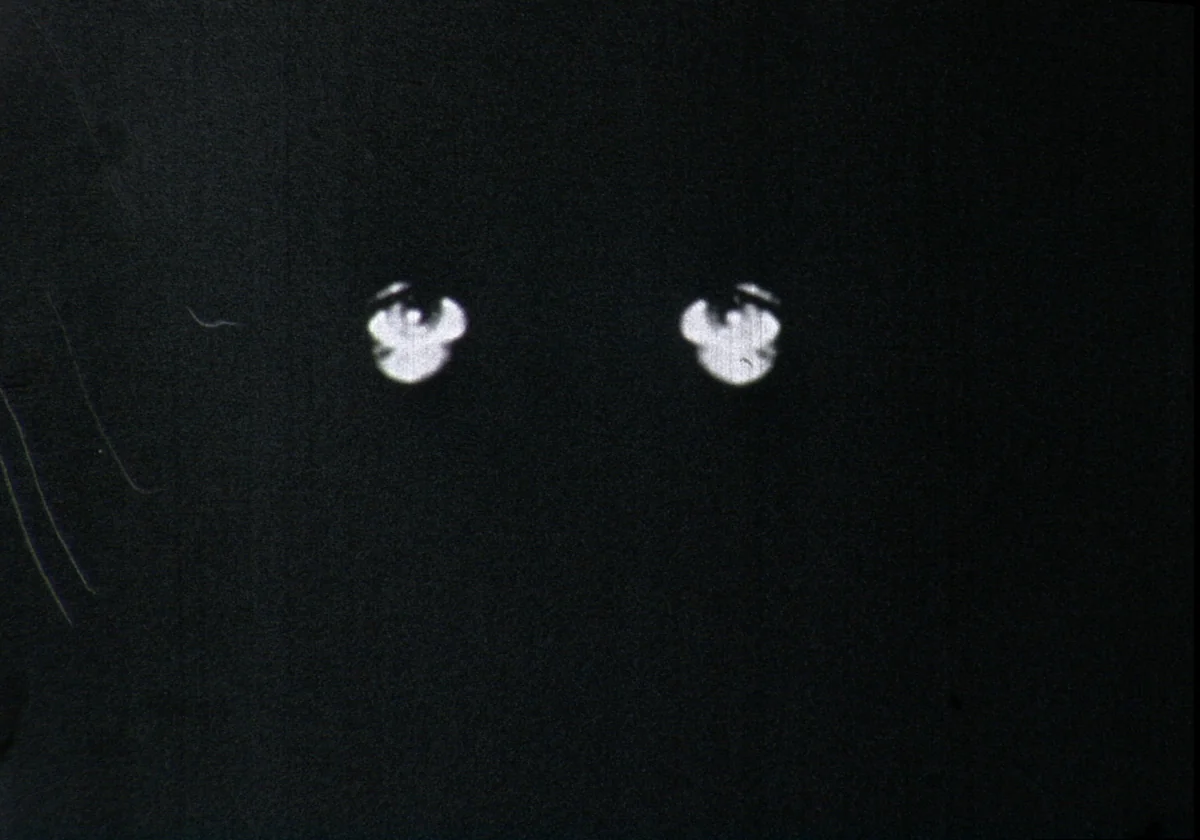
CH: At the same time as wanting to revisit particular points of view, when you spoke about Orpheus (Outtakes) in your masterclass at the festival, you mentioned a wish for formlessness. As a film that uses the outtakes of Cocteau’s Orphée [1950] to create a spectral filmic space without clearly defined figures or objects, is the formlessness of your film a way of mediating between the desire for order and chaos?
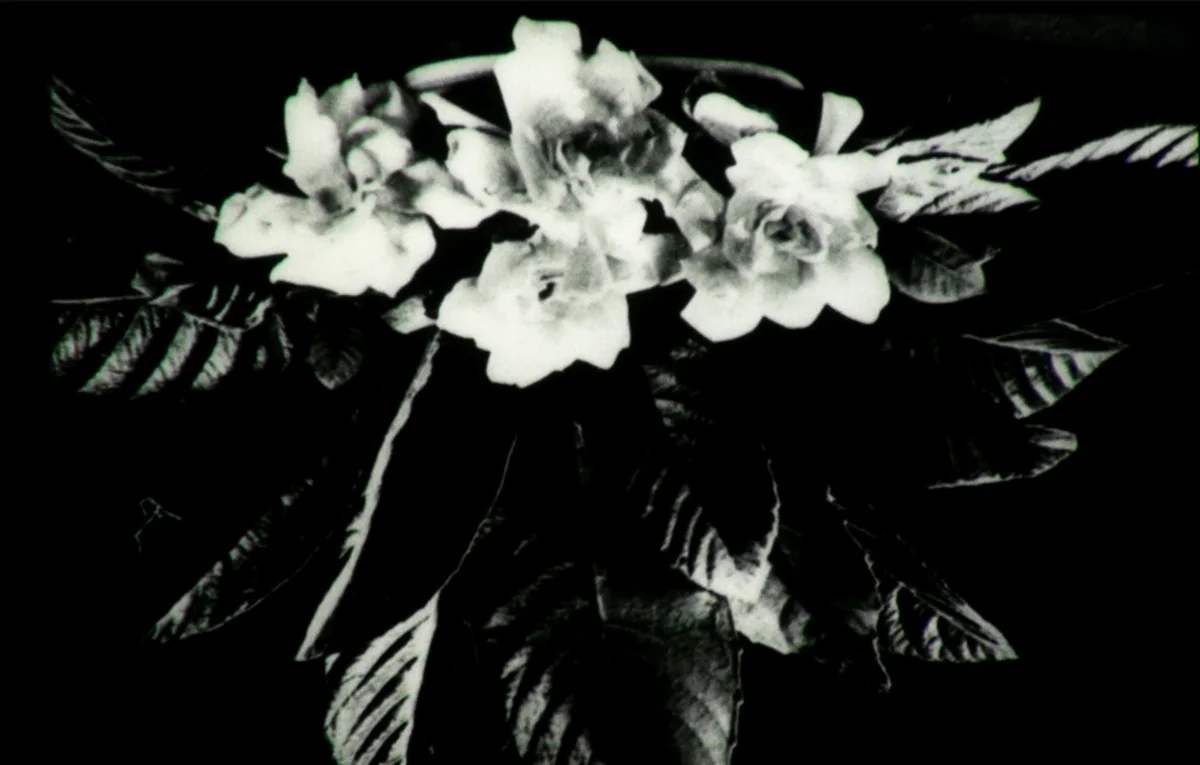
MHC: I like that reading. I feel like it’s a wish that going to the cinema can grant in a way. Sometimes you go there for discomfort or for duration, or a combination of the two. But I think you also go to the cinema to forget your body in a dark space. That’s something I’m interested in: having the ‘givens’ of everyday waking life be rewritten. For example, the eyes in the dark in Orpheus (Outtakes) which pose questions about the body (or the absence thereof). I think this wish for formlessness reappears at the end of Exhibition: the moment you have the ‘erotic thought’ of the Klein bottle, it’s proposing an impossible position for us to be in.First described in 1882 by mathematician Felix Klein, the Klein bottle is similar to a Möbius strip: a form which disappears into itself, so that there is neither an inside nor an outside but rather a continuous surface.
CH: This kind of impossibility or formlessness appears in Delphi Falls, too. It is one of your only films to use actors or dialogue, yet as viewers we are still denied access to any kind of narrative. We find ourselves in a field, in the forest, in a cabin where two young children, a boy and a girl, ask each other a series of riddles, but we don’t know where we are or how we’ve ended up there. There is a striking moment in the film when the girl says, “give me another clue”. Could you speak about switching between subject perspectives and the idea of offering a clue to your audience?
MHC: In Delphi Falls there is supposed to be a making and unmaking of the film's reality. The film was scripted. There was a hint of a story, something to open the field of what can be seen and what can happen. Going into the woods, calling out for someone who never appears in the film, proposes that these people are looking for someone that's missing. That perpetual questioning is really interesting to me.
There’s also the mythical and romantic space of the forest: I was trying to add something a bit darker, a little bit lawless. It’s this idea of using characters less in order to tell a story and more to act as viewpoints from which to disassociate. Ultimately, I just wasn’t interested in narrative. Riddles were my favourite game in middle school, and I remember there was one I loved in particular, about fire.“I am not alive, but I grow; I don’t have lungs, but I need air; I don’t have a mouth, but water kills me. What am I?” Not many people know this, but we ended up shooting the film in the woods behind my house. A little bit of reenactment for myself, I suppose.

CH: That’s not the only way you’ve inserted yourself into the work. For example, the ghostly eyes in Orpheus (Outtakes) are your own, and there’s a moment in By foot-candle light (2011) where we see your shoes and part of your studio floor…
MHC: With By foot-candle light, I was very interested in raising the curtain: having this brief moment where we see my studio, my studio floor, my feet.By foot-candle light begins with a literal raising of a red theatrical curtain. As in many of Clark’s films, there is no overt narrative. We are taken through various spaces including an underground cavern, a high-school gymnasium where a dance troupe performs a soundless routine, and a snowy forest with no one in sight. This is followed by a long sequence with a hypnotist in an office space. Inserting my presence there was a way of doing that. I also felt very present in the dance that I have with the hypnotist later on in the film. My camera doesn’t move a lot, but I really felt like it was us doing our little tango together, which was very charged and uncomfortable in the moment, even though it plays as very funny.
There was a period when I was interested in trying to hide in all my films, and I think it was an extension of the Hitchcock reference because Hitchcock did that too. And then my hands are in Palms [2015] and I’m wearing a blonde wig on the bus scene of The Dragon Is the Frame. In Orpheus (Outtakes) I attached a contact mic to my body to pick up the sound of my skin, which is some of that tactile sound you hear. But that was as close as I got.
CH: That idea of hiding in plain sight has echoes with ‘playing the detective’, a role which, as you just mentioned, you undertook in The Dragon Is The Frame. There's also a line in Exhibition in which Mary Richardson’s captors say she will either be a great artist or a criminal. Do you think there’s a similarity between the detective and the criminal, and what draws you to either of those impulses?
MHC: That line from Exhibition is borrowed from Freud’s ‘Rat Man’ case study. I do think of both of those women as artists who are rewriting or hijacking symbols. Berliner-Mauer didn’t see what she did as artistry, it was sincere, but think of the creative output involved in making those models. I think Mary Richardson’s stabbed Velázquez painting can also be viewed as its own artwork.
For me, the detective, the criminal and the artist might all be the same. Earlier on in my work, my interest in playing the detective was always in a meta sense. But, if you extend the metaphor long enough, you start to wonder: are you the sower of chaos or the creator of order? Maybe that’s another impossible form that the film is proposing you, as a viewer, take.

CH: In Exhibition, you’re not only concerned with criminality, but interested in our relationships with objects. There is another line taken from Freud’s ‘Rat Man’, where you fictionalise Mary Richardson yelling at her captors, “you lamp, you towel, you plate, you prison wall”, because she doesn’t know any swear words. How does your interest in subject-object relationships work together or against your interest in the body and disembodiment?
MHC: Your question is well-timed in my own mind because I don't quite know. With the line from Freud’s ‘Rat Man’ that you quote, I got excited about feminising other stories, and I always think of it as ‘Rat Woman’. That’s who Mary Richardson turned into when she was put in prison, right? The hand we see that picks the lock is Eija-Riitta’s hand, is Mary’s hand, is the Rat Woman’s hand; it's Agnes Martin as the doorknob of us being lock-picked. It's a tangle, a way of sidestepping a line of inquiry I don’t really want to be a part of.
With Exhibition, I wanted to make a film that uses actual objects, but not just any objects: objects that are full of desire and rage and sometimes a sense of trespassing. Instead of constructing a body or using these image-objects or sound-objects to relay an embodied or disembodied experience, I found myself gravitating towards these really complicated, messy women and their relationships to objects. The easier read of this film is that it’s against female objectification or a male gaze. But, really, it’s about female desire and trying to articulate a discomfort with subjecthood. The Agnes Martin line that’s quoted, “I'm not a woman, I'm a doorknob”, is her retort to the journalist Jill Johnson. She is pushing back against a feminist agenda that was being projected onto her. I think she might have felt that Johnson was erasing the particulars of her story. When Eija-Riitta Eklöf decided that the Berlin Wall was her lover, she wasn’t thinking about politics. But the type of queer desire she had for this object forces the world to be remade; the image of her standing next to the Berlin Wall becomes a portrait of a woman and her lover. Mary Richardson is similar. There’s a real politics behind her stabbing of the Velázquez, but I feel it’s an act of love or of dedication as much as a political, destructive, penetrative act.
I felt that the collage approach in The Glass Note and Figure Minus Fact [2020] allowed for an exploration of image and sound as objects placed in relation to one another, without any interest in connective tissue. In The Glass Note these are objects that are in a back-and-forth conversation about our own animacy.The Glass Note investigates ventriloquism by pairing the same noise with a series of images: lithophonic rocks which seem to sing, the throat of a woman humming, a simulated ocean whose waves crash and roar, a 3D-modelled throne, with ornamented armrests that open to project an unknown voice. We throw our voice out there, we give an object life, but what else? The chair was so exciting because it was like, where does the body end? Or objects that feel like they are performing multiple different roles, like the lithophonic stones which actually sound like bells – where do they end? We see one very briefly in the habitat of an abandoned zoo, which was full of these bears and big rocks. They become monuments for me in that space.
CH: I’ve noticed a sensitivity for space and the spatial dimensions of film viewing when it comes to the presentation of your work. For example, Palms, which explores disembodiment through the objectification of your hands, was a work which you later moved into the gallery space as an installation. Is that an exciting space for you? How do you feel it differs from the cinematic space?
MHC: This idea of using the space of the gallery has opened up my work a lot. Dealing with the acoustics of a room was exciting. Spatialising sound and image was another way to play around with ideas of amplification and voices that are ‘thrown’. I think Palms works much better as an installation because the opera singer is like a voice in the air, drifting through the room instead of being so direct. When I exhibited it, there were monitors which showed the actors rehearsing. They were falling in and out of these peak emotional states of either contemplation or rage or a little bit of laughter.
Now, when there seems to be a subject that either requires space or wants to play with scale or the behavioural space of a viewer in motion, I find the gallery a useful dimension to have.

CH: In your work, sound is not only spatialised, but dislocated. For example, in By foot-candle light, the sound of the cheerleaders performing their routine only appears later on, set to a different image, or in Figure Minus Fact a shot of bells swinging is paired with the sound of a swing set. During your masterclass, you spoke about “teasing a sense of causality”. How might causality manifest in your work through sound?
MHC: Bresson said that when you hear a train whistle you see the entire train station. I fully subscribe to the power of suggestion: it’s the hypnotist’s tool as well. It probably started with Orpheus (Outtakes), where the black emulsion could really exist in any dimension.Orpheus (Outtakes) opens with a circular black emulsion in an empty white space. The camera then takes us within this emulsion, so that we emerge in the filmic space. That made me think about the gaps that we fill in with our minds and the reconciliation that we’re desperate to have, particularly when dealing with sound and image, but also with narrative cohesion: the idea that, if the camera is pointed at something and we’re looking at it for a certain amount of time, then it must mean something. I’m interested in those knee-jerk cognitive compulsions and accessing them in a film. Sometimes they pay off and sometimes they might feel really cliché or mundane, or like a stairway to nowhere.
Expansions and collapses are also interesting to me because they get at our desire as creatures who seek out and generate meaning. When sound and image are purely juxtapositional, that sometimes feels too abrasive; if the sound can latch onto a certain part of the image, the dislocation happens in a much slyer way. I like to find something that isn’t ‘right’ but feels right and which usually rewrites the image. To have that kind of transformation purely through a sonic shift is one of the most exciting things you can do in a film.
The DNA of Figure Minus Fact was made by putting the sound of the swings with the bells. It's an attention to the apparatus as well as a total remixing of a sonic space.Figure Minus Fact explores loss and absence by depicting a world in which a mother and child lie in bed in the late hours of the night, someone walks in a darkened desert guided by the light of a torch, and church bells sway to the ringing of a swing set. You’re hearing the noise, not the signal. You’re hearing the carriage of the bell and not the bell itself, and it doesn’t really make any sense. I’ve always been compelled by how, in a purely fantastical way, that rewrites the viewer’s body. It’s like, where is your ear and where is your eye? That, for me, is the biggest game of all.
CH: That kind of misdirection is prevalent in your films: in The Plant [2015], you simulate the form of the spy film, but deny the viewer access to narrative, and in Figure Minus Fact, the images of calla lilies or bells, often used at funerals, very subtly seem to reference loss. How much do you want your audience to pick up on these clues? Do you want us to remain misdirected?
MHC: It probably changes over the course of making a film or in different moments within a film. I love a close viewer, someone who’s going to do the work or watch the film multiple times. But, in The Plant, it’s not really about solving anything, more like hanging with the work long enough to start to feel outside of something. Just assuming the outsider role in this eight-minute film world is part of the point. Being in doubt and even doubting the tools that we use to make sense of the world.
In Figure Minus Fact, it’s tied to the mess of non-linear, non-quantifiable feelings of grief. The only way to talk about it is to have it be a mess. But it’s still underpinned by an analytical impulse. One of the scenes in Figure Minus Fact was shot in this bell tower in Philadelphia. I was in this dark little room wearing big ear protection that threw off my spatial awareness. I might have thought about a sound substitution for the bells. But I also interviewed the change bell ringers because I didn’t know where it was going at the time. Maybe having those human interactions when collecting these images is the personal side of the filmmaking, and more of the misdirection comes in the editing.

CH: Your interview with the change ringers doesn’t directly feature in the work. Are there particular sources you turn to in your research, and how much of it doesn’t feature but informs what you’re doing?
MHC: Often a broader interest in something will make me cast a wider net of research. But it’s rare that I make a comprehensive portrait film. For Figure Minus Fact, I wanted to talk to the change ringers. We went out for beers. I wanted to know what it’s like to dedicate yourself to this serialised form of music and to be at a million strangers’ weddings. It’s another outsider position. You’re there, but you’re also not there and your reason for being at a church is not to be a worshipper.
I like to remain open to any encounter when I’m making a film. That usually means multiple shoots, and then I only use footage from one. In terms of what I read, there might be a few texts I always return to, but I love to stumble upon things and have that sense of happenstance. Lately, I’ve been reading pretty much anything by Lisa Robertson. The way she writes about girlhood, womanhood, objects, and inner subjectivity is really compelling.
CH: What are some of those texts that you find yourself always returning to?
MHC: Lyn Hejinian’s Strangeness and The Rejection of Closure and Roger Caillois’ Mimicry and Legendary Psychasthenia. The poems of Peter Gizzi, Ann Lauterbach and John Ashbery are also big for me, because they’re such good users of that pronominal shift that Gizzi talks about.Gizzi, Lauterbach and Ashberry often use pronouns in interesting or unusual ways in their poems, challenging the limits of subjectivity. John Ashberry uses 'it' interchangeably with he/she/I/you, Peter Gizzi's poem Archeophonics plays with what he calls 'throwing the voice' by using the pronoun 'I' in unusual ways, which detaches the subject from itself: “If I saw you and the I said, / my poetry is changing, / I would say my life is changing.” (Gizzi’s Archeophonics [2016])
CH: Despite not having a musical background, your approach to music and sound shows incredible sensitivity and appreciation. Is there any kind of music you particularly enjoy or are drawn to?
MHC: I really like techno and its slow additive processes. There are a lot of sound bridges in my films and co-mingling of different textures. I also love a lot of drone music or highly repetitive music, or music that doesn't feel like it has a start and a stop.
In terms of studio music, lately I’ve been listening to a lot of Pauline Oliveros and Luc Ferrari. If I could make music, I would probably try to make it sound like Luc Ferrari’s. Maybe it feels more accessible to me because it employs so much field recording, which is something I understand.
I also like reverb moments that can alienate a sound or make you feel on edge. There’s a shot in The Dragon Is The Frame in the bus where we’re looking at a houndstooth pattern and the light flickers. I was like, how do I make a flicker happen inside of this ambulatory diary film? I wanted to try to recreate that in the world through sound. The great thing about Luc Ferrari is that there is a disintegration of recognisable spatial ambient recordings, something artificial inside of the field recording.
CH: Do you play any musical instruments?
MHC: No, but if I could play anything it would be the piano. I love the piano. Or maybe some type of horn.
CH: Your work uses many different mediums, from film stock to found footage or even 3D modelling. What informs the decision to use one or the other medium?
MHC: There always has to be a reason behind the choice to use or include a particular medium, whether it’s a YouTube clip or 3D modelling software. They have to be very situated in whatever’s going on in the film. The reason behind using the simulated ocean in The Glass Note was that I wanted you to see the sea, without actually seeing the sea. It brought in that texture, that image-making technology. Using modelling for the acoustic throne was out of necessity because I couldn’t get access to the actual throne. But then it opened up all these possibilities for non-corporeal movement. It’s not like us walking around the chair in the archive: we get to actually assume the position of a sound wave and move into the chair.There is a moment in The Glass Note in which we enter a hole in the arm of the 3D modelled acoustic throne.
For me, what really grounds those stylistic choices and the conceptual thinking of a film like Exhibition is showing you, as a viewer, as little as possible. Showing you the scraps, the xerox of the xerox of the xerox. It was functioning in this more reduced image mode. It was a reset in terms of visual style. It made me feel like I could make anything.
CH: You curated a screening during the festival. Was that an exciting process?
MHC: It’s my favourite thing. I love putting together programmes and I was really hyped about this one, although you never really know how it’s going to work until you watch it in a room full of people. I love Stephen Sutcliffe’s films. He works with such restraint and play; so many of his films are under a minute. It Was a Lover and His Lass [2020] is the perfect picture, the perfect sound, it’s so beautiful. With Vika Kirchenbauer’s Untitled Sequence of Gaps [2020], I really like her writing and the way the film deals with questions around visibility and spectrums of light. I don’t think all theory films are good, but Jennifer Montgomery’s Transitional Objects [1999] is such an exciting and uncomfortable film; it felt like the centrepiece of the programme. After that, Steve Reinke’s Squeezing Sorrow from an Ashtray [1997] was a good release because he often plays with a philosophical voice in a great way.
With Friedl vom Gröller’s Eat [1999], she described itas recreating an action that she saw her mother do. When she was younger, she was so disgusted by the way that her mother removed her dentures. I love that, years later, she chooses to re-enact this in her film. The way that she spoke about shame in that work was really compelling.
Dorothy Wiley is also such a confident filmmaker who works in this collaged way and is unafraid of having some of the heaviest stuff sit side by side. Every time I watch Miss Jesus Fries on Grill [1973], I realise it has influenced another one of my films in some way. This time, I noticed a moment where she’s repeating a dark joke. It made me think of the very beginning of Exhibition, when I’m referencing a series of farmhouse jokes like, “Whatever you do, don’t sleep with my daughter!” If you know those jokes, the farmer has been fucking his daughter all along. I wonder if I got that from Dorothy Wiley. There is a sense of sitting in the everyday darkness of things, of not being held back by a sense of proprietary… the willingness to let things touch in the way that they do in life.
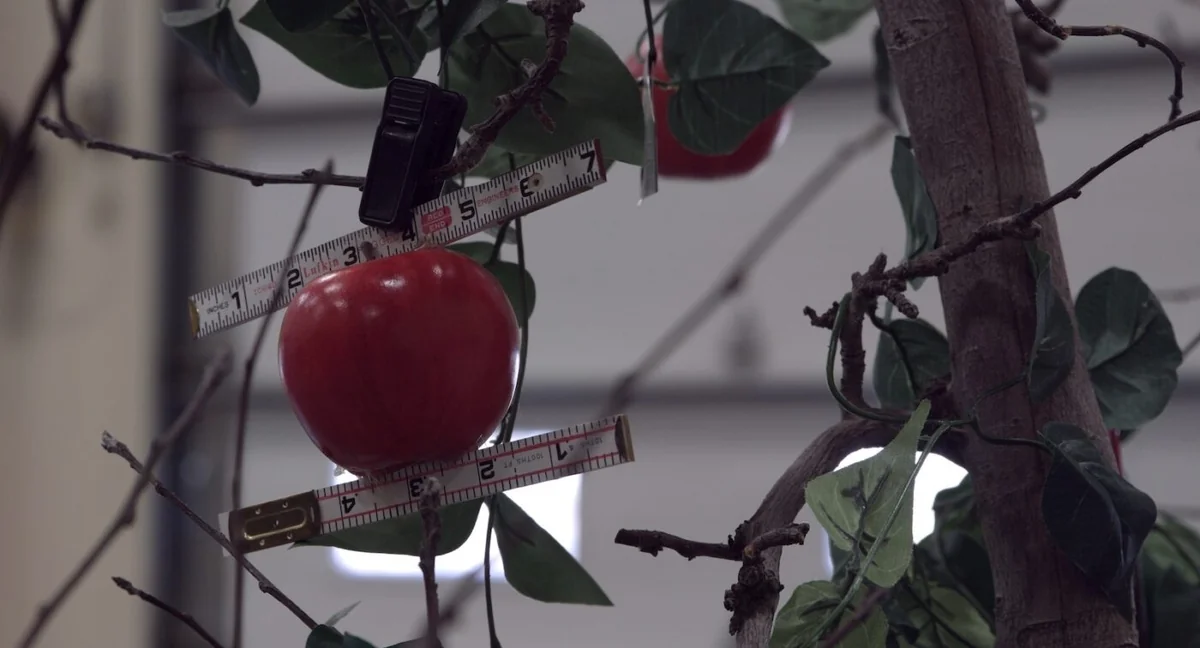
CH: With Exhibition, you mentioned that your process was slightly different because it began with writing and was grounded in the autobiography of these two women. Could you speak a bit about your most recent film, A Common Sequence (2023)? Does it mark a turning point in your approach to making?
MHC: Many of my films are about a relay of highly subjective experience, sometimes bodily experience. With A Common Sequence, I wanted to make something that would really take me outside of myself and be full of surprises. Something completely different. It made a lot of sense to work with my friend Mike Gibisser because we’ve been in conversation for a long time. We met in grad school while we were both developing our own solo practices.
At first, Mike and I thought we were making a film about ecological collapse. We were interested in this conservation lab in a convent in Mexico where they raise axolotl and use them to make a syrup that funds the convent. There was a seeming contradiction in raising an animal both to conserve it and to kill it. After we filmed there, the story of other people who lived on the nearby lake brought us to a family of fishermen in Washington State. We got really into certain labour issues, and realised that there were all these commonalities between genetic stories and stories of extraction. Then Mike hit on the idea that nature kept being rewritten in order for privatisation to happen. That became the compass for where the rest of our research would go.
A Common Sequence might read as more conventional because there are establishing shots and voices and people explaining things at times. But, conceptually, I think it’s in line with a lot of my work and especially my clinical approach to referencing the natural world, or even things that are personal. The idea of trying to explore complex spaces through non-human subjects also has echoes with my recent work which is so object-oriented. But it was a film I never would have made on my own and I’m so grateful to have been in conversation with so many people while making it.