
A Conversation with Clara Law
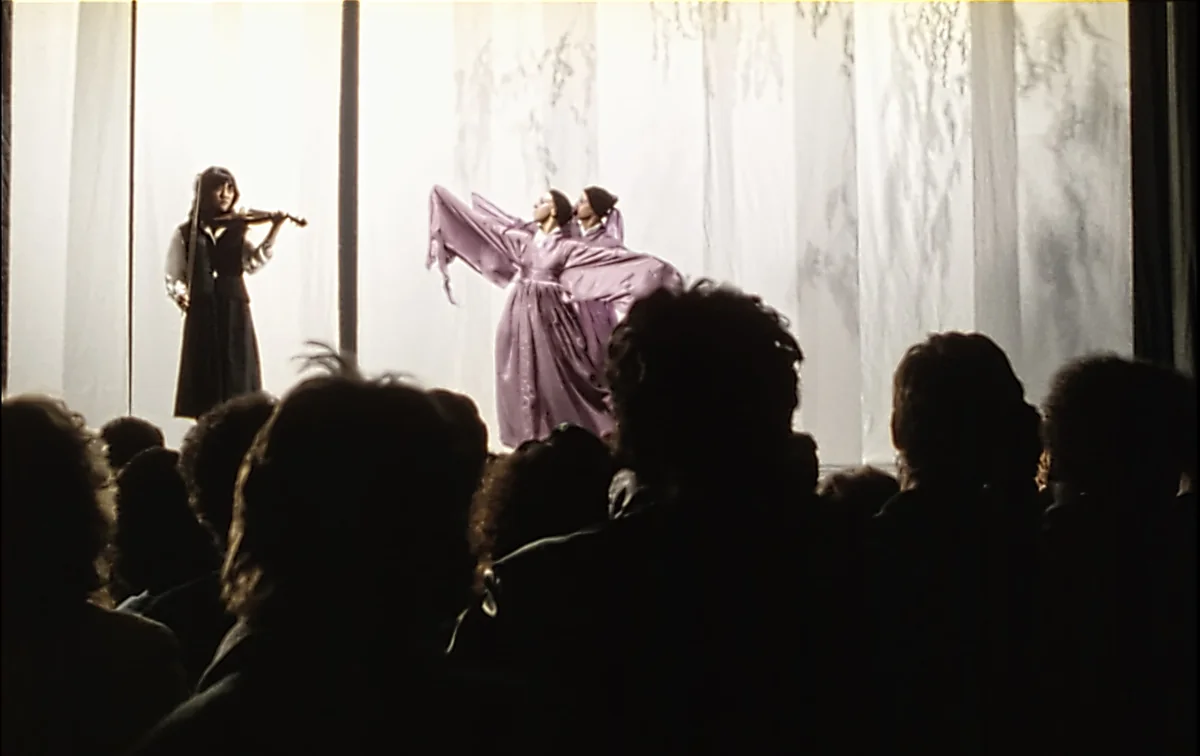
They Say the Moon Is Fuller Here (1985) opens with a long shot of an auditorium. On stage, the silhouette of a violinist comes into view. She starts to play ‘The Butterfly Lovers’ Violin Concerto’, and the camera pans to two dancers. While she is dressed in the formal attire that is standard to orchestral performances in the West, these Caucasian dancers are wearing lilac robes with long, wide sleeves, reminiscent of garments ancient Chinese scholars would once wear.
We soon learn that the violinist choreographed the piece. She is Lau Ling, a fine arts student from Hong Kong studying at Goldsmiths, University of London, played by the filmmaker Clara Law. In the Chinese legend of the Butterfly Lovers, a poignant romance blossoms between Liang Shanbo, a scholar, and Zhu Yingtai, a young woman from a wealthy family who disguises herself as a man so that she can attend classes at an academy. Eventually, the couple turns into a pair of butterflies and realises their wish to be together forever. In Law’s film, the dance piece mirrors the love story that unfolds between Ling and her Chinese classmate, Han Wah, who is on a state-sponsored scholarship.
Set amid the political uncertainty surrounding Hong Kong’s forthcoming handover from Britain to China, the film was inspired by Law’s experience of coming from Hong Kong to study in the UK. She writes in the director’s notes: ‘I thought I would be fully at home in England when I went there to study. Instead, I felt a deep sense of loss, of yearning, of nostalgia. It was the early eighties, when Hong Kong’s future was yet to be decided, [and] changes [were] imminent yet unnameable.’ She continues: ‘With an acute awareness of being foreign, a heightened sense of cultural difference, I felt an insatiable urge to seek [out] my roots [...] I had always felt caught between the East and the West.’Clara Law’s director’s notes for the retrospective of her work at the Australian Centre for the Moving Image (ACMI), 2023. Law made the film during her time studying as the first Chinese student at the National Film and Television School (NFTS). All students were expected to produce a short film as their graduation project, but Law was more ambitious: she had written a feature-length script and, with her unwavering determination, managed to convince the school to let her make it.
She launched her career at the height of what theorist David Bordwell called ‘the last golden age’ (1986–1993) of Hong Kong cinema.David Bordwell, ‘The Chinese Connections’,Planet Hong Kong, 2000. At this time, Hong Kong productions surged, driven by an expanding number of local movie theatres, loyal support from home audiences, and strong export demand from booming foreign markets, especially neighbouring regions such as Taiwan and South Korea. Wong Kar-wai, Stanley Kwan and Jacob Cheung, who also emerged as part of the second generation of the ‘New Wave’, are some of the most prominent names of this period, preceded by directors such as Tsui Hark and Ann Hui. While the term ‘Hong Kong New Wave’ is accepted among cinephiles and academics, Law’s eclectic body of work invites audiences to approach her cinema beyond such a static geographical marker.
Law’s films are informed by the places she has lived – Macau, Hong Kong, Australia – and migration is a recurring subject in many of her films. She has experimented with different modes of storytelling and navigated distinct filmmaking environments throughout her career, ranging from large-scale Hong Kong studio productions to entirely self-funded projects. This rich and dynamic filmography, shaped by a resourceful and inventive approach to filmmaking, makes it particularly difficult to summarise her career in a few words.
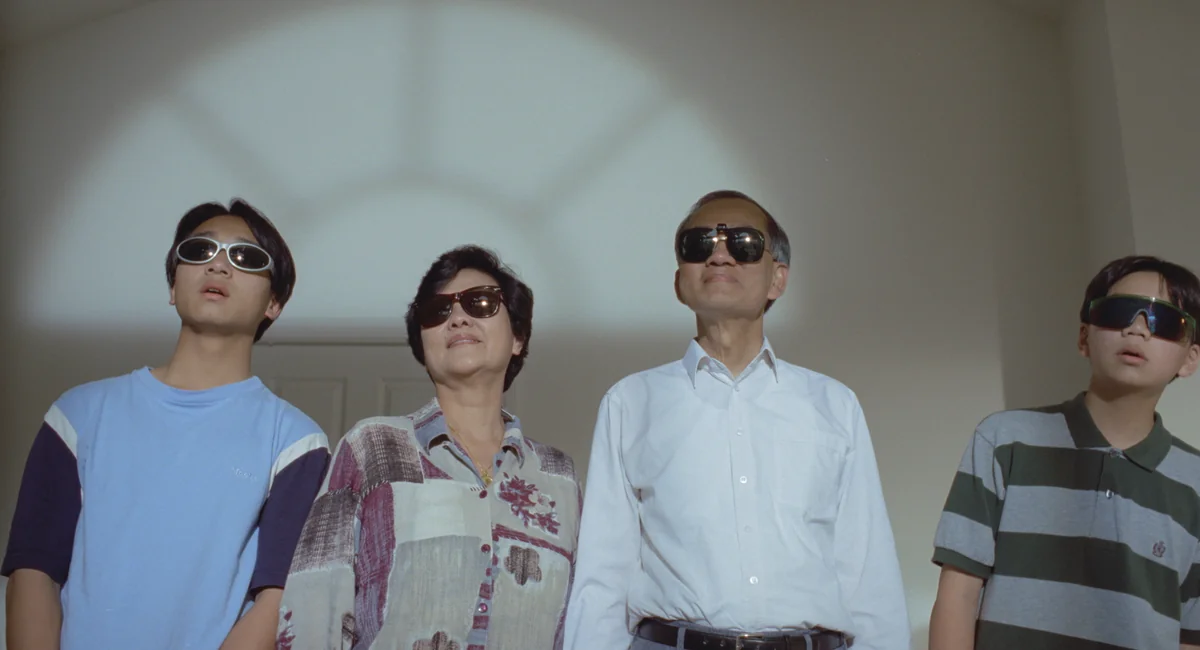
Perhaps it is for this reason – to evade reductive generalisations and avoid the trap of simplistic categorisation – that movement becomes a quintessential element of Law’s cinema. Not only does she frequently incorporate long takes of dance sequences into her films, but her characters are also often in motion. Some migrate to new countries, such as the characters played by Maggie Cheung and Tony Leung Ka-fai, who move from rural Guangzhou to New York City in Farewell China (1990), and the Chan family, who relocate from Hong Kong to Sydney in Floating Life (1996). Others are in transit, like the Japanese globetrotter played by Nagase Masatoshi in Autumn Moon (1992), or Kurokawa Rikiya and Rose Byrne, who, driving an iconic Citroën DS, roam the vast landscape of the Australian Outback in The Goddess of 1967 (2000).
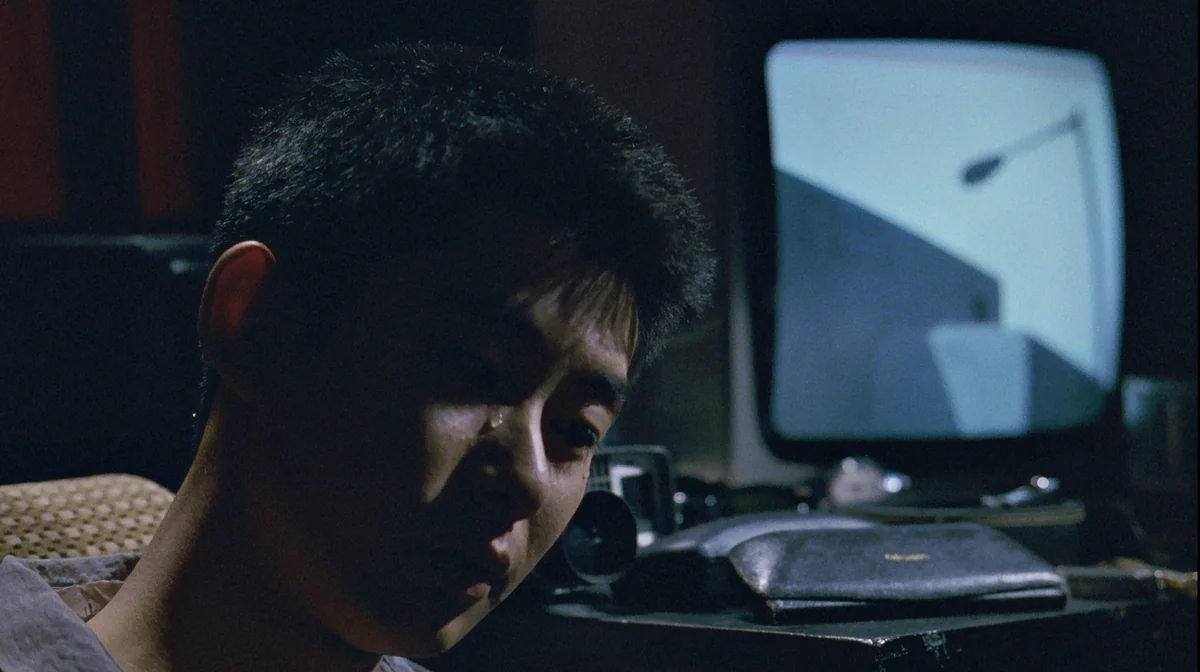
Before Law studied filmmaking at NFTS, she had cut her teeth at the Radio Television Hong Kong (RTHK), directing mid-length films for the public broadcasting service. One of her earliest works was Floating Cloud (1981), a 45-minute television film she directed for the series Hong Kong Hong Kong. It narrates the life of Flora, a middle-class young woman, freshly graduated from university and uncertain about her future.
When Law returned, after her studies in the UK, to her position at RTHK, she met her future long-term collaborator and partner, Eddie Fong. Together, they created multiple television films for the broadcaster. Adapted from a short story by Xi Xi, Law and Fong’s A Girl Like Me (1987) is about a woman who believes her love life is doomed because she works as a beautician for the dead: a few men have been ‘scared off’ after she has revealed her job to them, and in Chinese society, this line of work has long been highly stigmatised due to the belief that deathcare workers are jinxed. Law and Fong depart from the source text in their decision to give the protagonist a stutter, rendering her state of alienation more pronounced. Capturing difficulties in verbal communication resurfaces in Law’s later films, where language barriers pose a problem for characters.
Law and Fong’s collaborations for the big screen began with the romantic comedy The Other ½ & the Other ½ (1988). The literal translation of the Chinese title (我愛太空人) is ‘I Love Astronaut’ with the term ‘astronaut’ commonly used to describe couples or families who separate in order to fulfil the requirements of migration policies. The film, like Law’s subsequent commercial works, was produced by Teddy Robin, one of the most prominent producers of the Golden Age.
With The Reincarnation of the Golden Lotus (1989), Law became a commercially successful director. Produced by Golden Harvest (a major studio that financed comedies and martial arts blockbusters, including those of Bruce Lee), this box-office hit is adapted from a story by Lilian Lee, a household name in Hong Kong. Many of Lee's novels were adapted to screen; Stanley Kwan's Rouge (1987), Chen Kaige's Farewell My Concubine (1993) and Law's The Temptation of a Monk (1993) all take Lee's writings as their source text. The film retells the story of the notorious fictional femme fatale, Pan Jinlian, from the Chinese novels The Golden Lotus and Water Margin, from a new perspective. This time, she is reincarnated as a ballet dancer (played by Joey Wong) who has migrated from post-Cultural Revolution mainland China to Hong Kong. In Law’s retelling, she is no longer a condemnable seductress, nor a redeemed perfect victim, but a complex figure who has suffered political turmoil and sexual violence, yet does not shy away from following her erotic desires, even when they risk her reputation and honour.
Although Law’s directorial sensitivity continued to shine in spite of the creative constraints imposed by the commercial film industry, she gradually shifted towards projects that offered her greater creative freedom, albeit with much smaller budgets. In the early 1990s, Autumn Moonmarked such a watershed. The film centres on a friendship between a Hong Kong teenage girl and a man travelling from Japan; the pair meet when she spots him fishing off the side of Victoria Harbour. Neither is very fluent in the lingua franca, English. The characters’ lack of proficiency in their shared language allows the non-verbal elements of interacting – such as inflection, gesture and facial expression (often exaggerated here to facilitate communication, and in an almost childlike way) – to come to the fore. Words are used only when absolutely necessary; the film’s dialogue is reduced to broken sentences of simple vocabulary. It creates a bond shorn of pretence; through it, Law reveals how fundamentally cinematic human connection is, and that it is best observed between cultures.
With that film, Law entered the international festival circuit, winning the Golden Leopard at Locarno, and then took a break from commercial filmmaking. She went on to make Wonton Soup (1994), a short which was created for the anthology film Erotique (1994), in which a Chinese-Australian man attempts to improve his lovemaking techniques to satisfy his Hong Kong girlfriend by studying a thousand-year-old Chinese sex manual.
Later that year, Law and Fong moved to Australia, where they secured enough government funding to make Floating Life and The Goddess of 1967. Following the success of both films, Law made Letters to Ali (2004), an essay film inspired by a newspaper article about a sixteen-year-old Afghan boy seeking asylum. Since then, she has become increasingly invested in realising self-funded projects that move beyond the conventions of narrative filmmaking.
In 2016, Law launched what she called a ‘DIY series’. The first film in the series, Drifting Petals (2019), made by a small crew of five, follows the journeys of two individuals: a filmmaker (voiced by Law) revisiting her birthplace, Macau, and Jeff, an aspiring pianist she met in Australia and later reunited with in Hong Kong. Law weaves personal family history together with political events from both the past (the 12–3 Incident in 1960s Macau) and the present (the 2014 Hong Kong Umbrella Movement) through the juxtaposition of disjointed narratives, seemingly coincidental events, and shifting perspectives that blend reality with imagination.
Following the completion of her forthcoming film, Ripples in the Mists, a sequel to Drifting Petalsand the second instalment of the ‘DIY series’, Law co-founded (with Eddie Fong) the Film Society of Chinese Australian (FSOCA), with the aim of promoting independent filmmaking in Australia and offering emerging filmmakers professional guidance in developing their own work.The Film Society of Chinese Australian: https://fsoca.org.au/
I spoke to Law about her moviegoing memories, her love of poetry, music, and dance, the importance of philosophy to her cinema, and what it has been like to work in different industrial and international contexts across forty years of filmmaking.
Eleanor Lu: What first drew you to cinema?
Clara Law: When I was growing up in Macau, my parents and grandparents loved taking me to the movies. My mom took me to see westerns; she loved John Wayne and Gregory Peck. My grandparents, on the other hand, took me to see old Chinese films: kung fu and period films starring Yu So-chow and Walter Tso. I can still so easily recollect the images, which have stayed with me all this time: people flying in the air, a cowboy in a lonely landscape, or simply a face.
When we moved to Hong Kong, my extracurricular activity at high school was theatre. I was always the director, and at first I loved it. In the second-to-last year, the play I directed won all the awards in an inter-school competition. But strangely, I wasn’t happy about it. Everyone went to celebrate and I just went home. I was depressed because the project had finished. I didn't like the fact that it was over in such a short time, that I couldn’t make it eternal.
My eldest brother died when I was very young. The trauma was indelible and I realised at a young age that life is transient. I knew things could disappear, just like that, even when I might have wanted things to last. I continued directing theatre for a while in university but eventually stopped. After graduating, I ended up in the drama department of RTHK where I got promoted to director in half a year. That’s when I realised I loved directing. I knew then that this would be my vocation, my everything. So that was that. It was decided.
EL: You directed several remarkable TV films during your time at RTHK, including Floating Cloud and A Girl Like Me. I was particularly mesmerised by the ballroom dancing scene in Floating Cloud – within just three dances, as the music shifts, you gradually build an extraordinary sense of tension between the main characters. Could you tell me more about your transition from theatre to working with moving image?
CL: I guess I was always looking for a medium in which to express myself, so at different stages of my life I'd express myself either through poetry, prose, short stories or drama and theatre directing. It was always an urge, a need, and so the search never stopped. When I graduated from university, for a while I was very unhappy because, in the seven different types of job I tried out within a couple of months, I couldn’t do any of those things. I was planning to go back to university to do a masters so I could pursue poetry or drama. When I started work at RTHK as an assistant director in the drama section, I knew immediately this was my calling and I poured my whole self into it. Within half a year I was asked to direct, and the rest was history.
My first film, Little White Boat, was a 30-minute episode shot on 16mm for a TV series. It was made in memory of my eldest brother because he used to sing this song, ‘Little White Boat’. Strangely, I have little recollection of the script I wrote, though I remember vividly a scene where the actor buried a rabbit. I only found out the rabbit was dead later when I finished shooting and told the propsman to take her away and give her some water. I might have put my hand on her and was shocked to find her cold. I had no idea what the props department gave her to sniff, as I was on set and they brought the rabbit in when I was ready to shoot the scene. From then on I was extra sensitive when shooting with animals. I definitely do not and never again want an animal to die because of any film I make. The death of the rabbit was significant. It was somehow linked to the mystery of life, and to the death of my eldest brother. It confirmed to me the transience of life.
I like the dance scene in Floating Cloud too, and the scene on the hill when the character is with her boyfriend. There, I was experimenting with ambiguity and time, the implied and the unspoken. Now that I think back, a lot of my films have dance sequences, from my graduation film, They Say the Moon Is Fuller Here, to The Goddess of 1987, Like a Dream, Ripples in the Mist. Dancing is visual. It can be dramatic, and it can also be ambiguous, implied, seductive… I love music, rhythm, and that’s probably why I fell head over heels for cinema once I discovered I could make it, because I could immerse myself in all the things I love through it: from images to poetry to music to dance, and of course, people and their stories.
I like to include entire dances in one shot if I can, so that the choreography can flow without being interrupted by editing. In order to achieve this, I plan out the shot beforehand and we rehearse. However, with my latest film, I improvised. Nature is forever changing, unpredictable, and so I accepted what it gave me on each day of the shoot. And I loved that.
EL: How was directing theatre different from directing cinema?
CL: I prefer cinema, because I’m a very visual person. I can do so many things with the camera. I can capture things in ways that make meaning ambivalent. You can see everything in each individual take but only discover the meaning later, after you’ve seen the whole film.
Theatre is a totally different experience. You have to be there, in the present. And if you’re the performer, you need to catch the audience’s attention and adjust yourself according to their response. Of course, you can still create all sorts of visual effects in the theatre, but it’s a completely different experience when, in cinema, you can sit in your room, enter the world you’ve written the script for, and think about the shots. You’re also fully present on a film set, but in a way you lose yourself there: in the character, in the story.
Back when we were still shooting on negative, we’d also say, “It’s in the can.” It meant that we’d captured it – and that’s a kind of elation that can’t be compared to anything else. When [Masatoshi] Nagase finished his monologue for Autumn Moon, for example, and I knew I had captured it, it felt like magic.
EL: You mentioned that you had a great love for books and were planning to study literature. Some of your films – The Reincarnation of Golden Lotus, Temptation of a Monk – are adaptations of novels. How does literature inform your filmmaking?
CL: I love all sorts of literature. I was a bookworm as a child. I read in Chinese and in English, and I went on to study English Literature at university. I’ve always enjoyed writing poetry, and, in that I like to leave things unsaid, to imply rather than spell everything out, I would still consider myself something of a poet.
In school, we were taught in English and not allowed to speak Chinese (Cantonese). As English wasn’t my mother tongue, I didn’t feel I was in the best position to become a writer. That’s why cinema turned out to be so great for me: I could write my poetry with images and sound.
When I went to NFTS, the head of department asked me what I wanted to do in film, and I said that I wanted to write poetry with film. He said, “No no no, you can’t do that in film.”
For me, making films really does feel like writing poetry, or composing a symphony. I like to create that flow, that rhythm, that cyclical movement – and I want the audience to feel it. It’s such a beautiful thing, when they can feel it happening and come along with you.
I like to create films that transcend reality, that go beyond logic, beyond cause and effect. I do all the things I do because they are a part of me and I put them intuitively into the film. This is why I don’t like to be boxed in as someone who only makes diasporic films. It just so happens that I am always on the move. It’s the way many people live in the modern world. Nowadays, it’s hard to know where home is or to belong to a community. In life, we have no control over where we are born or who our parents are; we are given a situation and we just have to deal with it. Heidegger said we are thrown into the world. This is what my films are about.
EL: You’ve just referenced Heidegger, and you have elsewhere mentioned the importance of Chinese philosophy to your films. Could you elaborate on how philosophical ideas shape your work?
CL: When I was in the UK, I missed home very much and it made me want to know more about Chineseness. I don’t think you can be a director without knowing who you are.
So, when I returned to Hong Kong, I enrolled in an evening class about Chinese philosophy. One of the teachers, who was the last disciple of philosopher Mou Zongsan, taught us about Neo Confucianism. I began to delve into his books and they opened my eyes. I was able to really understand the root of my culture, where I came from. Without realising it, this Chinese culture and aesthetics had, in fact, always been in my films. Even when I thought I was doing something ‘intuitively’, it had actually been a process of ‘intellectual intuition’. It was something already in me that included a complicated process which I was already practicing. I totally believe if we can share this with the west, the world will become such a beautiful place. Eddie and I even met Mou in person and were planning to make a documentary about him. But at that time we were about to move to Australia and Mou was moving to Taiwan, so unfortunately that project didn’t happen.
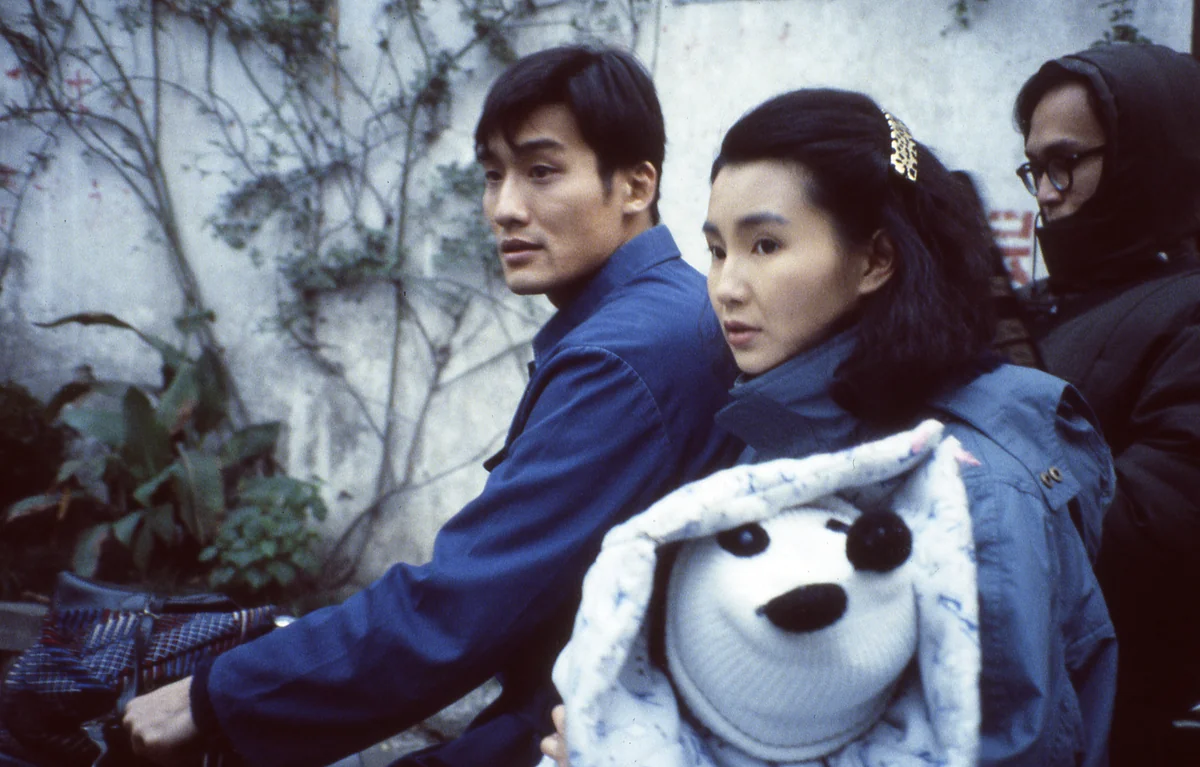
EL: All of this reminds me of the Hengchun folk music you use in Farewell China. The lyrics convey a sense of longing for a homeland. They are in Taiwanese Hokkien, so I couldn’t understand them at first, but I could tell they expressed a kind of sorrow. When I watched a subtitled version at the Hong Kong Film Festival, it felt like discovering the words for an embodied form of knowledge.
I was surprised to learn that Farewell China was produced by Golden Harvest, which was one of the biggest commercial film production companies in Hong Kong from the late 1970s through to the 1990s. The film is really bold and experimental compared to other films made with major film studios at that time. How was that possible?
CL: It wasn’t possible. The previous film I made for them, The Reincarnation of Golden Lotus, was a box-office hit, so they wanted to sign me as their so-called B-movie director. While I had some leverage from the commercial success of that film, the company still tried to talk Eddie and me out of making Farewell China because they thought it wouldn’t be profitable. We insisted so much that they allowed us to film it with a tiny budget. My whole career was like that: making all sorts of commercial films and keeping an eye on not losing the money from that, while trying to find space for us to try to do the things we really wanted to do. It was always a fine line between the two.
EL: You used to work a lot with big film studios. Now you’re working on entirely self-funded projects. Can we talk about what it’s like to navigate those different environments, and what led to that shift to independent filmmaking?
CL: In the commercially driven filmmaking environment of Hong Kong, we worked with what we had in order to survive; we couldn’t continue making films otherwise. But once we were in Australia, we were able to make a film like Floating Life. We were in a much better position there. We had soft money from the government, but only up until The Goddess of 1967. So we had more freedom, but not complete freedom. After all, the money had to come from somewhere. But I’m at a different stage of my life now, where I can just do whatever I want to do.
EL: I would also love to hear more about the making of Wonton Soup, a segment you directed for Erotique, which is an anthology film made by four women directors from four different countries [Ana Maria Magalhães, Monika Treut and Lizzie Borden were the other three]. I’m curious about your approach to portraying desire and sexuality on screen; it’s something you have explored throughout your work. How did you become involved in the project?
CL: An American producer approached me to make one of the four short stories for Erotique. I thought it would be important to imbue Chinese culture into my segment. In my view, eroticism is more interesting if it is implied, restrained rather than all out. Desire when it is unsaid but lingers is all the more beautiful, tainted with sadness. It is also much more seductive when it is suggestive.
EL: This reminds me of what Lau Ling says in They Say the Moon Is Fuller Herew hen she is directing: ‘less realism, more imagination’...
You just finished your second fully self-funded film. Could you tell me a bit about it?
CL: It’s called Ripples in the Mist. It’s a sequel to Drifting Petals. I wanted it to look like a Chinese painting, but there’s not really an aspect ratio that corresponds to the vertical dimensions of Chinese painting, so I settled on 4:3. I shot the film from February to June of 2024. Most of it was done in Taiwan; the rest in Melbourne. It’s a much bigger film, with more volunteers involved, and it was such a great journey. That’s all I can say.
EL: What style of Chinese painting were you thinking about? Were there particular paintings that inspired you?
CL: The paintings of Huáng Bīnhóng touched me deeply, especially his darker paintings from towards the end of his life. Chinese aesthetics is in my soul, part of my internal landscape. I tried to express the concept of the cosmos, earth, and humanity as one (天地人) in Ripples in the Mist.